Showing posts with label priests. Show all posts

Thursday, November 17, 2022

Double Demons


The Last Exorcism
(2010)
and Lost Souls (2000)

Exorcism films have been a staple here at Movie Churches because they pretty reliably have clergy. The masterpiece of the genre is, of course, William Friedkin's The Exorcist, with noble, heroic priests willing to sacrifice their own lives to serve the tormented and afflicted. The priests in the second Exorcist sequel are also quite admirable, as is the priest in the courtroom drama The Exorcism of Emily Rose. But sometimes the clergy in these films…aren’t that great.

The clergy in today’s films remind me of the would-be exorcists in a very funny story found in the book of Acts. From chapter 19, verses 13 - 16: “Some Jews who went around driving out evil spirits tried to invoke the name of the Lord Jesus over those who were demon-possessed. They would say, ‘In the name of Jesus whom Paul preaches, I command you to come out!’ Seven sons of Sceva, a Jewish chief priest, were doing this. One day the evil spirit answered them, ‘Jesus I know, and Paul I know, but who are you?’ Then the man who had the evil spirit jumped on them and overpowered them all. He gave them such a beating that they ran out of the house naked and bleeding.”

The charlatan exorcists in today’s double feature would have been grateful to come out as well as the seven sons of Sceva.


In 2010’s The Last Exorcism, it is made clear relatively early in the film that the "exorcist" is a phony. The Reverend Cotton Marcus (Patrick Fabian) brings in a documentary film crew to record what he believes will be his final (bogus) exorcism. The film crew consists of two members: producer Iris Reisen (Iris Bahr) and cameraman Daniel Moskowitz (Adam Grimes).

We first see Rev. Marcus getting ready for church in Baton Rouge, LA, with his wife and son. He tells his son, “Get in the shower, we’re going to church.” At the church, Cotton's father (another Reverend Marcus) introduces him. Cotton tells how he was a child prodigy preacher. 


His wife Shanna (Shanna Forestall) tells the film crew, “He’s a showman. People aren’t bored when they come to church. He does local theater, does special effects, he entertains like nobody’s business.”

He uses magic tricks for sermon illustrations and often speaks spontaneously. He bets Iris $10 he can do a sermon about banana bread -- and does so. (Of course, he's a hustler and probably already had that sermon in his back pocket.) 

His father (Justin Shafer) tells about his valuable volume that describes various demons and how to cast them out. He says, “If you believe in God, you have to believe in the devil. Jesus was an exorcist.” He claims to have practiced 150 exorcisms.


But when they leave the elder Rev. Marcus, Cotton makes a frank admission. “I do not believe in actual demons, no. But I’ve acted like I did. I helped heal them of what ailed them. If they believe it, I maybe helped them.” Marcus said he began to doubt the reality of the supernatural after his son’s birth. His son nearly died but was saved, and Marcus was shocked to find himself thanking the doctor but not God. He realized he might not believe in God anymore.

But he had continued to preach and practice exorcisms. A news story that led him to believe he needed to stop. A young boy, the same age as his son, was killed in a botched exorcism. Marcus says, “I want to expose exorcism for the scam that it is. If keep one kid from being suffocated, I will be doing God’s work.”.


Which is why the documentary crew is accompanying the Rev. Cotton to an exorcism at the Sweetzer Farm in Ivanwood, Georgia (an envelope was picked at random). As they drive to a remote location, Cotton says of the country, “You got voodoo, Roman Catholism, Pentecostalism… Perfect breeding ground for demons and evil.”

He meets Louis Sweetzer (Louis Herthum) who had written to ask Marcus to exorcise his daughter. Marcus is initially quite upset by the presence of the camera and tells Daniel to stop filming (he doesn’t), and then talks Louis into allowing him to film as he works with Nell (Ashley Bell).

We learn that after Nell’s mother died, Louis had been afraid of worldly influence, so he took Nell out of school and homeschooled her. He was also worried about the worldly influence in the church they were attending -- Pastor Manley (Tony Bentley) allows secular music. So Nell was taken out of Sunday School. Teenagers Nell and her brother, Caleb (Caleb Landry Jones) had been kept isolated on the farm for two years.


But then someone or something begins to brutally slaughter the animals on the Sweetzer farm. Louis believes it's the work of his daughter, Nell, who he believes is demon possessed. When Cotton interviews Nell, she seems quite sweet -- but he agrees to give her a full exam. He first gives her a medical exam (though he admits he’s no doctor) and then gives her a more specialized exam.

Cotton has Nell put her feet in a foot bath. Suddenly, the water begins to bubble. He says they need to continue with the exorcism and goes to his book, claiming to find her demon, Abalam, a powerful demon that defiles his prey. Cotton has Nell lie on her bed and asks her questions, and a powerful voice is heard, shouting and screaming. Cotton calls out the demon and claims Nell is healed.

Marcus talks with the film crew, away from the family, and admits that he used trickery to make the water boil and for the voice of the demon. Marcus takes a large amount of money from Nell’s father, but magnanimously says, “No need to count it, I trust you.” Marcus tells Louis to keep the devil away by loving his daughter. And Marcus and the crew depart to a motel many miles away from the Sweetzer Farm.


Nell comes to their motel, distraught and in horrible condition. They take her to the hospital (where they are asked not to film, but Daniel films away anyway). Nell is pregnant, so when Nell’s father comes to pick her up, there is a greater concern about whether she’ll be safe at home. 

At home on the farm, everything gets worse. And Louis asks Cotton to exorcize Nell again. Things do not go well. When Pastor Manley comes to help, let’s just say he isn’t helpful and does nothing to raise the already very low clergy rating for this film.
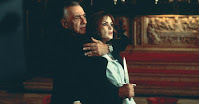

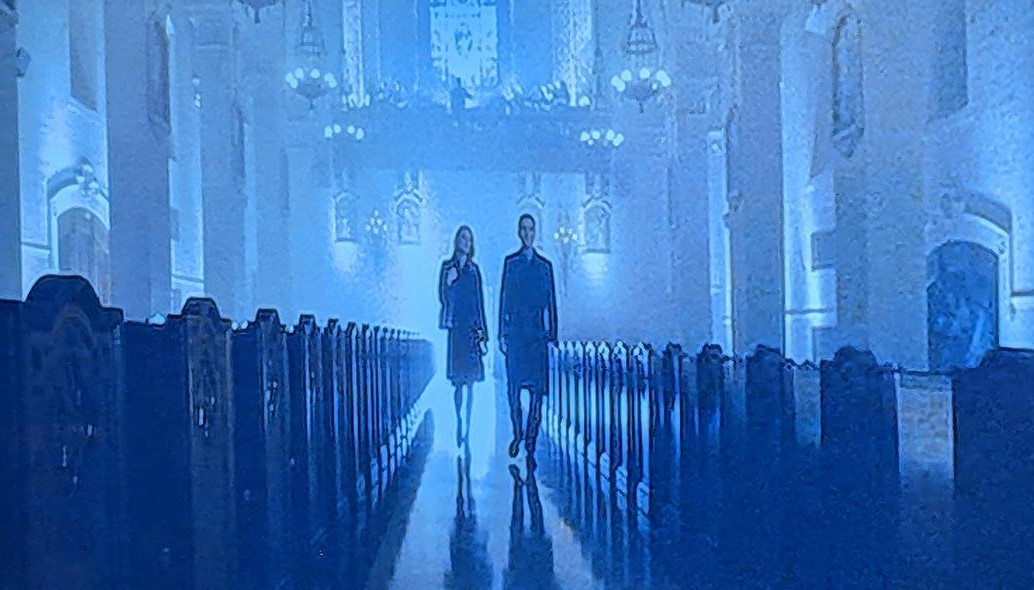
The clergy isn’t much better in 2000’s Lost Souls. Catholic school math teacher Maya Larkin (Winona Ryder) joins a team of exorcists to work with a mass killer. (I guess Maya is qualified to help because she was formerly possessed). But Father Lareaux (John Hurt), the pastor who leads the team, ends up being possessed himself. The other prominent priest in the film, Father James (Philip Baker Hall), is leading a plot to bring the antichrist into the world.

I should note that the film opens with an utterly bogus “Scripture” reference: “A man born of incest will become Satan and the world as we know it, will be no more” -- Deuteronomy Book 17. Apparently the qualities of the anti-christ are these three things: born of incest, with no faith, and unbaptized. So it's a pretty narrow field of applicants -- only a few million people have met those three qualifications over the last two thousand years.

I’m giving all the clergy in these films our lowest Movie Churches rating of One Steeple. 

(As we've been mentioning, throughout this month we are featuring DVDs I purchased for Movie Churches, but never got around to viewing. The reasons for procrastination include movies not fitting the themes of the month and films looking rotten, so I haven't been anxious to review them. Lost Souls was pretty bad, but The Last Exorcism was much better than expected.)
Thursday, July 15, 2021

Horror goes to church


The Last Drive-In
(a show on Shudder, a subscription video-on-demand service) gives out The Silver Bolo Award for excellence in horror media. On occasion, movie blogs have received this highly prestigious award, but sadly, Movie Churches never will -- only, we're sure, because horror isn't the exclusive topic here. Nonetheless, it's amazing how many horror films have been featured in this blog about clergy and churches.

But maybe it isn’t amazing at all. 

Many horror films presuppose something beyond the material world: the supernatural is a reality. That's right in line with the beliefs of the orthodox church and clergy. 


The Horror subgenre of Exorcism films is probably the easiest example, beginning (of course) with The ExorcistIt's one of the most acclaimed horror films of all time. , and everyone who remembers the film remembers the heroic priests in the film. 

Roman Catholic priests are usually featured in exorcism films, though surely some Protestants have taken on the job. We've discussed the churches and clergy in several exorcism films, and there are others we haven't talked about (yet). Check out The Exorcist III  (but not yet The Exorcist 2: The Hereticthough we'll get to it), The Exorcism of Emily Rose, The Rite, and The Nun (which has some discussion about exorcism).

Of course, there are a number of horror films with priests where the confrontation is with Satan or evil forces where possession is not the issue. We've dealt with plenty of those: Prince of Darkness, Pastorela, and The Unholy. The End Times are often the setting, as in The End of Days,  The Rapture, The Omen, The Calling and The Way of the Wicked.


Sometimes the clergy provide the horror, which happens in The Night of the Hunter, Day of Wrath, The Hunchback of Notre Dame, The X-Files: I Want to Believe, The Purge: The Election Year, or any of the very many films about nuns. Sometimes it’s just murder in an ecclesiastical setting as in Primal Fear or Alice, Sweet Alice or Heathers (well, in this one a few scenes take place in a funeral home, but still).

Of course, not all of the supernatural elements in horror films are the same kinds of things you find in the Bible -- like, say, the ghosts in Carnival of Souls or Poltergeist II: The Other Side. There have been a surprising number of vampires in Movie Churches -- Stake Land, Thirst, From Dusk Till Dawn, Priest, Vampyr, Van Helsing and John Carpenter’s Vampires. There have been a few werewolves, in The Wolfman, Silver Bullet, The Curse of the Werewolf, and The Howling VI: The Freaks. And there’s been one weredinosaur in The VelociPastor.

There’s even been churches and clergy with alien invaders in Signs and War of the Worlds.

So though we’ll continue to look at sappy Christian films, depressing foreign films, musicals, thrillers, and comedies… Horror films will always have a place here at Movie Churches.


Thursday, June 17, 2021

Satan Never Sleeps during Missionary Month


Satan Never Sleeps
(1962)


As priests in the 1962 film, Satan Never Sleeps (based on a novel by Pearl Buck and directed by Leo McCarey, director of Going My Way and The Bells of St. Mary), William Holden and Clifton Webb are bad priests. Really bad priests. Yet somehow, they aren’t the worst people in the film. That dubious title goes to a group of people who want to suppress a nation's entire population, stripping them of their possessions and their freedom. In comparison, the bad priests don’t look so bad. 

Still, let’s start with those priests -- because clergy and churches in films are what we’re all about here. So a bit about these two Catholic American missionaries in China shortly after World War Two. Holden plays Father O’Banion, a priest with a difficult issue: he's got a fan he can’t lose. 

In his former parish, O’Banion saved the life of a young woman (somehow), and that woman (France Nuyen as Siu Lan) believes he is now responsible for her life. O’Banion travels to a remote village to replace Father Bovard (Webb), who disapproves of the priest's traveling with a young woman. 

O'Banion says, “I should explain why this girl is with me. She is very anxious to learn Christianity.” (She does seem to have much to learn about Roman Catholicism. Somehow the concept of clerical celibacy is completely foreign to her.)


It's certainly not all Siu Lan's fault. O’Banion handles the situation poorly. Yes, he tries to drop her off at places along the way, but never successfully (she is very persistent). He tries to have heart-to-heart conversations with her, but he's never very direct about the real issues preventing a romantic relationship between them. Since there are several nuns connected with the mission, it seems logical that Father O'Banion could ask them to explain the birds and the bees and the priests -- especially since many who see the priest traveling alone with a young woman draw unpleasant conclusions. 

The older priest, Father Bovard, is angry with Father O’Banion even before he arrives -- five days late -- with Siu Lan. Bovard was anxious to get out of the country in advance of the Red Army and seems to have no concern about leaving his parishioners behind as he makes his escape. Bovard has the same personality Webb has in most of his films, bitter and sarcastic -- which is fine when he’s playing the babysitter, Mr. Belvedere, or slimy newspaper columnist Waldo Lydecker in Laura -- but makes for a really awful priest.

Bovard's houseboy, Ah Wang (Burt Kwouk), claims to be a Christian but is always stealing the Eucharist wine (The priests also drink quite a bit). When the Red Army frightens Ah Wang away from the parish and joins the Communists, so Sui Lan is given the job. Ah Wang’s desertion of the faith doesn’t speak well of Bovard’s discipleship.

Another of Bovard's former students, Ho San (Weaver Levy), has also joined the Red Army and returns to the mission to persecute the priests. He mocks them and takes over their school. But the very worst thing we see him do is rape Sui Lan. (The rape takes place offscreen. But there’s no doubt about what takes place.)

This leads to one of the worst things we see the priests do. We learn that as a result of being raped, Sui Lan is pregnant. (Many people assume that Father O'Banion must be the child's father.) When the priests learn how Sui Lan became pregnant, they take her to Ho San’s parents and encourage them to take Sui Lan and their grandchild in. They then encourage Ho San and Sui Lan to come together as a couple and escape China. I have no idea what counseling class they took in seminary that advised matchmaking a rapist with his victim, but there you go. (This is a Hollywood movie, of course, so Sui Lan and Ho San make a grand couple with a happily-ever-after ending. It does solve Father O’Banion’s plot complications and he even gets to baptize the child.)

So these priests are not...great. But the Communists, particularly the leadership of the Red Army are far worse. They do many of the things that history tells us the Communists under Mao Zedong did. They take the school from Catholic Church. Many of the children become forced laborers, while the rest are taught propaganda. Most of the medical doctors are imprisoned and most of the medicine they had is destroyed. The chapel is desecrated, with the crucifix torn down and replaced with a picture of Mao. 


In the 1960s, it wasn't considered an act of courage to (realistically) portray the Communist government of China as awful. The evils of the Cultural Revolution weren't portrayed because the West wasn't yet aware of the full extent of its horrors or the millions of Chinese people who were slaughtered. As late as 1987, in The Last Emperor (a Best Picture winner), Hollywood was willing to be critical of the Chinese government, but the last major Hollywood film to openly criticize Communist China was 1997's Seven Years in Tibet

Since then, Hollywood pandered to the Chinese government. The science fiction films, The Martian and Gravity, portray the Chinese space program assisting the American space program at great cost. Shortly before releasing the remake of Red Dawn, the invading nation was changed from China to North Korea. Tom Cruise’s fighter pilot wore a Taiwanese flag among the service ribbons on his uniform in the original Top Gun, but in the sequel coming out this year, that flag has been removed. In promotions for the new Fast and Furious sequel, John Cena aroused the ire of the Chinese government by talking about the country of Taiwan. Cena then felt compelled (perhaps by his studio) to issue a groveling apology for mentioning a country, that is, in fact, a real country. 


Though nothing like the horrors of the Cultural Revolution is currently taking place in China, many bad things are still happening there. The Christian Church is still harassed and persecuted. Children are working in unsafe conditions for the sake of American manufacturers. The Uyghurs, a Muslim ethnic minority, are even now being held in concentration camps. And though the origin of the Covid-19 virus continues to be obscured by the government of the People’s Republic, we know that for many weeks the government refused to give the World Health Organization information about the transmission of the virus, arguably adding millions to the virus’ victims. There is something to be said for the freedom of expression about Communism that Hollywood had in the 20th century as opposed to the 21st century. 

But that, of course, is not what this blog is about. It’s about clergy and churches in films. So let me just say that though the priests of the film are in many ways awful, at the end of the film, Father Bovard sacrifices his life to help others, helping these two priests avoid our lowest steeple rating. Two Steeples.

Oh, and one other thing. The theme song, which has the same name as the film, really stinks.

Thursday, April 15, 2021

Miracle Movies in Theaters Now: The Unholy


The Unholy
(2021)
While reading the Easter story a week or so ago, I was struck again about how many Marys there are in the Gospels. Obviously, it's easy to think of Mary, Jesus' mother. There's Mary Magdalene (who was possessed by seven demons, was healed, and followed Jesus). Then there's Mary of Bethany, Lazarus and Martha's sister. She might be the same as Mary of Galilee, but we’re really not sure. There’s also Mary the wife of Clopas. And Mary the mother of James and Joseph. Some combination of these Marys was at the cross and the tomb, but it's really confusing which is which.

Mary confusion is at the heart of The Unholy, a new horror film written and directed by Evan Spilotopoulos and based on the novel Shrine by James Herbert. It tells the story of a deaf and mute orphaned teen named Alice (Cricket Brown) who lives with her uncle, a priest, Father William Hagan (William Sadler). After a supernatural visitation from “Mary,” Alice is able to hear, speak, even sing. The healing is witnessed by a disgraced reporter, Gerry Finn (Jeffrey Dean Morgan), who sees an opportunity to revive his career with the story of a “divine” miracle. The problem is that everyone assumes the Mary that Alice saw was the Mother of God. 

It’s just an old-fashioned case of mistaken identity. Alice was actually healed by Mary Elnor, a woman executed as a witch back in 1845. As one would expect, complications from this mistake ensue.


We first see Father Hagan chasing a cow off the property, “It’s crapping all over.” He and Alice live in the small town of Banfield (the town sign reads, “A Little Bit of God’s Country”). The priest seems to be well known and liked in the town. Finn comes to that small town to investigate a false story about cattle mutilation by aliens (actually a local teen painting graffiti on a cow). Buried under a tree in the field, Finn finds a corn doll possessed the soul of Mary Elnor, and he sets it free. (Just trust me on this one, okay.)

That night, Finn is driving after drinking a bit, and he almost hits a sleepwalking Alice on a country road. Swerving, Finn runs his car into a tree. He gets out of the car and follows Alice to the tree where he found the doll. Alice begins to speak to Mary and then collapses. Finn takes her to her uncle’s, and Father Hagan calls the town doctor, Natalie Gates (Katie Aselton), who thinks Finn is imagining Alice’s healing.


But the next day at Mass, when Alice is in front of a statue of Mary (the one who was Jesus' mother), she stands up, seeming to be in a trance, and walks out of the church. A number of young women follow her, and soon the whole congregation (including Finn, Dr. Gates, and Father Hagan) follows. 

Mary walks to the tree she went to the night before, then turns to the crowd and speaks, “The Lady has an urgent message. She wants all of you to come back tomorrow. Her name is Mary.” All are in awe as the formally mute girl speaks. But Finn films it all and posts the story. Soon crowds come to the church because of this miracle.

Alice is thrilled to be able to hear and speak (part of the miracle, of course, is that she can speak English clearly, in spite of not having heard it her whole life). Finn is excited to have a story. Dr. Gates is thrilled with Alice’s healing, which she believes is a sign from God. Only Father Hagan seems leary. He is concerned about people exploiting Alice. The priest points out to Finn all the times in church history that people have been taken advantage of with signs and wonders. 

The priest says, “For where God built a church, there the devil would also build a chapel.” 

Finn replies, “I never thought I’d hear a priest quote Martin Luther.” (That attribution is correct.)

Alice overrides her uncle's wish that she stay out of the spotlight and instead has a gathering at the tree the next day. A boy with muscular dystrophy rises from his wheelchair and walks, which is live-streamed. More people flock to the small town, including reporters. Alice agrees to a press conference, but only answers questions from Finn.


The Vatican sends a bishop and an inquisitor to Banfield. Bishop Gyles (Cary Elwes) is quite obviously thrilled by the attention the church is receiving from the spectacle. Monsignor Delgrade (Diogo Morgado) has the duty of doing his best to disprove the miracles. The inquisitor has three criteria for testing the miracle: the affliction must be incurable, the healing instantaneous, and it must be complete. Those criteria seem to be met in Alice’s healing as well as the boy in the wheelchair. Another miracle soon follows, when Father Hagan is cured of his emphysema, which Dr. Gates had deemed terminal.

Alice claims Mary has called her to have a great service where, through the internet, the whole world will be called to place their faith in Mary. But as Bishop Gyles helps prepare for that service, Father Hagan, Monsignor Delgrade, and Gerry Finn begin to investigate the sinister truth about “Mary”.

Father Hagan discovers a book in the church that tells of Mary Elnor’s trial as not only a witch, but a bride of Satan who performed miracles in Banfield, similar to the miracles of Alice. Before he can tell anyone about his discovery, someone comes to the church for confession. 

During the confession, Father Hagan realizes he is talking to Mary Elnor. Soon afterward, Finn comes to the church to find the priest hanging from a rope, tied to the rafters. Suicide is presumed.

Bishop Gyles asks Monsignor Delgrade to perform a funeral for the priest, insisting the means of death be covered up since it might spoil the upcoming big event to celebrate Mary. That big event becomes a confrontation between the forces of good and evil with much in the way of CGI effects and pyrotechnics as one has come to expect in even moderately budgeted horror films. (Spoiler… Good wins, but at a cost.)

So how do the little Catholic church of Banfield and the various clergy rate on our Movie Churches scale? The church seems to serve the community well, up until when it opens a Hellmouth and threatens to be the focal point of many descending into eternal damnation. Father Hagan and Monsignor Delgrade are men who pursue truth before fame, riches, or health, and they're quite aware of Jesus’ teaching of Matthew 7:15, “Watch out for false prophets. They come to you in sheep’s clothing, but inwardly they are ferocious wolves.” (This verse is posted as a title card at the film’s conclusion.)


On the other hand, Bishop Gyles is quite willing to put fame and riches before truth, and before, you know, God. But because of the sacrificial service of the priest and the monsignor, the bishop only knocks one steeple off the film’s rating, resulting in 3 Steeples.

Thursday, April 1, 2021

Miracle Month: The First Legion


The First Legion
(1951)


Atheists don't seem to be villains in movies these days, at least in big studio films. Sure, some Christian films, such as the God’s Not Dead series have bad guy atheists who are just shy of Snidley Whiplash (though they generally don't twist their mustaches while tying the heroine to the railroad track).

But in mainstream films, Charles Darwin and Stephen Hawking are heroes. Even fictional characters such as Jodie Foster’s scientist in Contact and Nick Angel in Hot Fuzz are heroes -- and often the most rational, compassionate people in their fictional worlds. Ricky Gervais' 2009 film, The Invention of Lyingis a full-throated advocation of atheism. TV features even more fictional atheists as heroes: Greg House (House), Temperance “Bones” Brennen (Bones), and Mal Reynolds (Firefly). Atheists are often portrayed as the only people who see things clearly and are free of hypocrisy. 

This is not the atheist physician in Douglas Sirk’s 1951 film, The First Legion.


Douglas Sirk had a unique career in Hollywood. In 1937 he fled his German homeland with his Jewish wife to begin a career in Hollywood. His commercial hits of the 1950s (Imitation of Life, All That Heaven Allows, Written on the Wind, Magnificent Obsession) were dismissed by critics of the time as “women’s weepies” and sentimental melodrama. Today his films are highly regarded by critics and filmmakers for technique, use of Technicolor, and Sirk's compassionate treatment of society’s outsiders. His focus on domestic situations and the problems of women is now celebrated rather than dismissed as unworthy content.

The First Legion was made before those well-regarded classics and very different in form and content. First of all, it was filmed in black and white, and rather than being set in a suburban home, it is set in a Jesuit seminary. (A title card at the beginning of the film gives a history lesson, “Four centuries ago St. Ignatius of Loyola, a former soldier founded a company of priests called the Society of Jesus, the Jesuits. This a group of them in the modern world.”)


We meet Father John Fuller (Wesley Addy), a priest considering quitting the ministry. He says, “I’d like to go home. I’d like to be part of a real family again. It’s pretty lonely being a man of God all the time.” He prepares to leave the seminary, but the night before his departure, Friar Jose Sierra (H.B. Warner), who has been bedridden for years, rises from his bed and walks to Fuller’s room and tells him he had a vision which told him that Fuller must not leave the order.

Friar Sierra's healing is considered a miracle by most at the seminary. Headlines across the country proclaim the healing. The Rector of the seminary, Father Paul Duquesne (Leo G. Carroll), is excited by the attention the “miracle” is attracting not just to the seminary, but also to the patron saint of the seminary, Joseph. Crowds surround the seminary, and concession stands spring up (including one selling St. Joseph dolls for a dollar.)

But one priest, Father Marc Arnoux (Charles Boyer) does not share the excitement. He is concerned about those who are making a trek to the seminary seeking healing, fearing the travel will harm people’s health and finances. Arnoux, a former lawyer, is dubious about the healing. He investigates, interrogating Sierra’s physician, Dr. Peter Morrell (Lyle Bettger). The doctor asks Father Arnoux if he can make a confession, and confesses that he gave Friar Sierra a drug that brought about the healing. 


As an atheist, he found it amusing to see the believers celebrating a “miracle” of God when he knew that it was no such thing. Arnoux urges Morrell to publicly disavow the “miracle,” but he refuses and reminds the priest that making the confession public would break his vow of silence. The doctor even burns his records of the Sierra case. He considers it all a fine joke.

The doctor only comes to question his decision when one of his patients, Terry Gilmartin (Barbara Rush), beautiful but wheelchair-bound, seeks healing from Saint Joseph. She wants to go on the seminary grounds, which is forbidden. (Forbidding the public from being on the seminary grounds, particularly the seminary chapel, is a rule I found quite strange.) The doctor confesses what he did to Terry, looking to quash her false hope.

But Terry still believes. She finds a way to the seminary chapel and there prays for the soul of Dr. Morrell. She then finds she can rise from her chair and walk. A true miracle.

Most of the priests of the seminary are good men (there is one priest who is a self-righteous ass, but he’s an exception.) There is also a non-Jesuit priest, Monsignor Michael Carey (William Demarest), who enjoys  teasing “God’s Marines” but seems to be a good man. He delights in dogs and says at one point, “Today I saw a man die and a baby born. It was a good day. Everyone should see a baby born.”


So the priests of this film earn our highest Movie Church Rating of Four Steeples and Dr. Morrell should be glad we aren’t rating atheists.

Thursday, September 10, 2020

Back to Back to School Month: The Devil's Playground


The Devil’s Playground
(1976)
There are quite a lot of films called The Devil’s Playground, but few of them would work for the purposes of this blog about churches and clergy. The 1932 documentary on fishing around the world certainly wouldn’t help. Neither would the 1937 romance with Richard Dix as a submarine officer and Delores del Rio as a dance hall girl. I love Hopalong Cassidy as much as the next guy, but his 1946 adventure pits him against a corrupt sheriff, not a corrupt clergyman. The 2002 film about Amish youth on Rumspringa comes closer, but it’s a documentary and we generally do feature films here. I’m also not going to bother with the 2010 feature about a mercenary seeking a cure in a zombie apocalypse or the 2018 short about military veterans who become cartel hitmen.

No, the best The Devil’s Playground for our purposes was made in 1976 by writer/director Fred Schepisi. Schepisi was a part of the Australian film renaissance of the 1970s and 1980s that included directors such as Peter Weir (Picnic at Hanging Rock), Gillian Armstrong (My Brilliant Career), George Miller (Mad Max), and Bruce Beresford (Breaker Morant). Schepisi first received international attention with his film about Aborigines, The Chant of Jimmie Blacksmith.

Schepisi based the script of The Devil’s Playground on his own experiences as a student in an all-boys Catholic school in the 1950’s. The film opens in the beginning of a school year in 1953. Tom Allen (Simon Burke) is a thirteen-year-old student at a De La Salle Brothers seminary for young men in Melbourne.

In much of the film, the priests deal with the “coming of age” of the boys (chiefly issues of sexuality). The sexual abuse of young people by priests has been an important story for some time now, but this film made in the 1970’s doesn’t portray any physical abuse of the children (but emotional and psychological abuse perhaps).

Let's look at the individual priests of the Brotherhood at the school. They certainly vary in temperament and suitability for caring for young students.


Brother Francine (Arthur Dignam) most probably should never be allowed within hearing distance of adolescents. We first meet him as he is watching boys shower. Most of the boys are wearing bathing suits, but one is naked. He says, “That’s disgusting. The body is the enemy of the soul. The rest of you boys, avert your eyes. The eyes are the window to the soul. Guard against your senses at all times. Preparing to be a brother requires… self-denial, self-discipline to be one of God’s chosen few.” (As a priest in the Roman Catholic Church, Brother Francine should know that calling the body evil in this way is Gnostic heresy. God made our bodies and our bodies are not “enemies.”)

Brother Francine is the character who drops the title line, saying, “Undisciplined minds are the devil’s playground,” but as the film goes on, we learn that his mind is not disciplined. We see him take the boys to a public swimming pool and Francine peeps at women and girls in the changing room (I do hope most public restrooms in Australia were built better. In the film it is scary-easy to look into the changing rooms from the outside). As Francine rests in his bed, we see some of his lurid fantasies of swimming with naked women.


Eventually, we see Francine break down utterly in front of his fellow priests. He's sent off to a psychiatric facility after this outburst, “I hate life. It’s evil, sick, despicable. The body dominates the mind. It always wins. What else are you thinking, Frank? Your mind is a cesspool of desire. The only answer is to give in, or lose your mind. I have a damn good body, but no one has looked at it for years, let alone touched it. It’s done nothing. But the mind, it has. It’s sinned. Oh, how it’s sinned. Twisted, cowardly, perverted sins. I hate life. I hate it.” This is a man who should not have been allowed around young men.

The school brings Father Marshall (played by novelist Thomas Keneally) to speak at a special retreat for the boys that focuses on sexual purity and preparing for a future in ministry. He has a much more positive view of life than Francine, “Don’t give into falderal and fanatics, be yourself. Keep your smile seen around the world.” He concludes the conference with these words, “I’m sure you all have a future in the religious life. This retreat should have helped you grow in confidence for your future vocation. I have no more to say. I’ve enjoyed being with you. I’d give my right arm to stay with you longer. By the way boys, if you ever become a missionary, don’t use that phrase with a cannibal.” He then blesses the desserts the boys are about to enjoy after a two day fast.


We see Brothers Jim (Peter Cox) and Frank in civilian clothes when they go to a soccer game in the city. After the game, the men stop at a bar where they drink freely. Frank begins to flirt with a woman in the bar, and when he is asked what he does for a living he responds, “I’m a school teacher.” Jim is shocked by Frank and stumbles drunkenly out of the bar and Frank must follow him. (At the end of the film -- spoiler! -- when young Tom flees from the school, Jim and Frank give him a ride to the boy’s home in the city.)

Brothers Frank and Jim seem like nice guys who encourage the students. Brother Arnold (Jonathan Hardy) who leads the boys in singalongs and soccer games. Brother Victor (Nick Tate) is assigned for sharing the facts of life with the students and seems to do so in a comfortable and practical way.

Also on campus is a retired member of the faculty, Brother Sebastian (Charles McCallum), who seems to be getting senile. He has a different view of things than most priests saying, "What’s so wrong with masturbation? We spend so much time hating our bodies.” He is opposed to Brother Francine in every way, particularly in temperament. Toward the end of the film, Sebastian talks with Tom and encourages him to live his own life, which is a turning point in Tom deciding to leave the school.

So the priests are a mixed bag. A worrisome thing is that the school doesn’t quash a secret society of students whose sadomasochistic practices lead to the death of a student.


So what's the steeple rating for the seminary and clergy in The Devil’s Playground? Two Steeples, which isn't our lowest rating, but it isn’t great.

Thursday, February 28, 2019

Small town movie churches I: The Confession

The Confession (1920)
Sometimes it seems as if every movie takes place somewhere between the moon and New York City --either in a land of fantasy or rarified Manhattan (but I repeat myself). But some movies are set in a different place. This month we’ll be spending all of our time in small town America, in rural churches.

We’re starting with a film nearly a century old, 1920’s The Confession. When released back in the day, it would have seemed like a contemporary tale, but from today’s perspective the setting of Deer Lodge, Montana seems like the Old West.

The film opens with an illustrated Bible verse: a priest standing on a rock by a lake in the woods, with the words of Matthew 16:18 (“On this rock I will build my church”) superimposed on the screen.

Immediately the audience is given something else to read -- a title card. “The Walled Sanctuary -- Within the sacred silence of the Roman Catholic Church are recounted the sins, transgressions and sorrow of countless thousands and whatever be our religion we are bound to respect that exalted devotion which prompts a priest to hold forever inviolate the secrets of the Holy Confessional.”

It's interesting that in this film, the Confessional is treated as an exotic practice while still emphasizing the importance of respecting another faith’s practices. The concept of the confidentiality of the confessional was used in many films and television shows over the years (for example, in Alfred Hitchcock’s I Confess), but this may be the first time the practice was used as a plot device.

Let’s start with a plot summary.

Father Bartlett (Henry Walthall) lives with his mother and brother, Tom (Francis McDonald), in a small, Western town. The brother is a heavy drinker, much to his mother’s distress. A stranger, Joseph Dumont, comes to town seeking revenge against the man he believes dishonored his sister. He kills the man and confesses the murder to Father Bartlett. But the priest’s brother, Tom, is accused of the murder.

Tom is arrested. A crowd of citizens forms a mob to rescue Tom (wearing KKK type hoods, with very poor cutting skills for the eye holes). Father Bartlett stands against the crowd, trusting God for salvation rather than human strength or cleverness.

The trial is held. Father Bartlett is called to testify and refuses to share what Dumont confessed to him.

Tom doesn’t appreciate his brother’s stand. When Father Bartlett visits him in the cell, Tom knocks his brother out and escapes in the priest’s clothing.

Tom hops a train to Canada, and in a train car meets the real killer, Joseph Dumont. Since Tom is still in his brother’s clerical collar, Joseph mistakes him for a priest and confesses again. The two fight and then separate. Both wind up in Canada.

Father Bartlett follows his brother north of the border, but the Mounties find Tom before his brother does and ship him back to face the gallows. Bartlett finds Dumont and convinces him to go back to Montana to confess. But will they make it in time?

If you want out what happens next, you can find the film on YouTube. The question for this blog is, what kind of priest was Father Bartlett?

On a title card, he's described as “A man who sees the beauty of all things,” even in an alcoholic like his brother and a murderer like Dumont.

He treats even a man like Dumont with respect. After the confession, Father Bartlett tells him, “You must pray morning, noon, and night, for the soul of the man you have murdered. Until the end, he may intercede for your salvation. I am about to absolve you, but before doing so you must promise, should the weight of your crime fall upon another, you will make reparation.” Some questionable theology in that statement, but it is compassionate.

Father Bartlett's treatment of his brother is even more problematic. Since he urged the killer not to let another be punished for his crime, it seems like he could have been more proactive in the situation without breaking his promise to Dumont.

But all turns out well in the end. As the priest says, “By faith in God and His infinite mercy the sunshine of love has come to stay.” So Father Bartlett earns our highest rating of Four Steeples.

Friday, August 3, 2018

Middle Ages Month begins: Morality Play

The Reckoning or Morality Play (2002)
The Reckoning (in Spain it was called El Misterio de Wells or Morality Play) provides an excellent transition from Mystery Month to Middle Ages Month, nicely fitting into both categories. It is set in England in 1380 (the title card reads, “For more than 300 years, Norman barons have ruled their domains with absolute power. Church and State speak with one voice to maintain the existing order…”) and tells the story of a disgraced priest solving a murder with the aid of a traveling troupe of players.

The film begins with a priest named Nicholas (Paul Bettany) ispeaking to his congregation from the pulpit, “Seek what is above, not what is on the earth… Every day I hear a grumbling against God. Times are hard. But let us not forget the writing of the Apostle to the Romans… Life has to be harsh to keep human happiness from being loved. It is still dark; we cannot yet see God or all He has promised us.”

As he preaches, he is distracted by a young mother nursing her child. Another woman seems to catch his attention as well. Flashbacks show us the priest sleeping with that woman, and we soon see him fleeing from the villagers -- who seem to have learned about the priest’s adultery.

Now on the run, the priest comes across a group of traveling players. They think the worst of him, referring to him as “robber scum”, but he convinces them to allow him to join them. Eventually they figure out that he was a priest.

The acting troupe performs only Biblical stories, often retelling the stories of Creation, the Flood, the Passion, etc. Many of the players believe that varying from Scriptural truth with their plays would be blasphemous, but their leader, Martin (Willem Dafoe), thinks telling other stories might bring in more money. When they come to a small town where a boy has been murdered, Martin decides they should do a play that recreates the murder. The priest encourages them, saying, “God is everywhere, even in this story.”

But through the play, the priest comes to believe that the woman accused of the murder may be innocent, and he tries to convince the acting troupe and the village of her innocence. The question becomes, who did commit the murder?

But Nicolas is more than a detective in the film. When the troupe discovers he is a priest, they urge him to give a proper burial to a troupe member. Villagers call on him to do the same, and these functions bring great comfort even to those who seem not at all pious. Martin asks him, “What kind of God would allow such suffering in this world?”

And the priest responds, “Or such suffering for HIs own Son?”

We later learn some dark secrets from the priest’s past, but in pursuing the answers to the boy’s murder (and other killings that follow), he seeks redemption for himself and salvation for the village. The former brings down the Movie Churches Steeple rating for Priest Nicholas, but the latter brings him up to a rating of Two Steeples.

Thursday, June 14, 2018

Nun Month: Bad Nuns

The Little Hours (2017)
When the most common source material for film adaptation is comic books, you’d think it would be heartening to come across a film based on one of the true classics of Western Civilization’s literary canon, Giovanni Boccaccio’s The Decameron. This classic work of literature is a collection of tales told by seven men and three women taking refuge in a villa to avoid the Black Death. 2017’s The Little Hours is based on Tales III: 1 & 2, but if you look to this film for literary uplift, you’ll probably be sorely disappointed.

Some of the tales in The Decameron are primarily remembered for their erotic content, and that’s the emphasis in this film, set in 1327 at a small convent whose nuns seem to live lives utterly without purpose. Sisters Alessandra (Alison Brie), Ginevra (Kate Micucci), and Fernanda (Aubrey Plaza) squabble and bicker with each other and tattle on each other to their superior, Sister Marea (Molly Shannon).

The poor farmer who lives on the convent property and supplies the sisters’ food fares even worse. They curse at him (an amazing number of F-bombs are dropped for a film featuring nuns) and even worse (in the context of the film) call him a Jew. They throw the turnips he gives them back at him. Eventually, they beat him. Quite understandably, he flees the grounds.

Father Tommasso (John C. Reilly), the drunkard priest in charge of the convent, hires a new farmer and groundskeeper, Massetto (Dave Franco). Massetto is actually a fugitive from his former master (Nick Offerman) who was enraged when he learned his servant was sleeping with his wife. To disguise himself, Massetto pretends to be a deaf-mute. Father Tommasso enjoys Massetto’s company and together, they drink a lot of sacramental wine.

Massetto is a handsome young man, and the sisters are attracted to the new workman, though only a couple of them succeed in sleeping with him. This is only one of the sisters’ vow breaking vices. They also binge on wine and drugs (belladonna or nightshade), seduce each other, and dance in naked pagan rituals in the woods. Really worse than any of these things, though, is their lack of love. Attempting to kill Massetto in a Satanic rite in the woods is not a loving thing to do. The sisters show no compassion for each other and never seem to give a thought to a loving relationship with God.

To be fair, the sisters don’t really want to be in the convent. Alessandra would like to be married (“I’m going to waste away here,” she frets). Her father, a rich man, sent her to live in the convent, and since he provides large donations, Father Tommasso is quite happy to keep Alessandra around.

Eventually, Bishop Bartolomeo (Fred Armisen) learns of the untoward doings at the convent and holds a hearing to punish them for their acts (“This is the longest list of sins I’ve ever written.”)

Father Tommasso offers the one sacrificial act in the film when he asks to take responsibility for all the sins of those under his authority. He’s sent off to live with monks, but instead, he’s met by Sister Marea. They confess their love for each other and kiss.

They might be happy together, but the nuns who lived with them in the convent will continue to live awful lives unless they stop being awful people, which is why we’re giving the clergy of the Little Hours our lowest rating of One Steeple.

Tuesday, January 2, 2018

Robert Mitchum Movie Churches Month

It could be argued that no single actor lowered of image of clergy in the cinema more substantially than Robert Mitchum. During the first decades of cinema in the sound era priests were represented as being kindly and wise, played by the likes of Bing Crosby, Pat O’Brien, and Barry Fitzgerald. These men raised funds for the poor (or at least the building fund), offered sage advice, and made a difference in the lives of troubled youths.

With one performance, as the homicidal preacher Harry Powell, Mitchum changed the perception that a clergyman in a film was someone the audience could trust to do the right thing. He might instead be the person who will do the very worst thing.

You might remember reading a post about that film, Night of the Hunter, during a month of Halloween horror films. Mitchum again played a murderous pastor in Five Card Stud, a Movie Churches post from before there was a Movie Churches blog.

From these two films, one might get the impression that ministry and killing always go hand in hand. Fortunately, this isn’t the case in all of Robert Mitchum’s filmography, so we’ll be looking at clergy and churches in Robert Mitchum films to see if there are more pleasant ecclesiastical outcomes. (Spoiler, Deborah Kerr, as a nun in Heaven Knows, Mr. Allison, doesn’t go on a deadly killing spree. She’s rather nice, in fact.) Look for a new Mitchum Movie Church every Friday this month.

Friday, October 13, 2017

Vampire Movie Month: Priest

Priest (2011)
“Remember, to go against the Church is to go against God,” is a lesson repeated incessantly by clergy and public address systems in the 2011 film Priest (not to be confused with the 1994’s Priest, which is entirely vampire free).


You can look at this concept from a couple of perspectives. In Scripture, the Church is the Body of Christ, and so that teaching is true -- but we also know that individuals in the Church, even (sometimes especially) clergy in the church, do very unChristlike things. Opposing those actions and those people isn’t just okay; it’s the right thing to do.


Throughout history, clergy have said and done things that were wrong. Misogyny and racism have been preached. Right now people in some churches teach diametrically opposed things about sexuality from people in other churches. Someone must be getting things wrong. In this film, the church hierarchy is teaching false things about vampires.


It says 2010, but it came out 2011
The film (based on a graphic novel) lays out its cosmology in an animated preface, “This is what is known: there has always been man, and there have always been vampires. Since the beginning, they have have always been in conflict. Vampires were quicker and stronger, but man had the sun -- but it was not enough. The two races threatened to destroy not only each other, but the world itself.


Facing extinction, mankind withdrew behind walled cities under the protection of the Church. Then the ultimate weapon was found: the Priests. They alone could turn the tide for man.  Warriors with extraordinary powers trained by the Church in the art of vampire combat.”


The Priest Warriors were drafted from families while young and trained in combat. The Sign of the Cross was tattooed on Priests’ faces, and they took vows -- like other Catholic priests -- of poverty and chastity. (Another distinction separating Catholic seminaries of this world from our own is the recruitment of female priests.)


But when the vampires seem to be under control, these Priest Warriors are driven from ministry into obscurity. The Church hierarchy wants people to remain in the Cities under their control, but when the Priest with No Name (Paul Bettany taking the role because Clint Eastwood inexplicably passed on it) learns there have been vampire attacks in colonies outside the Cities, he urges action.


The Church Hierarchy claims they weren’t really vampire attacks and forbids the Priest from investigating the attacks. When the Priest says that he won’t obey those orders, the Church sends men to restrain him, but they are no match for the combat ability of the Priest. Soon he is out in the Wastelands.


The vampires are supposed to stay on Reservations, and the Priest goes to one of those, only to find that the vampires have overcome their guards and are on the loose. The danger to the humankind, and the Cities is real. Nonetheless, the bishops send out a team of four priests to capture the Priest. There is even a priestess in the priest posse (played by Maggie Q). Three of the male priests are killed by vampires. Not surprisingly, the Priestess teams up with the Priest.


One of the things I really liked about the Priests in the film is that before any of them go into battle, they quote from the Psalms (usually Psalm 23, a favorite in films). The Priests are obviously going out trusting the power of God.


But the Priest must eventually face the Big Bad, a fallen priest, Blackhat (Karl Urban), a former comrade of the Priest’s who was turned into a vampire. When Blackhat plans an attack on the Cities, the Church hierarchy must admit they were wrong and support the Priest in his return to battle (in a sequel that was not to be).


So, is it right to oppose the Church when it is wrong? Of course, because one of the ways we support the Church is to help it do the right thing. If you’re a Christian, you aren’t just in the Church, you are the Church -- so we should never “go against the Church.” We should always, however, strive to make the Church act as the Body of Christ. And fight vampires.

The Good Fight of Priests and the Head in the Sand Attitude of the Bishops averages the Church rating in Priest to 3 Steeples.