Showing posts sorted by date for query case for christ. Sort by relevance Show all posts

Thursday, December 22, 2022

Best Movie Churches Films


To be honest, most films don’t exactly have good life lessons. 

I love Liam Neeson action films, and while Taken does teach the important lesson that Father Knows Best (and as much as we in the audience cheer on his sadistic trail of revenge to save his daughter), we know that going out on our own to kill bunches of people would not lead to good places. We may delight in James Bond’s bon mots as he hops from one bed to another, but in real life, emotional and spiritual havoc is brought on by such behavior (leaving aside pregnancy and STDs).

I am a Christian and a pastor who also happens to love films. I recognize that most films, even ones that I enjoy, don’t present a healthy approach to decision-making or relationships. I’m with Paul who (in Romans 12:19) advised against taking revenge because that's God’s territory. Yet I still want to see Wayne or Eastwood shoot up the town. I agree with the writer of Hebrews in the 4th verse of the 13th chapter that the marriage bed should be kept holy, but part of me really wants Rick to fly off with Ilsa.

But every once in a while, the filmmakers get some things right and show characters making choices that would be wise choices in real life. The following films are sources of spiritual encouragement for me, and maybe they will be for you, too. 

12) Silence (2016) 
The first couple of films on this list aren’t the kind of films you’ll find on PureFlix, the Christian streaming channel. Martin Scorsese adapted this grim film about the persecution of the church in Japan from the novel by Shusaku Endo. It’s not a film about Christians boldly holding up to persecution; it’s a film about Christians giving in to severe persecution. It teaches that life can be hard, we can mess up, but God is still there and still faithful.
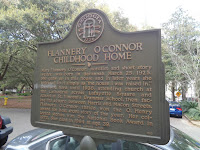


11) Wise Blood (1979)
John Huston adapted Flannery O’Connor’s tale of a man who tried to create a "Church without Christ," but instead finds he can’t escape Christ. These are two films in a row of people not being faithful where God is faithful. Both films encouraged me greatly.

10) Millions (2004) 
In Luke 16 you can read the parable of the Shrewd Manager about a man who used resources he was entrusted with for his own benefit. The point of the story is that we should use our resources for the benefit of others and eternity. This story is told in another way in this film. (I do have a problem with St. Peter's recollections in this film, but otherwise…) Bonus -- it's a Christmas film!

9) The Case for Christ (2017)
This is the only “Christian” film on the list. Most films made by Christian filmmakers are… what's the word? Oh yeah. Bad. This true story of Chicago Tribune reporter Lee Strobel’s investigation into the truth of the Christian faith works. For three Christmases, I’ve shown this film to men in a recovery program at my mission, and every time they've found it to be moving in a positive way. 

8)
Ordet (1955) 
The great Scandinavian director, Carl Theodore Dreyer, told this story of a family and a town, divided by petty denominational differences, brought together by a man who seems mad -- and a miracle.

7) Chariots of Fire (1981) 
“I believe God made me for a purpose, but he also made me fast. And when I run I feel His pleasure.” So says Eric Liddell in this Oscar-winning story of an Olympian who didn’t put his sport first. Liddell was a man who recognized what was truly important in life but found joy in secondary things as well.

6) Joyeux Noel (2005)
This is the second Christmas film on the list. Set in World War I, it tells the story of peace on Christmas Eve. If it could happen that one night, why not more?

5) Babette’s Feast (1987)
This Oscar winner for Best Foreign Language shows the joy to be found in sharing your gifts with others.

4) A Hidden Life (2019)
Terrence Malick isn’t known for making edge-of-your-seat blockbusters. This isn’t an exception to the rule. It's a meditative telling of a lone man's opposition to the power of the Third Reich.


3) The Apostle (1997)
Robert Duvall has starred in three of the best films about Christianity ever made. (If this was a top twenty list, I would have also included Get Low.) Duvall wrote and directed this film, as well as starring as the Apostle, E.F. There have been many films about flawed clergymen, but this film does an amazing balancing act of presenting a preacher’s mistakes and sins with the glory and value of the Gospel.

2) Leon Morin, Priest (1961)
Over this blog's seven years, I’ve seen many pastors on the silver screen. Some were crooks and murderers, but more often they were sappy and insipid. This French film presents an intelligent, funny, and wise man who is also faithful to God and his ministry.

1)Tender Mercies (1983) 
This is my favorite film about faith. An alcoholic country-western singer passes out in a small, rural motel. The motel's owner cares for Mac Sledge (Robert Duvall) as he comes to recovery and new life. He still has pain and regrets. I work with men overcoming addictions to alcohol and drugs, and this film rings true. Mac’s walk of faith rings true. And do you know what else? The pastor and church in this film deserved the Four Steeple Rating.

Next week, we'll wrap up the blog and 2022.

Thursday, January 6, 2022

Movie Churches Has a Laugh


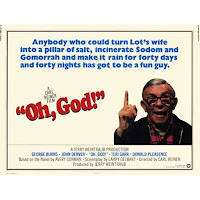
Oh God!
 (1977, 1980, 1984)


It's rather amazing that a little under half a century ago, one studio executive said to another, “I think we can make a movie star out of John Denver.” 

Hey, nothing against the guy. When “Country Roads” or “Thank God I’m a Country Boy” come on the radio, I happily sing along. But he wasn’t much of an actor or comedian.

Denver’s limitations didn’t keep 1977’s Oh God! from being a hit, though. It even knocked Star Wars out of the top spot for a week, but the film’s success can probably be attributed to the comic gifts of then-octogenarian George Burns and the high concept of "what would happen if God visited an ordinary guy."


With a screenplay by Larry Gelbart and directed by Carl Reiner, the film tells the story of Jerry Landers (Denver), a grocery store manager who receives a mysterious invitation to meet with God (Burns). It takes some convincing (such as a rainstorm inside a car) for Jerry to finally believe God really was appearing to him in the form of a little old man with glasses.

God gives Jerry a simple message to bring to the world: He exists and humankind can work things out. Jerry tries to share this message through the Los Angeles Times and television, but he ends up with his marriage and job endangered. Everyone thinks he’s crazy.


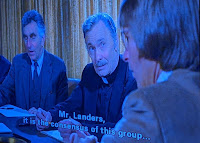
Fortunately for this blog, Jerry draws the ire of the religious community. An ecumenical group of religious leaders including a Roman Catholic bishop (Barry Sulivan), a Greek bishop (Titos Vandis), a rabbi (George Furth), a televangelist (Paul Sorvino), and other religious leaders gather to question Jerry. 

I was totally baffled that all the leaders at this meeting talk about the impossibility of God appearing as a man. Maybe it makes sense for the rabbi to make the point, but I'd expect the Christian leaders would all be pretty invested in the idea that God had already appeared as a man, but not one mentions Jesus.


The religious leaders make Jerry submit to a test. They lock him in a hotel room and give him a long list of questions written in Aramaic. (This was a more difficult task in pre-internet days.) God appears and helps him through the quiz. One of the questions is whether Jesus is the Son of God. God says Jesus was the Son of God, as was Gandhi and the man in the kitchen who charged $11 for a room service steak. Obviously, this film doesn’t purport to be based in Christian theology.

The one member of the clergy who continues to play a part in the film is Sorvino’s Reverend Willie Williams. The characterization of this televangelist is rather baffling. He is presented with all the cliches of a fundamentalist preacher -- a loud polyester suit and a Southerner's vocal cadence -- but he brags about breaking bread with the Rabbi and getting along with all the religious leaders. Very ecumenical, while a stereotypical fundamentalist would pride himself on keeping separate from such "blasphemers."


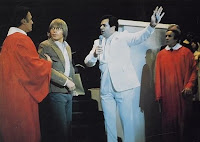
God sends Jerry to one of Willie's worship services to denounce Willie as a money-grubbing fraud. Strangely, asking for money is the only thing Willie does in the service. Usually, there's a promise of healing or prosperity or (at least) salvation, but instead, he just talks about love (“porno is lust, not love”) and asks for cash. I’ve never seen such a preacher not spend at least some time talking about Jesus or the Bible.

Willie sues Jerry for slander. (Also something very unlikely, since such a court case would open the evangelist’s financial records to discovery.) At the trial, God reveals Himself to the court. Jerry gets off without a penalty. Willie comes under sharp scrutiny in the Movie Churches Steeple Ratings.


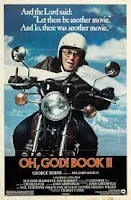
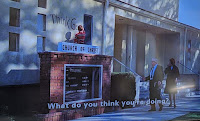
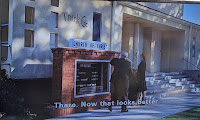
The success of Oh God! led to a sequel, 1980’s Oh God! Book II. George Burns returns as God, but John Denver is nowhere to be seen. Instead, God appears to a young girl, Tracy Richards (Louanne), the daughter of Paula (Suzanne Pleshette) and Don (David Birney). Don is in advertising, so Tracy tells God He should advertise. God challenges Tracy to start a “Think God” campaign, encouraging other kids to put up posters with the motto all over town -- which gets Tracy in trouble with her school principal, who threatens to have Tracy institutionalized. God must appear to a group of psychiatrists to keep Tracy out of an insane asylum.

There is a much smaller role for the church and clergy in this film. One of Tracy’s friends begins to spray paint “Think God” on the wall of a Church of Christ building but runs off when the pastor comes out and yells at him. Then the pastor finishes the job.


Lucy looks for God in three churches and a synagogue but doesn’t find Him there. He tends to appear to her in restaurants.

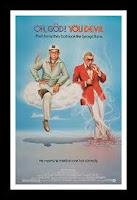
In 1984, one more sequel was released. Jerry and Tracy are missing, but George Burns is back one last time as the Almighty in Oh God! You Devil! Ted Wass (an actor Hollywood kept trying to make happen but who never really happened) plays Bobby Shelton, a songwriter who makes a deal with the Devil (also played by George Burns) trading his soul for stardom.

Like Tracy, Bobby isn’t successful when looking for God in a church. He talks to a priest in a confessional and asks for ten minutes to talk to the Big Guy. The priests in the church think Bobby's crazy, so he flees the scene. Bobby has better luck with a street preacher standing near a van with a bumper sticker that reads, “What are you doing for Heaven’s sake?” There's writing on the side of the van, too: “‘And those that seek me earnestly…Shall find me.’ Proverbs 8:9 (17)


Bobby asks the preacher where he can find God. The preacher responds, “He’s in the desert! Look to Him, for Him, in the desert!”

Which turns out to be true. Bobby finds God in Las Vegas. Where God and the Devil gamble for Bobby’s soul.

So the Movie Churches Steeple ratings vary greatly between the Oh God films. Willie and company in the first film receive a meager One Steeple rating, Three Steeples for the Church of God cameo in the second, and Four Steeples for the street preacher in the third film for apparently actually listening to God.

Thursday, December 30, 2021

2021 Movie Churches in review


Movie Churches Wraps Up 2021

It feels like I always have to explain the Movie Churches rating system. People see a low rating for a church (or clergy member) and assume I didn’t like the movie or, vice versa, think I like a film because it got a high steeple rating.

For example, one of my favorite films this year, A Hidden Life, featured a man of great faith, but he was not a member of the clergy. The clergy and church in that film were corrupted by the Third Reich, so though the film was wonderfully made and featured people boldly imitating Christ, it received a lowly Two Steeple rating.

On the other hand, this year I watched the “Christmas Classic” Love Actually for the first time. Apologies to those who love this film, but I rather loathed it. So many people in the film made stupid, selfish choices that the film seemed to celebrate. The few fleeting glimpses of church and clergy were relatively innocuous, arguably positive, so the church and clergy in the film received a respectable Three Steeple rating.

With all this in mind, I decided to feature the films that received Four Steeple ratings this year -- which doesn’t mean, of course, that I loved the film or even that it's worth seeking out. But in a world where the popular media often presents the church and pastors negatively, it is worth pointing out that it isn’t always the case. Fourteen films received that coveted Four Steeple rating.


January began with a celebration of British film. 1947’s Odd Man Out, directed by master filmmaker Carol Reed (The Third Man). This film is worth pursuing, and the priest in it is a marvelous man who makes a difference in the lives of many, including thugs and gangsters.

We often celebrate Black History Month at Movie Churches, and the best clergy and church this year were found in a film added to the U.S. National Film Registry in 1991. The Blood of Jesus (1941) is an interesting film that uses alternate realities several years before It’s a Wonderful Life. It's a strange film, but the church and clergy in the film are very supportive of a hurting woman.

Okay, I admit I’m not a big fan of legendary director Douglas Sirk. I find his work too sentimental for my tastes, but I can’t fault the men in the Jesuit seminary in 1951’s The First Legion. During the month of April, Movie Churches looked at miracles in movies, and the first miracle in The First Legion is a kind of April Fool’s prank. The second is not.


If I offended any cinephiles by dissing Douglas Sirk, maybe I can get back in their good graces by praising the director of 1937’s You Only Live Once, Fritz Lang. No one could set up a creepy, foreboding atmosphere like Lang. May was Criminals month, and poor Henry Fonda led a life of sinister foreboding. His few bright spots in life came from his love interest, Sylvia Sidney, and his prison priest. Father Dolan is a source of unquestioning, unconditional love. As they say in the film, “Father Dolan is for everyone!” so we’re all for him.

During Criminals month, we also had a positive presentation of a nun in a film about Postal Inspectors. Really, apart 1951’s  Appointment with Danger, have you ever seen a film about postal inspectors?

Not surprisingly, June (Missionaries month) was a good time for High Steeple ratings. Though a good guy, Humphrey Bogart wasn’t a real priest or missionary in China in 1955’s The Left Hand of God, but he did encounter real missionaries worthy of a Four Steeple rating. Though 2016’s On Wings of Eagles is not nearly the film Chariots of Fire was, it gives an accurate enough presentation of Olympian/Missionary Eric Liddell who is as worthy of Four Steeples as he was of Olympic gold.


Christian film month, in July, presented other real people worthy of Four Steeples. Joni Eareckson even played herself in 1979’s Joni. I have very great respect for this paralytic woman who allowed God to use her injuries as a source of strength, building ministries to hurting people throughout the world. Though Pat Boone’s performance as real-life urban pastor David Wilkerson (in 1970’s The Cross and The Switchblade) isn’t what you could call, um, good, we do get the glimpse of a very good man who founded a very worthy ministry, Teen Challenge.

In August we looked at Hollywood Biblical spectacles about the start of the church: The Sign of the Cross, Quo Vadis, and The Robe. I didn’t really enjoy any of those films very much, but if you think I’m going to give Peter and Paul and the other apostles anything less than Four Steeples, you’ve got another think coming.


Looking at Christian schools in September, I was happy to watch a film I really love that also happens to have a positive presentation of clergy: 1993’s Rudy. It is often listed among the films that can make a man cry. Not me, of course. I was, um, just chopping onions.

Our last Four Steeple films were found in November with a triple feature of films about the founder of the Protestant Reformation, Martin Luther. Though he had his faults as a man of his time, and all people have, he still earned his Four Steeples in 1953’s Martin Luther, 1974’s Luther, and 2003’s Luther.

So this is the last Movie Churches post of 2021. Next week we'll start a month of Comedy Churches to kick off 2022.

Thursday, November 4, 2021

Martin Luther, Luther, Luther


Martin Luther (
1953)
Luther (1974)
Luther (2003)

I was duped by contemporary holiday priorities. 

Last Sunday was Reformation Sunday and this post should really have led into that day, but instead, like most of America, I thought first about last Sunday being Halloween. 

As penance, I watched not one, not two, but three films about Martin Luther. This really makes no sense at all because Luther was all about getting rid of penance and seeking forgiveness through faith in Christ alone. So my bad twice.

But let's move on, shall we?

Martin Luther (1483 - 1546) was one of the most influential men in history. His life and work led to the foundation of not just the Lutheran Church, but all Protestant churches. Because of Luther, religious and also political authority became open to question. His translation of the Bible into the German vernacular had the same kind of impact on the language that the King James Bible did on English, and furthered the cause of popular literacy. And he changed the kind of beer consumed in his homeland, as drinking hops was an act of rebellion against the Catholic Church (the whole beer thing never comes up in any of the films below.)

1953’s Martin Luther very much has the feel of an educational film, because, well, it is. Though the opening crawl reads that it is the work of “historians of many faiths”, the film was a co-production of the Lutheran Churches of Germany and America (sponsored by Luther Filmgesellshaft and the Lutheran Church of America.) and Luther comes off well throughout.


The film opens with Martin (Niall MacGinnis) leaving law school to go to the monastery, much to the displeasure of his father who had pinned hopes on his son’s success as a lawyer. Martin had hoped to find peace after taking the vows of poverty, chastity, and obedience, but as a monk, believes God doesn’t approve of him. His superiors send him to Wittenberg to serve as a priest saying, “We’ll keep him so busy, he won’t have time for his troubled soul. He’ll find his peace in Christ.”

Luther is sent to Rome and is encouraged to see one of Judas’ silver coins and the Pope, Julius the Second, for his spiritual benefit. But he is disappointed by what he sees. He sees the relics as not symbols of salvation, but “crutches to uphold a faltering faith.” Luther claims to have found true hope in “Romans 1:17” (though the numerical system for denoting New Testament verses was popularized by Robert Estienne in the 1550’s, after Luther’s death).  Luther says, “The just will live by faith. Is there anything about relics? Faith in what God has done for him through His Son.”

Luther speaks out against relics as a means of grace, much to the displeasure of Duke Frederick, the sponsor of Luther’s professorial chair at Wittenberg University. Luther also preaches against indulgences (the theology of giving financially to the church to shorten the years loved ones spend in purgatory). Johann Tetzel, a representative of the Vatican, was most displeased about this since his chief work was selling indulgences.

Tetzel threatens Luther, “I’ll burn his books, and I’ll burn him, too.” The Vatican begins to take Luther seriously as a threat. The German people admire Luther for standing up to Rome, and one of the locals says, "For the first time in a hundred years, someone has told the Pope where to get off!” 

Martin’s supervisor, Augustinian Father Johann von Staupitz, sees nothing but pain for Luther, “Martin, Martin, I see nothing ahead of you but the Cross. May God have mercy on your soul and those who try to follow your preaching.”

The Vatican condemns Luther, but he is protected by the Emperor of Germany, leading to the country's break from the Roman Church. We see Luther working on his translation and his joy in seeing his servant read the Gospel for himself for the first time. And we see his marriage to Kate the nun. And the narrator assures us that all of this led to the still prospering Lutheran Church. “A Mighty Fortress” (lyrics by Martin Luther) plays during the end credits, in case we had doubt who produced this film.


1974’s Luther was most certainly not a production of the Lutheran Church but rather a production of the American Film Theater. This production company was made with the goal of bringing important stage plays to the screen, including this adaptation of John Osborne’s 1961 play. Osborne was interested in the themes of rebellion against society; he was best known for his plays Look Back in Anger and The Entertainer.

Stacy Keach plays Luther as a man who can be understood by psychological rather than theological drives. He is dealing with daddy issues and toilet troubles. (Both of these things were certainly influences on Luther, but the play and the film make these Luther’s primary drives.)

The film opens later in Luther’s life, during the Peasants' Rebellion when Luther encouraged the authorities to crack down on the rebellion. A peasant accuses Luther of being a butcher with blood on his hands. “My father is dead, and you’re alive and well and cuddling in the arms of your nun.”

But then we go back earlier in Luther’s life when he stripped down to a thong to take his vows and was told, “Choose God or the world, if you choose the order, you are not free to reject it.” He chose the Augustinian order, but of course, would later reject it.


He is shown dealing with digestive issues as he struggles with the question of his salvation (“I wish my bowels would open”). And when he does rebel against Rome, he talks about it in scatological terms, “If I break wind in Wittenberg they might smell it in Rome.” But he does break with Rome, saying, “It is as hard for me to do what I must do as for a man to truthfully call his mother a whore.” And he says, “When the words emerged, ‘The just shall live by faith’ and my (intestinal) pain vanished.”

The film ends as it begins in the Peasants' Rebellion. He sees violence all around, but says “There’s no such thing as an orderly revolution… In the teeth of death we live, if He (God) butchers us, then we live.”


2003’s Luther is my favorite biography of the man, and certainly the most entertaining. It features a great cast: Joseph Fiennes in the title role, Peter Ustinov as Frederick the Wise, Claire Cox as Katrina, Alfred Molina as Tetzel, and especially Bruno Ganz as Luther’s Augustinian mentor. This film was also produced by the Lutheran Church (“Thrivent Financial for Lutherans” reads the production credit), so there is little doubt as to where its sympathies lie.

This film begins with Luther's conversion, his decision to give his life to God to become a monk. Caught alone on a road during a fierce thunderstorm, he fears for his life. “Help me!” he cries out. “Don’t let me die like a dog on the road! I give myself to God!” (One can’t help but be reminded of the conversion of Saul to Paul on the road to Damascus.)

Again we see Martin confront his disappointed father who hoped his son would become a lawyer. We see him struggle with fear of judgment, “I’m too full of sin to be a priest!” 

His Augustinian father tells him, “After two years of confessions I’ve never heard you confess anything remotely interesting.” He encourages Martin to “Bind yourself to Christ and say, ‘I am yours, save me.’”

Again we see Martin travel to Rome, to his great disgust. He hears barkers hawking relics, such as, “This way for the John the Baptist’s head!” On these sites, he is encouraged to “Give generously!” He is distraught to learn there are brothels for clerics in Rome. “You can buy anything, sex or salvation,” he frets.

After this, he is sent to Wittenberg to be a priest and study the New Testament. This perplexes him. But he is told it is there, as a preacher, he will find his faith.

We are shown two events that, in the film, change him greatly. In a class lecture, the priest teaching the class assures them that there is no salvation outside of the Roman Catholic Church. Luther asks, “There are no Christians outside of the Roman church, so you consider Greek Christians damned?” 

The teacher asks, "Do you question the authority of the church council?” 

Luther responds, “Salvation can be found outside of the church, but not outside of Christ.”

We see Luther come across a boy who has hung himself. Against the orders of the church, he buries the boy in the church graveyard, arguing that the child is no different from a man killed by the robber in the woods because the boy was killed by the lies of the devil.


As in the other two films, we see Luther preach against relics and indulgences, but in this film, his preaching is genuinely funny. “God once spoke through the mouth of an ass, and He may be about to do it again… 18 of the 12 apostles buried are in Spain... Enough nails from the cross are available in Rome to shoe all the horses in Saxony.” His preaching is not just funny, but gracious and enlightening.

We also see Tetzel's preaching, which is the epitome of fire and brimstone. “Can’t you hear the screams of your parents? Grandparents? Aunts and uncles? For a few coins, you could rescue them.”

When Luther learns that a poor widow, mother of a young child, gave money to Tetzel, he is outraged, “This paper means nothing. You must trust in God’s love, use your money to feed Greta.”

But Tetzel claims, “I can save the soul of a man who violates the Holy Mother herself.”

Luther preaches against putting hope in relics and indulgences. He says, “Christ isn’t found in the bones of saints, but in your love for one another, in His sacraments, and in His Holy Word.”

So again we see Luther in trouble with Rome. He is called to appear there but is warned, “The Rome Inquisition doesn’t give rulings, it gives death sentences.” When the German authorities refuse to hand him over, the trial by Rome is set for the Diet of Worms.

When he refuses to deny his work, he gives one of the most famous of history’s speeches, “Unless I am convinced by Scripture and by plain reason and not by Popes and councils who have so often contradicted themselves, my conscience is captive to the Word of God. To go against conscience is neither right nor safe. I cannot and I will not recant. Here I stand. I can do no other. God help me.”

Luther’s relationship with Katrina von Bora is shown with humor and tenderness. Katrina is one of a dozen or so nuns who escaped a convent hidden in herring barrels, and she's the only one who can't find a husband. She has to settle for Martin (and he didn't especially want to marry her -- or anyone) The marriage eventually becomes a delight to both. 

Luther, as presented in these films, is a man who would be a pleasure to know as a preacher and a companion in a pub. That’s why he earns our highest Movie Churches rating of Four Steeples.


Thursday, October 14, 2021

The Devil Takes a New England Holiday


The Witches of Eastwick
(1987) 
The Lords of Salem (2012) 
Elvira: Mistress of the Dark (1988)

In the Spring of 1692 a group of young women in Salem, Massachusetts claimed to be possessed by the devil and accused others of witchcraft. Mass hysteria seized the town, and over the next few months, 19 people were hanged for the charge of witchcraft while five others died in custody. 

By September of that same year, public opinion turned against the trials, and they ended. The Massachusetts General Court would later annul all the charges of witchcraft. Historians concur with what people of the time came to believe: the charges of witchcraft in Salem were a deadly hoax.

Hollywood does not agree. Oh, sure, occasionally a film has been made from history's point of view, such as The Crucible. Usually in movies, the witches are real -- which is the case for the three films we’ll look at today. Not only do they feature able necromancers, but (fitting with our theme this month) also the devil as well.


The Witches of Eastwick
is based on a novel by John Updike about three women who live satisfying lives in Eastwick, a small village in New England. Alexandra (Cher) is an artist and the single mother of a daughter. Jane (Susan Sarandon) is an infertile, divorced music teacher. Finally, Sukie (Michelle Pfeiffer) is a columnist for the local newspaper and the mother of six daughters. The three friends try to support each other, but none of them seem happy.

Then a new man comes to town. Or -- is he a man?

Jack Nicholson plays Daryl Van Horne, a man who disrupts the village with his vulgarity. And seduces the three women, one by one. They establish a strange, polygamous family until the women decide to cast the devil out, leading to a battle between the devil and the women who have discovered their witchy powers.


You might ask, what does any of this have to do with Movie Churches? Interestingly, director George Miller continually puts the local church in the center of everything. The aerial establishing shot in the credits even has the church in the center of the shot. Many of the exterior shots have the church in the background.

A few scenes actually take place inside the church. We hear the congregation singing a favorite of mine, “Lead on O King Eternal,” but one woman in the church, Felicia Alden (Veronica Cartwright), opposes the three friends and their new lover. 

When she speaks out against them in a church service, she seems to go more than a little mad. She screams “Whores! You know what’s going on in that house? Perversions! Drugs! Incest! Spanish flies!” Her husband has to drag her out of the church. 

Felicia goes to the hospital where the doctor explains, “Some fat got into her brain.”


There is another major scene in the church. As the pastor is preaching on Elijah, a mighty wind blows the door open and Daryl, who has been battling “the witches of Eastwick,” comes through the doors. 

He has been tarred and feathered, and he explains, “Sorry, having a little trouble at home, just female problems.” And then he vomits... a lot. He is then able to talk again. “Let me ask you something. You’re all church-going folks. Do you think God knew what He was doing when He created woman?... I really want to know. Was it another mistake like tidal waves, earthquakes, and floods? You don’t think God makes mistakes? Of course, He makes mistakes. But when we make mistakes they call it evil. When God makes mistakes they call it Nature. So what do you think? Women? A mistake? Can we find a cure, a vaccine?”

The congregation looks at the Devil with puzzlement and concern, but he leaves the sanctuary enraged.

Overall, it seems like a nice little church.


A very different film, a horror film rather than a comedy, is Rob Zombie’s The Lords of Salem. The film opens in 1696 and shows a coven of witches denying Jesus and pledging themselves to Satan.

We then see these same witches burned at the stake for their practices (which history shows is not how “witches” were dealt with in New England.)

We then go to the future where an author, Francis Matthias (Bruce Davison) is promoting his new book, Satan’s Last Stand: The Truth About the Salem Witch Trials on the radio show of D.J. Heidi Hawthorne (Sheri Moon Zombie). Matthias argues that “witchcraft is a psychotic belief brought about by a delusional state of mind.”

As the film goes on, Heidi encounters witches through a band called the Lords of Salem and through women at her apartment complex. It turns out Heidi is a descendant of those who persecuted the witches of Salem, and the witches are taking vengeance on her and other relations of those early witch hunters.

So where does the church show up in this film? In New England, as was true in Europe, civil authorities rather than ecclesiastical authorities prosecuted people for witchcraft. Not in this film.


There is a brief appearance of a contemporary church in the film. One day as Heidi is walking her dog, she stops to go inside a small country church. She sits in a pew. A priest comes in and she says “Hi!” 

The priest responds, “Why are you here?” in a voice that sounds more than a little judgmental.

Heidi: “I don’t know. I was walking by with my dog, I thought I’d come in. Is that okay, are you closed?”

Priest: “No. We’re never closed. God is always there, ready to listen.”

Heidi: “I just needed to sit and think.”

Priest: “It is a nice place to come and sit.”

Heidi: “Yes, nice.”


The priest sits next to Heidi on the pew and says, “You're a very sad girl.” He then grabs her arm and says, “You have to understand there is a war in heaven between Satan and Michael and his angels but you must understand, God does not forgive angels when they sin, He sends them to hell. You are a filthy whore of Satan. Christ can’t save you, only I can save you.” He tries to kiss her. And then Heidi wakes up.

The priest looks down on Heidi, waking up in the pew, and says, “I believe you fell asleep. It’s very peaceful here.”

Heidi finds an old book, the diary of the Rev. John Hawthorne, her ancestor. It tells how he opposed the master witch who made the devil’s music and so he killed that master witch. So the contemporary witches kill Heidi and other descendants of the opponents of witches from back in the day. They do so in a ceremony that mocks the church. They even post a “Jesus Saves” cross.


This time around, the devil wins.

Today’s last film with a real witch in New England is Elvira: Mistress in the Dark. Again, the church isn't seen much in this film, but toward the end of the film, the title character finds herself sentenced to death in the contemporary New England village of Fallwell, Massachusetts.

A priest comes to Elvira’s cell before she is taken to be burned at the stake. She's happy to see him arrive, thinking he's there to save her. He says he is there to save her soul, but then he (like about half of the men in the film) makes a pass at her, grabbing her breasts. This priest really brings down the Movie Churches Steeple rating, bringing these three movies to Two Steeples.


Friday, August 27, 2021

Movie Churches is confused: Is this old or new?


Hail Caesar
 (2016)

I’ve watched the Coen Brothers’ Hail Caesar a number of times, but this time I watched it after watching some of the Biblical epics satirized in the film, particularly Quo Vadis and The Robe. Among other things, Hail Caesar presents a compelling argument for why such films are so very bland.

The film follows Eddie Mannix (Josh Brolin), a studio fixer whose job is to keep the worst antics of the studio’s stars out of the newspapers and to ensure that the studio’s releases don’t offend the “average American.”

The film opens in a church, with Eddie in the confessional booth. Eddie is a frequent occupant of the confessional, concerned about his smoking habit and white lies to his wife but showing very little concern for the lies and crimes that are a part of his job.

His current task is to make sure the studio’s new Biblical epic, Hail Caesar, is not offensive to religious audiences. As a Catholic, Mannix naturally thinks of bringing in a priest but adds, “Let’s also invite a Rabbi and a Protestant padre of some kind.” Which he does, along with an Orthodox priest.

Mannix addresses the clergymen (and they are all men): “We don’t want to send it to market except in the certainty that it will not offend any reasonable American, regardless of faith or creed. Now that 's where you come in. You’ve read the script; I wanna know if the theological elements of the story are up to snuff.”


The response of the Eastern Orthodox priest (Aramazd Stepanian) is not really to the point, “I thought the chariot scene was fakey. How is he going to jump from one chariot to the other, going full speed?”

Mannix is trying to sell the men on the power of movies to educate and exhort people (“Yes, and entertainment,” he adds with a winning smile) and particularly on this production which he insists will be the best telling ever of the story of Jesus. 

Again, the Orthodox priest answers, “Perhaps, sir, you are forgetting the telling in the Holy Bible.” 

Eddie answers, “You’re quite right, Patriarch. The Bible, of course, is terrific.” (High praise indeed.)

Eventually, Eddie asks, “As for the religious aspect, does the depiction of Jesus Christ cut the mustard?”


The Catholic priest (Robert Pike Daniel) answers, “Well, the nature of Christ is not quite as simple as your photoplay would have it.”

“How so, Father?” Eddie asks.

“It’s not the case, simply, that Christ is God or God Christ…” The priest responds.

“You can say that again,” explodes the rabbi (Robert Picardo), “The Nazarene was not God!”

“He was not not God,” the Orthodox priest interjects.

“He was a man!” the rabbi insists.

“Part God,” adds the Protestant (Allan Havey).

“No, sir!” answers the rabbi.

“Rabbi, all of us have a little bit of God in us, don’t we?” asks Eddie, seeking common ground.

When the Catholic priest insists the important thing is to show that Jesus is the Son of God, the rabbi responds that God doesn’t have children. The priest answers, “God has children.”

The rabbi gets sarcastic, “What? And a dog? A collie, maybe? God doesn’t have children. He’s a bachelor. And very angry.” 

The Catholic priest answers, “No! No! He used to be angry!” 

The rabbi asks, “What? He got over it?”

The Protestant butts in, “You worship the God of another age!” 

“Who has no love!” adds the priest. 

“Not true,” the rabbi responds, “He likes Jews.”

(I must interrupt here to say the theology of the Catholic priest and Protestant minister is going to dock them some Steeples in our clergy rating. Christianity actually teaches that the God of the Old Testament and the God of the New are one and the same.)


The Catholic priest makes another shot at explaining Jesus to Eddie saying, “It’s the foundation of our belief that Christ is most properly referred to as the Son of God. It’s the Son of God who takes the sins of the world upon Himself, so that the rest of God’s children, we imperfect beings, through faith, may enter the Kingdom of Heaven.” (Not a bad little Gospel presentation.)

Eddie asks, “So, God is...split?”

“Yes! And no,” says the Catholic priest.

“There is unity in division,” says the Orthodox Priest.

“And division in unity,” says the Protestant.

“I’m not sure I follow, padre,” says Mannix.

“Young man, you don’t follow for a very simple reason,” the rabbi tells him, “These men are screwballs.”

Now I wouldn’t call these men screwballs, but for Christian clergymen, they seem to have a pretty poor understanding of Christology, or at best aren’t very good at explaining who Jesus is. Orthodox Christianity teaches Jesus was and is fully God and fully Man. None of the Christian clergymen expressed this doctrine.

Perhaps the real problem was the Christian clergymen going along with the idea of a presentation of the Gospel as uncontroversial. According to the Apostle Paul, the Gospel has always been a scandal, a stumbling block for the Jews, and foolishness to the Gentiles.

To tell a story of the Gospel in a way that is uncontroversial neuters the story and makes it rather dull. But Eddie’s concern is making money for the studio and protecting the business. Even though his Catholic faith is important to him, he doesn’t consider staying true to the Gospel as part of his job.

But that is one of the most endearing things about Eddie, his devotion to his work. Throughout the film, he considers leaving the studio and taking a more cushy and financially lucrative job in the aerospace industry, but a talk with his priest (as far as we can tell, not the priest in the focus group) reminds him that his job makes people happy and God wants people to be happy. So he stays at the studio because he believes it is what God has called him to do.

So while the presentation of the clergy at the studio meeting is less than impressive (though quite funny), the care that Eddie receives from his priest keeps the Movie Churches rating for the church and the clergy in the film at a rather respectable Three Steeples.

Thursday, May 20, 2021

Crime Month: Can I Get a Witness Protection?


Can I Get a Witness Protection?
(2016)

Many people can’t stand Christian films because the films tend to be...how should I put it? Let's just say sub-par quality. Or incompetently produced. Or insipid. We here at Movie Churches have a different problem with Christian films. We figured that if any filmmakers get the mundane, nitty-gritty details of church and Christian service right, it would be Christian filmmakers. But no.

This sad fact was demonstrated once again in this week’s film, Can I Get a Witness Protection? The 2016 film has a potentially workable high concept: a man who witnesses a murder is put in the witness protection program as a pastor in a small church. Similar themes have been used in films like My Blue Heaven, For Richer or Poorer, and Did You Hear About the Morgans? but this film gets very few of the facts of small church life right, especially in the particulars of denomination and location.

This appears to be the only movie writer/director Robert G. Lee has written or directed, though he has written a number of episodes of VeggieTales. Lee has had an extensive television career as a warm-up comic for a number of sitcoms - Designing Women, Perfect Strangers, Wings, Just Shoot Me, and others. To make this film, he used crowdfunding resources (Kickstarter and Indiegogo).


The wacky comedy tells the story of Jack (Jamie Alexander) and Julie (Jacquelyn Zook), a couple with a rocky marriage forced to move from San Diego to Fresno in the Witness Protection Program after Jack witnesses a murder in a garage of his trucking company. (Since Fresno is only a five-hour drive from San Diego, one might wonder if this is much of a hiding place. Someone in the film raises this objection asking, “You don’t think people in San Diego can find Fresno?” The federal agent responds, “We’ve found most people in San Diego don’t want to find Fresno.”)

Jack is given a position as associate pastor in the First Presbyterian Church of Fresno. Senior Pastor Bronwen (Kevin Brief) takes two large bricks of cash from the federal agents as reimbursement for helping  Jack and Julie. He provides them with living space in the church (which has no showers or private bathrooms) and admits the dilapidated church has been struggling financially. Federal protection money helps them get by.


We then meet the rest of the staff of the church. Danny (David Storrs) serves both as the church janitor and youth pastor (of a youth group with a single member.) Kathy (Karen Whipple) is the music director who is not only unable to play any musical instruments but can’t even play a boombox (at a memorial service she inadvertently plays Christmas carols and the Hallelujah Chorus). And Linda (Jodi Shilling) is the church secretary but calls herself the pastor’s “indentured servant.” With Jack, that makes a staff of five serving a congregation of fewer than fifty people (guessing from the church services we see). The staff all seems quite incompetent, and I was sure the joke would be that they were all part of the witness protection program. But no, this congregation hired and continues to pay a large staff of people wholly unsuited to their work.


The next plot twist comes when the senior pastor dies, putting Associate Pastor Jack in the place of Senior Pastor (you know, like royalty or Presidents). Jack really shakes things up by going out into the neighborhood, serving community meals, and letting a couple of homeless men sleep in the church. This brings the church to the attention of the media (oddly, it's as if no church anywhere -- not just in Fresno -- has ever done such a thing before) and the media draws the attention of the killers.

At the conclusion of the film, the killers come to the church during a service and --at gunpoint -- threaten to take Jack away. But the congregation is able to overcome the killers and call the police. Jack admits he isn’t a real pastor, does not have any seminary training, and, in fact, just became a Christian during his weeks of service at the church, but the congregation acclaims him their new pastor nonetheless.

So what does the film get wrong about churches? And about Fresno? And even about crime? So many things.


First, mistakes about churches:
  1. Pastoral hiring. It was a very poor choice to make the church Presbyterian. There are a number of Presbyterian denominational variants in the United States, but all of them have elaborate procedures for hiring pastors involving bureaucracies in the denomination, church elders, and the congregants. If filmmakers had made the church an independent congregation or even if they just called it Baptist, it might be possible the senior pastor would choose his own associate and the congregation chooses its own senior pastor, but this doesn’t happen with Presbyterians.
  2. Church signs. We see a number of “witty” sayings on the church sign in the film. (“We Don't Raise Our Hands In Church - We're Afraid God Might Call On Us!” “Presbyterians - We’re like Methodists but without the excitement.” “Download God’s Prayer App for Quality God Facetime”) I’m more than willing to believe all of these sayings have appeared on the signs of real-life small churches, but the signs don’t get changed that quickly.
  3. Financial accountability. The senior pastor keeps the funds in cash in a safe. No one but the senior pastor has the combination to the safe. The IRS would be very interested in these things.
  4. Pastoral requirements. Jack’s first sermon is a disaster and his attempts to use the former pastor's library just confuses him,  so his staff gives him several books: Lee Strobel's The Case for Christ, C.S. Lewis's Mere Christianity, and Josh McDowell’s New Evidence That Demands a Verdict. I’ve read all these books, and they’re good, but it's hard to believe that in one week these books on apologetics not only lead Jack to become a Christian but also make him a passable preacher. As Paul wrote, “Whoever aspires to be a pastor desires a noble task...He must not be a recent convert, or he may become conceited and fall under the same judgment as the devil.” I don’t think Paul would have been cool with making Jack a pastor.
  5. No way this would be First Church. The name of the church is First Presbyterian Church of Fresno, but it seems to be located in an upscale newer neighborhood. In a city like Fresno, most First churches (and sometimes even Seconds and Thirds) of a major denomination will have their campuses near the center of the city in a downtown area.

Geography is outside our purview here at Movie Churches, but as a former resident of Fresno, I have some quibbles. The few people in the congregation in what appears to be a very tidy neighborhood seems relatively well-to-do, but our introduction to the church mentions homeless people living in the neighborhood (we see a few well-groomed people pushing shopping carts on the street or getting clothes from what they think is a clothing giveaway). In addition, everybody seems very white, though Fresno's population is only about 50% white. About 40% of the people living there are Hispanic, more than 10% are Asian (Fresno is home to the second-largest Hmong population in the US), and about 30% are Black, Native American, or "other"). Not surprisingly, the church used in the film is located in a Los Angeles suburb. 

I also had real problems with how the way the criminals conducted their business. I admit I'm not an expert, but does it make any sense that criminals concerned about one man witnessing their criminal activities, would hold a whole congregation at gunpoint, creating dozens of witnesses? Again, I’m not in the murder business, but that isn’t how I’d conduct my murder dealings.

But we don’t rate geography, demographics, or the accuracy of criminal representation here. We rate churches and clergy in movies, and we’re giving the entirely fictional First Presbyterian Church of Fresno a meager Two Steeples.

Thursday, July 16, 2020

Kanopy Month: Leon Morin, Priest

Leon Morin, Priest
(1961)
 

Frankly, I wasn’t looking forward to watching this week’s film on the library-sponsored streaming service, Kanopy. The IMDb plot summary reads, “Set during occupied France, a faithless woman finds herself falling in love with a young priest.” 

I’m afraid my expectations for a French film of that period (1961) were that the priest would eventually reciprocate that romantic love, and I’d end up very annoyed. But I was wrong.

Jean-Pierre Melville goes another route in his direction and adaptation of Beatrice Beck’s novel. Instead of telling of a sordid affair, he tells the story of a seeking woman whose love for a man turns to love for God. And a faithful priest has a part in that journey.

The film is set in a small town in France at the beginning of the Occupation during World War II. A woman named Barny (Emmanuelle Riva) is unconcerned about the Italian soldiers who have come to her town. In their silly uniforms and feathered hats, the Italian army inspires more quiet mockery than fear. Things change when German soldiers take their place.

Barny is a Communist, and she has Jewish friends. They have reason for concern about the new overseers. Barny and her two friends, all mothers, decide to go to the local Catholic Church to have their children baptized. They must then decide on Godparents and alter the dates on the baptismal certificates to make it look like the children were baptized as infants. (A priest says, “We practically crank out baptismal certificates.”)

This arouses Barny’s interest in the church. She decides to go to confession just to argue with a priest. There are three confessional stalls and each has the name of a priest on the door. Based on the names alone she decides to avoid one priest because he sounds old and another because he sounds middle-class. But to her ear, Leon Morin sounds like a peasant and she goes in.

Barny tries to pick a fight with the priest in the confessional, but he doesn’t take any of her bait. He doesn’t get angry, doesn’t seem shocked by her Marxist declarations. He declares her absolution of sin even though she doesn’t technically confess. And he gives her a penance of kneeling on the stone floor of the sanctuary before she leaves. She scoffs but kneels before leaving.

Leon (Jean-Paul Belmondo) offered Barny an opportunity to borrow books. She comes to his office at night and makes a snide remark about the materialism in the church -- then notices patches in the priest's cossack. He points to the bookshelf and offers any book. When she picks A Life of Christ by Karl Adam, Leon remarks, "Oh, you would choose that one!" (I didn't get the joke until I Wikied Adam and found he was the most prominent theologian to reconcile Catholicism with Nazism.) She devours the book and comes back the next week for another. The weekly book borrowings continue along with weekly discussions.

Barny is not the only woman in the village that visits the priest. Christine (Irene Tunc), a woman from Barny’s office with Vichy sympathies, asks Leon whether she should collaborate with the Germans. He notes the Jews that are being deported and the responsibility of Christians to care for those in need. Christine responds, “Why should I risk my life or the life of my daughter for those Kikes?” 

“Our Lord was a Kike,” the priest answers.

Another woman, Marion, known for her relationships with a variety of men (two men with the French Resistance, two with the Vichy government and a German), sets her sites on the young priest. Christine says of the woman, “Once she plans on having a man, she doesn’t fail.” 

Marion does fail -- in that way -- with the priest. In his office, she makes a suggestion, “You should be a country priest and I could be your housekeeper” (with the implication of a more intimate domestic relationship.)

“A country priest’s housekeepers should be old hags,” Leon says. “Maybe in a few years.” 

After this rather sardonic insult, he strikes a more kindly tone, “You poor birdbrain. My poor child, it’s crazy how much the Lord loves you. You’re one of his favorites, and Heaven was made for you, especially for you.” The town is astounded to note Marion becoming a regular church-goer.

Marion isn't the only person to radically change. Barny herself, in what she calls a “catastrophe,” is convicted of her need for conversion. She is shocked when Leon doesn’t treat her decision with acclamation.

When she tells the priest she feels she must become a Christian, the priest responds, “Think before you make such a monumental decision.”

“I have no choice,” she says

“You imagine that.”

“I have no choice but to join the Church.”

“A clear case of possession,” he says mockingly, “I must exorcise you.”

“You did everything you could to make me a Christian,” she declares.

“You’ll ruin your life.” he says, “Have you ever thought of being a Protestant? They’re fine people.”

“Why are you making fun of me?”

“I’m not. It’s the truth.”

Not only does Barny come to faith, but her young daughter Danielle does as well. Danielle comes to her mother one day and says, “I know everything. I understand everything now. I know who made me.”

“Who?” her mother asks

“God,” the girl says matter-of-factly.

“Who told you that?”

“The man, the priest. Now I know God. We can’t see Him, He has no body. But that’s alright.”

Leon continues to counsel Barny, in matters of theology and Christian living. I enjoyed Leon’s response when Barny tells him she never answers the door, “It could be the Gestapo.” 

He admonishes her, “It could be someone in need.” That soon turns out to be the case. Jewish friends come to Barny for help in getting food and hiding from the Germans.

Along with seeing Leon as a counselor, we do have one opportunity to see him as a preacher. From the pulpit, he tells his congregation, “Are you Sunday Christians in a rush to leave God? Most of you leave before the final Gospel reading. If you are Christians in name only you drive away the undecided. You crush their desire to come. Each of you should be an apostle in your own setting.”

Barny continues to want Leon to be more to her than just a priest. She bluntly asks him, “If you were a Protestant pastor, would you marry me?” She even asks God to give her just one night in her bedroom with the priest. 

Leon tells her, “I wish you pursued God as ardently as you pursue men.”

When the priest tells Barny he is leaving their town to minister to unreached parts of the country, Barny finally realizes God has been doing what was best for her all along, by providing a pastor for her rather than a lover. She prays, “Thank you, Lord, for loving me more than I love myself.”

This blog always rates the clergy and churches in films rather than the films themselves. But if we were recommending films here, Leon Morin, Priest, would be highly recommended. As for Leon, though he is more sympathetic to Marxism than I would ever be, and though he is at times a bit brusque with the women in his congregation, and though he attributes a quote to St. Paul that didn’t come from St. Paul (“The world would be better if you were”), we’re giving him our highest Movie Church rating of 4 Steeples.