Showing posts with label World War 2. Show all posts

Thursday, September 29, 2022

Literary Movie Churches Adaptations Volume V: The End of the Affair

The End of the Affair
(1955 and 1999)

Literary Month concludes with a religious novel featuring tawdry sex. Well, perhaps tawdry isn't a fair term at all because I’m sure the characters, a married woman and her unmarried love, believe theirs was a singular love, beautiful and not at all wrong. Graham Greene’s The End of the Affair, published in 1951, has been adapted twice for the screen, in 1955 and 1999.

Considering when they were made, it’s not surprising there are a number of differences between the films. The first is in black and white, and the second is in color. The first starred an American (Van Johnson) as novelist Maurice Bendrix, and made the character a Yank, while the second starred Ralph Fiennes as a British writer (also named Maurice Bendrix). And the second film has explicit sex scenes while the 1955 film does not. (Both films were made in England, so while the first film didn’t need to follow the American Production code, the British code could be even more strict.)

Of course, these differences don’t matter much to us here at Movie Churches. The differences in how the films handle churches and clergy matter here.

The novel and the film adaptations all share the same basic plot. During World War 2, a novelist in London begins an affair with Sarah, the wife of Henry, a British bureaucrat. (Greene admitted the story was based on an affair of his own.) As Maurice and Sarah meet during an air raid, the apartment building is bombed. Sarah is concerned that Maurice is dead and prays, promising God that if Maurice does live, she will break off the affair. Maurice is uninjured, and Sarah breaks up with him.


Time passes and Maurice doesn’t know why Sarah ended the relationship. He suspects there may be another man, so he goes to Henry (Peter Cushing in 1955, Stephen Rea in 1999) and says he will be hiring a private detective to follow Sarah (Deborah Kerr in 1955, Julianne Moore in 1999). Maurice (pronounced "Morris" in case you wondered) tells Henry he will pretend to be Sarah’s lover to save Henry from the embarrassment of the situation. A detective named Pakis, who brings his young son along on his jobs, follows Sarah. This is where the film plots diverge from one another.

The two Sarahs in the two films follow two very different men.
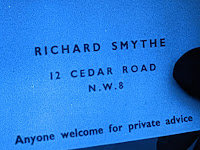

In the 1955 film, Sarah hears a “preacher” in a park proclaiming a message of atheism. He offers counseling to help people overcome the hindrances of religion. Sarah goes to him, hoping he will free her from her promise to give up Maurice. Pakis reports to Maurice that Sarah is seeing a man. This man, Richard Smythe (Michael Goodliffe), fails to persuade Sarah that God doesn’t exist. In fact, his hate for God is so strong (half his face is covered by a birthmark) that Sarah says he convinced her that God exists. How could he hate someone he didn't believe exists?

Sadly, Sarah coughs in the film. We all know that in old movies, coughs indicate a fatal illness (usually, but not always, consumption). Sarah goes to a priest who refuses to give her any easy answers. Sarah comes to embrace her faith in God. And dies offscreen.


Maurice meets Sarah’s mother, who tells him that Sarah was baptized into the Catholic church when she was two, but her father was Jewish so they couldn’t practice their faith. Maurice comes, reluctantly, to faith in God.

In the 1999 version, Parkis the detective finds Sarah has been seeing a different Richard Smythe (Jason Isaacs). He’s a priest who lives with his sister. Believing he has been having an affair with Sarah, Maurice confronts the priest, “Aren’t you bound by the vows of chastity?”


Maurice is mistaken. Sarah has been receiving spiritual counsel, not physical affection from the priest. She comes to have faith in God. In this version, it is Sarah who tells Maurice that she was baptized in the Catholic Church at the age of two. She also coughs in this film, obviously signaling a fatal illness.

Because of her illness, Sarah is confined to her home with Henry, but Henry, learning of the affair, invites Maurice to live with them and help care for Sarah. Though neither Henry nor Sarah know it, Maurice bars Father Smythe from seeing Sarah. After Sarah dies, Maurice convinces Henry to cremate Sarah rather than have a Catholic funeral.


However, after her death, Maurice learns more about Sarah. The detective’s young son Lance has a deforming birthmark. Lance follows Sarah as his father's assistant but falls asleep. Sarah, finding him asleep, kisses his birthmark, which vanishes within weeks. In this film also, Maurice comes grudgingly to faith in God.

Both films lead one to think that Maurice eventually believes in God, but in the novel, Maurice believes God exists but refuses to have a relationship with Him because Maurice now believes that love is too painful.

In both films, Sarah goes to a church to wrestle with her painful promise. In both films, she receives kind but firm counsel from a priest. So we’re giving the Church, Father Crompton (Stephen Murray) from the 1955 version, and Father Smythe from the 1999 version our highest rating of Four Steeples.

Graham Greene Bonus: This month we've been focusing on film adaptations of novels, but while the focus is on Greene, I'd like to recommend Went the Day Well? based on his short story, "The Lieutenant Died Last." (Both of those titles are bad, but I believe the film title is worse). Made in 1942, it imagines German soldiers emulating Brits and invading a small English village. It is well worth seeking out. Most of the villagers are confined in the local church. The priest takes a stand against the Nazis that would earn him a Four Steeple Movie Churches rating.


Thursday, August 25, 2022

A World War Two Movie Church


A Man Called Peter
(1955)


During World War Two, the Canteen Musical was a popular film genre. Canteens were places that provided food and entertainment for soldiers, usually on leave or preparing to go overseas. In 1944 alone, studios released Hollywood Canteen (about movie stars entertaining service men), Stage Door Canteen (about Broadway stars entertaining service men), and Cowboy Canteen (about service men being entertained on a dude ranch). All of these were based on actual service projects to honor those going to battle.

In A Man Called Peter, a portion of the film recalls a canteen created in a Washington D.C. church. During World War Two, the New York Avenue Presbyterian Church opened its doors for a “Saturday Evening Canteen” with “Songs” and “Jokes.” (I noticed that the film also showed trays of donuts. A consistent thing, perhaps because it was true, is that these films always show donuts served.) According to the film, the pastor of the church, Peter Marshall (Richard Todd), got into some hot water for this.


In the film, Marshall instigates the canteen and leads in the singing of popular songs (such as “Mairzy Doats”) around the piano. Many from the church volunteered (even a U.S. Senator who attends the church). But one night, an elderly matron of the church, Miss Laura Fowler (Marjorie Rambeau) comes to the church to bring flowers to the Lincoln Parlor on the anniversary of the 16th President’s death (Lincoln attended the church). As she steps into the parlor, she sees a couple kissing! She's appalled and tries to have the canteen shut down due to the scandalous behavior.

Fortunately, Rev. Dr. Marshall is able to explain that the couple had just been married by Marshall himself. The young sailor was about to be shipped overseas, and he and his new bride were enjoying their two-hour honeymoon. The couple had just forgotten to lock the door. The scandal is averted and the canteen is allowed to carry on.

Miss Fowler doesn’t know how easy she has it. 


I was a youth pastor for many years. At various camps and retreats, teenagers were caught doing more than kissing, and I worked as a chaplain in a mission homeless shelter where one of my chief duties was to make sure the restrooms weren’t used for drug deals and other carnal transactions.

Miss Fowler's idea of the church is that it is a place where nice respectable people go to meet one another for the edification to be found in sermons and fine music. Marshall preaches a different view of the church: “Religion is not for sale, it is given away. The Christ of the Scriptures was a manly Christ. He himself was red blooded: he called a spade a spade and let the chips fall where they may…He invited people the church doesn’t usually appeal to. He wants people of all kinds, He want to hear laughter…His big carpenter’s hands stretched out in welcome.” (Marshall’s description of Christ here is rather like the contemporary criticisms of modern American evangelism, equating Jesus with John Wayne, but I still find his vision more compelling than Miss Fowler’s.)

The canteen is just a small part of this film. The rest tells the story Peter Marshall (not to be confused with the host of Hollywood Squares), who was born in Glasgow, Scotland, in 1915 but migrated to America and went on to become a prominent pastor and the Chaplain of the United States Senate.

I’ve included A Man Called Peter (based on Catherine Marshall's biography) in our month on War Churches because of the ministry of his church to servicemen and for one other incident in Marshall’s life portrayed in the film. His wife, Catherine (Jean Peters), gives birth to their only child, a son, on the same day that Marshall was to address the United States Navel Academy in Annapolis.


He leaves his wife and newborn son to give the address. Arriving at the school, he feels compelled to give a different sermon than the one he originally planned. For his text he uses James 4: 14, “Your life is a vapor.” He says this is a “strange statement to find in the New Testament.” I don’t find it a strange statement at all. All of Scripture points to the life’s brevity and the parables of Jesus often have life coming to an unexpected, abrupt end. But nonetheless, Marshall goes on to preach about the need to prepare oneself to meet God because no one knows when this life may end.

The date of Marshall’s son’s birth and his address to the Navel Academy was December 7, 1941. The day the Japanese attacked Pearl Harbor, which shortly led to the United States entering World War Two. Death was about to be a tangible reality to the young sailors that Marshall spoke to on that day. And Marshall’s ministry was about to be greatly changed by during war time in the nation’s capital.

Marshall would struggle with mortality in his own life, too. His wife suffered a prolonged illness which kept her bedridden for many months. Marshall also faced his own life-threatening illness (neither illness is specified in the film) but recovered with the help of the prayers of his congregation. But in 1949, Marshall spoke to his congregation about being homesick for his native land of Scotland. He then fainted in the pulpit and passed away at the age of 46.

One might argue that there isn’t much warfare in this film to qualify for including it in our theme of “War Churches,” but according to Ephesians 6, every believer should put on “the full armor of God” to engage in battle against the “forces of darkness.” Because the Reverend Doctor Peter Marshall fought that battle well, we’re giving him and his church in A Man Called Peter our highest rating of Four Steeples.

Thursday, August 4, 2022

War month begins with a Battle Hymn


Battle Hymn
(1957)


Prayer is pretty basic to the Christian life, and not just life among the clergy. The Apostle Paul wrote that we should “pray without ceasing." When He gave His disciples The Lord's Prayer, Jesus provided a prayer believers recite from memory as well as a blueprint for new prayers. 

In its most basic form, prayer is just talking to God. It's not surprising that even atheists have thrown up plenty of “God, I don’t really think you’re there, but if you are…” from foxholes.

So it’s rather baffling why, in the film Battle Hymn, the Rev. Lt. Col. Dean E. Hess (Rock Hudson) is so hesitant to pray, even in a wartime setting. (The film has scenes both in World War II and the Korean War, which is fortunate as this is War Month here at Movie Churches.) The film was based on Hess’s autobiography (also entitled Battle Hymn), and is directed by Douglas Sirk (the acclaimed director who fled Nazi Germany with his Jewish wife).


After an introduction from General Earle E. Partridge, a four-star United States Air Force general who expresses his admiration for Hess and declares the film to be “an affirmation of the eternal goodness of the human spirit,” the story begins with Hess (Rock Hudson) as a World War II bomber pilot over Germany. A malfunction causes a delay in dropping one of his bombs, causing it to land on an orphanage, killing 37 children.

He is wracked with guilt. The film makes it appear that he enters the ministry to assuage his guilt, but Hess had been ordained in the Disciples of Christ Church prior to the war. We see him preaching on a Sunday morning, “A broken and contrite heart the Lord will not despise.”

After the service, one of the church officers gives a mild critique of the sermon. Hess talks to his wife (Martha Hyer) and mourns, “He’s right, Mary. All I seem to be able to do is repeat words from a book.” 

Considering that the book he is talking about is considered the very word of God in his denomination, perhaps he shouldn’t have such a lowly opinion of that work. He seems to be in ministry only to deal with his guilt, but he says, “I’ve tried for two years. When I became a minister, I thought I would find a way to live with it, but I haven’t.” Anyway, he decides to rejoin the military when the Korean Conflict begins. He tells Mary he is enlisting again to fly and fight (“One doesn’t always have to have a clear reason for the things he does, he just feels it.”)

Hess is assigned to train South Korean pilots. One of the American men serving under him is Captain Dan Skidmore (Dan DeFore), a friend he served with in WWII. Dan remembers Hess by his nickname, “Killer”, and has no knowledge of Hess’s work as a pastor. (Skidmore is unpleasantly surprised when he sees a letter addressed to Rev. Hess --from the same church leader we saw earlier). Why would Hess keep his ministry history secret from the other soldiers? 


We learn why when his men discover he's a minister.  They practically revolt, worried that a minister won’t be ruthless enough to lead them in battle. This seems rather absurd. The soldiers have surely seen many military chaplains whose training was the same as theirs, who faced the same dangers in battle they would face. Eventually, they come around to trusting Hess again.

The problem, though, isn't just that Hess hides his calling from the men. He seems to want to hide his faith completely from his men. At their Thanksgiving meal in the field, one of the soldiers stands up and says, “On the farm, my pa always said grace at Thanksgiving. Not that we were particularly religious. Is there someone more qualified to pray?”

The ordained minister stays seated and allows the farmer’s son to pray awkwardly. Later, when that man learns of his superior’s other profession, he’s steamed. “You mean Thanksgiving you just let me fumble around?” 

Hess tells him, “You did fine, Frank. People who volunteer usually do.”


There is another more serious instance in the film where Hess avoids praying aloud. With his friend, Skidmore, they fly into battle against the North Koreans. Skidmore’s plane is hit, and Skidmore is hit as well. He manages to land his plane and Hess pulls him from the cockpit.

Skidmore says to Hess, “Could you pray for me?” 

Hess responds, “I already did.” 

This is a jerk move. If someone is in pain and dying, one doesn’t just say one prayer and be done with it. If someone believes in God, in prayer, they will not just pray once and be done with it. And Skidmore asked for prayer. Many people, even those who don’t consider themselves religious, will find some comfort in hearing a prayer, or perhaps a recitation of the 23rd Psalm. Hess denies his friend this comfort but provides some words of encouragement.

You may be wondering, at this point, why they even bothered making a film about Hess. Well, he was part of two rather worthwhile projects. He helped found an orphanage for Korean children and when that orphanage was threatened by the North Koreans, he helped evacuate the orphanage. These were wonderful acts, but he confesses to a wise old Korean man that while working with the children, “I couldn’t find anything to say, even a prayer.” 

The old man assures him that his acts of kindness are a true presentation of the Gospel. There is truth to that, but many other important participants in these projects weren’t necessarily people of faith. So his work for the orphans was good work, but was it really the work of a clergyman? And after the publication of his autobiography, there were some who accused Hess of taking more credit for “Project Kiddie Car Airlift” than he deserved.

Hess seems to have been a good man, but as a clergyman, the best we can manage to give him for a Movie Churches rating is Two Steeples.


Friday, March 4, 2022

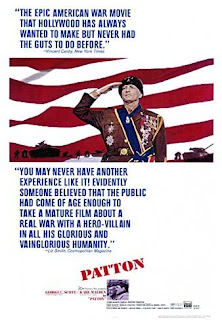
Best Picture Winners: Patton


Patton
(1970


Many people have complained about the Oscars becoming too political, but I don’t think that’s the reason for the current decline in interest in the ceremony. Other years have had far more political overtones. 

Take the 1978 Academy Awards, for example.

When Vanessa Redgrave was announced as the winner for Best Supporting Actress for her work in Julia, she used her moment on the platform to denounce the “the hoodlums” attacking the Palestinians. The audience responded with both applause and loud boos. Later in the ceremony, before presenting the Oscar for Best Adapted Screenplay, Paddy Chayefsky chastised Redgrave for her remarks and was loudly cheered.

Whatever view you take on this issue, you’ve got to admit this was great theater and greatly entertaining.

The problem with Oscars now is that the politics are so very monolithic and boring. Someone will get up and say, “Down with Trump” or “Racism is bad,” and everyone will cheer. Perhaps not everyone in the Academy has the same political views, but it appears that only one set of views may be freely expressed. 

In 1970, when Patton was released -- or when Patton won the Oscar in 1971 -- this wasn't the case. The Vietnam war was raging. Just as the nation was divided by the war, so was the Academy. Everyone knew that John Wayne and Jane Fonda had diametrically opposed views, but both had a place in the Academy and the Oscar ceremonies.


Francis Ford Coppola has said that when he was writing the screenplay for Patton, he knew that some in the audience would view the general as a hero and others as a jingoistic warmonger --so he included both Patton’s slapping a soldier for cowardice and his rescue of the soldiers of Bastogne. People who opposed the Vietnam war and those who supported it saw arguments for their case in the film. So they voted for it. And it won Best Picture because it's a film that is art rather than propaganda. It presents the complexity of this man, of war, and of life.

The film, fortunately for us here at Movie Churches, presents clergy but avoids simplicity in its presentation of the church.

One device used throughout the film is cutting to German military headquarters and listening in on German officers' comments about Patton. Field Marshall Erwin Rommel (Karl Michael Vogler) mentions that Patton (George C. Scott) “prays on his knees but curses like a stable boy.”


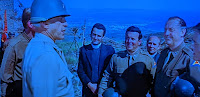
We are shown this contrast in Patton's personality when a group of clergymen meets with him. They are introduced as “men from the states here to look after the spiritual welfare of the men.” Patton greets them warmly. One of the chaplains says, “I was glad to see a Bible by your bed. Do you find time to read it?” Patton answers, “I sure do. Every G*d d**n day.”

Patton always seems to show great respect for the church and the clergy. When he entered the liberated city of Messina, Italy, he knelt before the Bishop of the city to receive his blessing. On the other hand, his theology wasn't strictly orthodox for a Christian. He also believed in reincarnation.

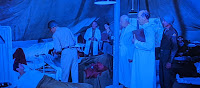
One of the most damaging moments in his career occurred shortly after Patton’s successful campaign in Sicily: the Slapping Incident. While visiting men in the infirmary, he encountered a man who claimed to be there because of shell shock. He had lost the nerve to fight. Patton reprimanded him for his cowardice and said his presence was an affront to the brave men in the tent who had been physically wounded in battle. He slapped the man and demanded he be removed from the tent.


This incident made headlines back in the States and caused great turmoil in political and military circles. Many demanded that Patton be booted out of service, or at least demoted. In the film, he rightly fears his career might be over. What bothers him most is that he won’t be able to fulfill what he feels is his divinely appointed destiny of glory in battle.

Patton goes to a church, kneels near the altar, and recites Psalm 63:

“O God, thou art my God; early will I seek thee:
my soul thirsteth for thee,
my flesh longeth for thee in a dry and thirsty land, where no water is;
to see thy power and thy glory,
so as I have seen thee in the sanctuary.
Because thy lovingkindness is better than life,
my lips shall praise thee.
Thus will I bless thee while I live:
I will lift up my hands in thy name.
My soul shall be satisfied as with marrow and fatness;
and my mouth shall praise thee with joyful lips:
when I remember thee upon my bed,
and meditate on thee in the night watches.
Because thou hast been my help,
therefore in the shadow of thy wings will I rejoice.
My soul followeth hard after thee:
thy right hand upholdeth me.
But those that seek my soul, to destroy it, shall go into the lower parts of the earth.
They shall fall by the sword:
they shall be a portion for foxes.
But the king shall rejoice in God;
every one that sweareth by him shall glory:
but the mouth of them that speak lies shall be stopped.”

He seems most fervent in the prayer for enemies to fall by the sword and be the portion of foxes, but he does ask for God’s will to be done.

Patton’s command is restored for what is arguably the most important battle of his career, the Seige of Bastogne. Part of the Battle of Bulge, this was the last great German offensive action of the war. In the Ardennes Woods of Belgium, a small contingent of American soldiers held out against the great Nazi war machine. On Christmas Day of 1944, the Nazi forces demanded that General Anthony McAuliffe surrender. His one-word reply was, “Nuts!” 

Patton said a man of such eloquence must be rescued.


But there were obstacles to that rescue, chief of which was brutal winter weather hindering adequate aerial coverage for an attack. Patton recognized the problem and said, “If we have 24 hours of decent weather, we might make it.” He was told the weather forecast was for more snow, and his advisor said they would have to wait. Patton said, “We’re going to keep moving.”

Nonetheless, Patton realized he needed help, so he called in the Third Army Chaplain (Lionel Murton).

“You wanted to see me, General?”

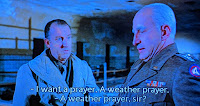
“Oh, yes, Chaplain. I’m sick and tired of the 3rd Army having to fight the Germans without the support of the Supreme Command, no gasoline, and now this ungodly weather. I want a prayer. A weather prayer.”

“A weather prayer, sir?”

“Yes, let’s see if you can’t get God working with us on this thing.”

“It’ll take a pretty thick rug for that kind of praying.”

“I don’t care if it takes a flying carpet.”

“Well, I don’t know how this is gonna be received, General. Praying for good weather so we can kill our fellow man.”

“Well, I can assure you, sir, because of my intimate relations with the Almighty… If you write a good prayer, we’ll have good weather. And I expect that prayer within an hour.”

“Yes, sir.”


The chaplain writes a prayer, and Patton prays it.

“Almighty and most merciful Father, we humbly beseech thee of thy great goodness to restrain this immoderate weather with which we’ve had to contend. Grant us fair weather for battle. Graciously harken unto us as soldiers who call upon thee that armed with thy power we may advance from victory to victory and crush the oppression and wickedness of our enemies and establish thy justice among men and nations. Amen.”

Director Franklin Schaffner allows us to hear the prayer over brutal scenes of battle as Patton’s forces savage the German troops. (It’s rather amazing that this film is rated PG. The PG-13 rating didn’t exist in 1970, but I would think today the realistic violence of the film could earn it an R rating.)

Patton doesn’t forget to whom he owes the conditions that allowed for the attack. He says, “Weather’s perfect. Cod, get me that Chaplain. He stands in good with the Lord, and I want him decorated.”

But after the victory in Europe, Patton is not sent to the ongoing war in the Pacific. Patton recognizes his day is done. He remembers that Roman conquerors would have a slave whisper in his ear, “All glory is fleeting.” I do wish we had seen the clergy in the film more strongly remind Patton that God’s glory was eternal. Still, we’re giving the clergy and the churches in the film a Three Steeple rating.

Thursday, November 18, 2021

European Heritage


A Hidden Life
(2019)


Franz Jägerstätter” is a name officials of the Third Riech hoped would be forgotten. He was an Austrian peasant farmer who lived in the small town of St. Radegund, and there was no obvious earthly reason why he should be remembered. 

Until Nazi officers did the very thing that would make his name remembered: they killed him.

One way Jägerstätter has been remembered is by Terrence Malick’s 2019 film, A Hidden Life. The film opens in 1939, and Jägerstätter (August Diehl) is working his farm along with his wife, Fani (Valerie Pachner). We also see Franz sweeping the floors of a church and ringing the church bells. We see him playing with his children. (We also see many shots of the lovely valley in which they live and the pretty blue sky and lovely white clouds. This is a Terrence Malick film -- which means many long, lovely views of pretty scenery.) Franz says in a voiceover, “I thought we could build our nest high up, in the tree. Fly away, like birds - to the mountains. It seemed no trouble could reach our valley. We lived in the clouds.”


But trouble does come. Franz is drafted to military training in the Austrian army (which is serving alongside the German military). When he comes back to his village after training and is greeted joyfully by his family, he knows he cannot go back to serve in the army. He tells his priest, Father Ferdinand Fürthauer (Tobias Moretti) about his mistrust in the Austrian government, “Father, if they call me up, I can’t serve. We’re killing innocent people, raiding other countries.”

The priest is not happy to hear this. He says, “Have you spoken to anyone else? Your wife, family? Don’t you think you should consider the consequences of your actions, for them? You will almost surely be shot. Your sacrifice will benefit no one. I will speak to the Bishop about your case. He is a wiser man than I.”


The Bishop (Michael Nyqvist in his final role) tells Franz, “You have a duty to the Fatherland. The church tells us so.” 

So Franz learns he will have no support from the church in his decision not to serve. So he continues to work his farm. Someone comes to his farm and says, ”We are collecting for the war effort.” 

He responds, “I don’t have anything to give.” 

His family refuses to accept Austria’s “family allowance,” and when someone passes him on a trail and says, “Heil Hitler!” Franz responds… Well, let’s keep this as a family blog and just say he has another suggestion for Hitler.


Franz is arrested and held by the German authorities.

And Franz’s wife and daughter are left to work the farm in St. Radegund, and Fani must also care for Franz’s mother, who blames Fani for “changing her son.” The people of the village look at the Jägerstätter family as traitors and refuse to support them.

Perhaps worst of all, the local Catholic church treats Fani and her daughters as pariahs. On Corpus Christi Sunday, as is the tradition of this village, a parade of children walk past; Franz and Fani’s children are not allowed to participate. Father Ferdinand apologizes but tells her it would just cause too many problems if they joined in.


Many other political prisoners are in prison with Franz. He cares for the other prisoners, sharing his food with them and sharing the love of Jesus. For many months visitors are forbidden, but eventually, Fani and Father Ferdinand are allowed to visit.

Franz’s lawyer has what he thinks is good news for his client. He says Franz doesn’t have to serve as a soldier, he could serve in the medical services. Surely that wouldn’t be against his conscience, the lawyer argues, but Franz asks if he will have to pledge his allegiance to the Fuhrer. The lawyer tells him that yes, he would.

Franz refuses to say those words.

The priest tells him, “The charges will be dropped, I’m sure, if you just change your stand. I beg you. The war will soon be over. We might never again have to face the situation of doing the opposite of what you’re called to do. You have time to change. God doesn’t care what you say with your mouth, only what is in your heart. Say the oath and think what you like.”

But Franz believes that the words he says matter.

Jesus seemed to be of the same opinion that words matter. He said, “Whoever acknowledges me before others, I will also acknowledge before my Father in Heaven. But whoever disowns me before others, I will disown before my Father in Heaven.


The priest urges Fani to speak sense to her husband, and she says, “I love you. Whatever you do. Whatever comes, I'm with you. Always. Do what is right.”

Franz wouldn’t relent. He was tried, sentenced (by a judge played by Bruno Ganz in what was also his last role), and executed. The German and Austrian authorities assumed he would be forgotten.

But Franz Jägerstätter was not forgotten. He was declared a martyr and beatified by the Roman Catholic Church. And, of course, Terrence Malick made this magnificent three-hour film about his life that screened at the Cannes Film Festival. His life did make a difference


As for our Movie Churches rating for the clergy and church in this film, I am tempted to give the lowest Steeple Rating. After all, Franz’s priest and the Catholic Church in Austria didn’t just stay silent about the evils of the Nazis, they supported them. But Franz’s priest was at his parishioner’s side until his death, and the Catholic Church did eventually recognize and honor this hidden life. Two steeples. 

Thursday, March 18, 2021

Carl Theo. Dreyer Month Continues: Day of Wrath


Day of Wrath (Vredens Dag)
1943


I find it interesting that so many popular depictions of the witch trials of centuries ago portray witches with supernatural powers. Quite recently the Marvel/Disney show Wandavision had a flashback to the Salem witch trials, but instead of innocent citizens dealing with charges of black magic, we saw a supernatural battle between powerful witches. Television shows like Bewitched, Buffy the Vampire Slayer, Charmed, and Sabrina the Teenage Witch and movies such as I Married a Witch, Bell, Book and Candle, Hocus Pocus, and The Lords of Salem all featured the Salem witch trials along with “real” witches.


Arthur Miller’s The Crucible is a surprisingly rare story where accusations of witchcraft are completely unfounded. For the most part, the same can be said of Carl Theodore Dreyer’s 1943 film, Day of Wrath. Rather than taking place in New England, this film is based on witch trials in 16th century Norway. Though the charges of witchcraft are assumed to be without basis, witches' curses in the film to tend to be carried out. 


Day of Wrath
was produced in very difficult, even dire, circumstances. After the completion of Vampyr in 1932, Dreyer was unsuccessful in raising funds for a film adaptation of Madame Butterfly, a work about Mary Stuart, or a documentary about Africa. Dreyer worked as a journalist and was unable to work as a filmmaker for over a decade. Day of Wrath was filmed in Denmark while the nation was under Nazi occupation, and some were concerned that the witchcraft theme in the film would be perceived as a critique of the Reich’s treatment of the Jews, but the film was completed and released. Dreyer took the opportunity of the film’s foreign distribution to travel to neutral Sweden, where he lived for the remainder of World War II.


The film is set in a small Danish village in 1623 where Rev. Absalon Pedersson (Thorkild Roose) lives with his young wife and his mother. The Reverend is old enough to be his wife’s father -- which becomes all the more apparent when his son returns to the village. His wife, Anne (Lisbeth Movin, who bears quite a resemblance to Elizabeth Montgomery of Bewitched fame) and his son, Martin (Preben Lerdorff Rye), are the same age and the attraction between the two is immediate. The attraction is noticed by the pastor’s mother, Merete (Sigrid Neiiendam), who already dislikes her daughter-in-law.

One night an old woman, Herlofs Marte (Anna Svierkier), comes to the parsonage, and Anne answers the door. The woman asks Anne to hide her, saying she is being pursued by some who wish to kill her. Anne hides her, and others from the village come to the door saying they are looking for a witch. They break in and find Herlofs and take her to the local church where she is imprisoned as a witch.


Rev. Pedersson is sent to talk to Herlofs Marte and seek her confession. Herlogs Marte is naked from the waist up, due to her recent torture by other church authorities. Pedersson asks Marte whether she has been dealing with the devil, “Did you sell your soul for eternity?”

The pastor tells her she must confess to the Lord to be saved. Marte looks with disdain at the pastor, “Stop your prattle! I fear neither heaven or hell! I fear only death. If I burn at the stake, so will Anne!” Marte says that Anne’s mother was accused of being a witch, and she knows that the pastor intervened so that he could marry Anne. She begs the pastor to save her as well.

The pastor claims to be only interested in saving Marte’s soul, “Have no fear, God is merciful! He will forgive you for your sin!”


But Marte, denounced by three worthy citizens who claim she cursed people who died, is sent to the stake to be burned to death. As she burns, Marte cries out that Anne is a witch. But the roar of the flames drowns out her accusation.

But the curses Marte made in life seem to continue to have power after her death. She cursed the Bishop who sentenced her to death. That bishop becomes ill, and Reverend Pedersson is at the man’s bedside as he dies.

Things grow worse for the Reverend. The attraction between his son and wife grows into an affair. He confronts his wife who admits to the affair, and she verbally attacks her husband, accusing him of stealing her life, even failing to provide her with a child. She tells him she had long wished him dead. And following her words, Absalon seems struck by a heart attack or stroke and dies on the spot.

Absalon’s mother accuses Anne of being a witch, so she too must go to trial. One assumes her fate is the same as Marte’s: torture and death at the stake. Anne won’t even deny that her curse caused her husband’s death.


The church in this film tortures women and burns them at the stake. That alone would likely lead to a poor Movie Churches Steeple rating for the clergy and church of Day of Wrath, but one other detail insures the lowest rating of One Steeple for the church. When Herlofs Marte is burned at the stake, a choir of young boys is brought to stand near the fire to sing a hymn (“Day of Wrath”) as the flames engulf the old woman. That has to be the worst Christian Education program we at Movie Churches have ever seen.

Friday, January 1, 2021

Brit Month Begins


One of Our Aircraft is Missing
(1942)


Happy New Year! 

I don’t believe we at Movie Churches have ever been so happy to say that, but there it is. Many of us are hoping we can do some things we weren't able to do last year, like going to the movies. And, like, well, traveling. So we're going to start this year off right by traveling to Merry Ol' England: films with British locations, actors, and filmmakers.

It's hard to name more acclaimed British filmmakers than the directing team of Michael Powell and Emeric Pressburger. There were other great British filmmakers, of course: Alfred Hitchcock, David Lean, and Carol Reed. But all of those filmmakers eventually made films with Hollywood. 

Not Powell and Pressburger. They made films for their English studio, The Archers, and never “went Hollywood.” 


The first film the two men directed together was One of Our Aircraft is Missing. It was made in midst of the Second World War, and it is, in many ways, a propaganda film. But it's a well-done propaganda film that tells the story of a Royal Air Force (RAF) bomber crew forced to abandon their plane in German-occupied Netherlands. They must somehow make their way home to Britain.

The crew --  Rear Gunner Sir George (Godfrey Tearle), Co-Pilot Tom (Eric Portman), Observer Frank (Hugh Williams), Gunner Geoff (Bernard Miles), Pilot John (Hugh Burden), and Radio Operator Bob (Emrys Jones) -- must depend on the Dutch for help, and (fortunately for this blog), some of that help is found in a church. The crew puts civilian clothes over their uniforms (risking being executed as spies), and one even dresses as a woman.

They go to a Catholic Church and are unable to join in the hymn singing, it being in Dutch and all. During the service, they whisper with some of the resistance fighters and learn that the Germans have discovered one of their parachutes. The Germans are looking for them. The priest preaches, but it was in Dutch as well, so I can’t comment on the accuracy of his exegesis. There is some Latin as well. (It’s not Greek to me, because I actually know a tiny bit of Greek.) 

After the sermon, German soldiers break into the service. The organist begins to play the national anthem of the Netherlands. The soldiers don’t recognize the British crewmen, so they leave, and the congregation then joins the organist singing the anthem.


The crew joins a family and their friends for dinner in a home after the service. The priest, standing by the table, says grace in Latin before people dig in, but a traitor, a Quisling, enters the room and recognizes the British crewmen. (The term “Quisling” comes from Vidkun Quisling the Norwegian military leader who collaborated with the Nazis and headed the government of Norway during WWII.)

The men block the traitor’s exit with guns, but he says they wouldn’t dare fire the guns and attract the attention of the Germans. Suddenly, they hear the Dutch national anthem coming from the German headquarters. It turns out that the Germans had asked the Quisling to send them phonograph records. He in turn had asked a boy to select the records to be sent, and the boy had put recordings of the National Anthem in the jackets of other records. Though the boy had made the switch, the traitor would be blamed by the Germans.  

The traitor is caught between the resistance and the soldiers. He turns to the priest, bowing to him and crying, “Father! Help me! Tell me what to do. [The Germans will] be after me if they don’t find me at home!”


The priest responds, “Evidently, you know your friends. You don’t think they’ll believe you if you tell them the truth, do you?”

The traitor answers, “They believe everyone in Holland wants to kill them. They will shoot first and ask questions afterward. You are a servant of God! You can’t let them kill me!”

The priest tells him, “You expect God to help you escape, but I think you were meant to fall into our hands.”

During a war, Christians -- and especially clergy members --  are always challenged whether their loyalty should be primarily to God or to country. This priest certainly sees no conflict between his ministry and working for the Resistance, but it does seem he could have urged the traitor to turn to God.


Oh, I should note that the Dutch priest is not played by an actor from the Netherlands. It was an early role for the quite English Peter Ustinov. He would go on to be a star in Britain and in the States, eventually winning two Oscars for Best Supporting Actor. But his priest in this movie earns the Movie Church honor of Three out of Four Steeples.

Thursday, November 12, 2020

Roberto Rossellini Month: Paisan


Paisan
(1946)


Roberto Rossellini’s second film, Paisan, was (like Rome, Open City) set in World War II Italy and filmed shortly after the war ended. By necessity, the director used the same neorealistic technique as in the first film, but used it quite effectively. The battered landscape and ruins of buildings are the genuine article, not a set created on a soundstage. 

Paisan is an anthology film about the campaign of the Allied forces through Italy. As in the previous film, most of the actors aren't professionals, but people rather like the characters they play in the movie, including some American soldiers.

The story unfolds in six sections, with documentary footage between each section, and fully a third of the stories suit our purposes here at Movie Churches. 

The first episode takes place during the Allied invasion of Sicily. The Germans had been in control of the island, but as they battle the Allies, a large group of civilians -- primarily women, children, and the elderly -- gather in a Roman Catholic Church for safety. A group of soldiers approaches the church, but those inside are unsure which side the soldiers are on. 

A man from the church calls out in German, but the soldiers are Allied soldiers, English speakers, Americans. The citizens don’t trust the soldiers, the soldiers don’t trust the citizens, but they find common ground in the church.

Admittedly there wasn’t a lot to write about in regard to the church in that portion of the film, except that it was the place where people in the town met, which is slightly interesting. There is much more to write about in the fifth episode of the film.

Episode 5 is set in a 500-year-old monastery, where monks have endured as battle has raged outside their walls. And they are not alone; they have chickens. (My wife is much more inclined to like a film if the film has chickens.) They actually have a variety of animals -- sheep and goats, and a cow that villagers entrusted to the monks so the creatures would stay out of the hands of the Nazis while the war continued. 

As the war has moved beyond the community, the people return to collect their animals, and the monks give them gladly. Together they kneel and pray, “Brothers, let us thank our Lord who delivered us from danger.”


Soon, three men in army uniforms arrive at the monastery. Captain Bill Martin (William Tubbs) introduces himself and the two other captains, "We are American chaplains." The other two, Jones (Newell Jones) and Feldman (Elmer Feldman) new visitors arrive at the monastery, three men in army uniforms. “We are American chaplains,” said Captain Bill Martin (William Tubbs), introducing the two other captains, Jones (Newell Jones) and Feldman (Elmer Feldman). (Captains Martin and Jones have crosses on their helmets, Captain Feldman does not.) 

The monks greet them and say, “Our doors are open to all!”

The monks refuse the cigarettes the chaplains offer, but accept some Hershey bars. In return, the monks offer the chaplains liqueur made from their homegrown apples, accepted by Captains Martin and Feldman, but refused by Captain Jones (“I never touch the stuff.”)

The monks invite the chaplains to dinner, realizing they have only meager supplies left for the meal, but the chaplains chip in with some canned foods. The monks marvel at the canned milk. The villagers again offer the monks their animals for use (chicken dinner.)

The monks soon learn distressing news: Captain Martin is the only Catholic among the chaplains. Jones is Lutheran and Feldman is Jewish. This worries them greatly. “Merciful Saint Francis!” one of the monks exclaims. 

When one of the monks learns the denomination of Jones he frets, “The heresy of Luther is the worst of all Protestants!”

The Father Superior is quite concerned about these “two lost souls” but also says, “No soul is lost while it still has life and a will to be saved. There are always opportunities for redemption. We can do something for these brothers.” He finds a time to talk with Chaplain Martin alone.

“May I ask you a question, Father?” The monk says to the chaplain, “Have you lived long with these two other priests (sic)?”

“We’ve been together the entire Italian campaign, twenty, no twenty-one months,” Martin responds, “They’re good and dear friends, I admire them very much.”

“Have you ever tried to lead them to the true religion?”

“But Father, the Protestant and the Jew are just as convinced they are on the true path.”

“But we know they are in error. We must try by every means possible to save those two souls that could be lost.”

“I am a Catholic, Father, and a priest and I humbly believe I am a good Catholic,” Martin says.

“Forgive me, Father, I didn’t mean to remind you of your duties,” the Father Superior replies. “I just meant you are military chaplains. Your duties expose yourselves to the same risks and dangers as soldiers. Have you thought your two companions might perish any day?”

“I never felt I could judge them,” Martin says. “I know them well, they are good friends. I don’t feel guilty, my conscience is clear.”

The monk does not seem persuaded.

When the chaplains arrive for dinner, they are told to keep silent through the meal without exception.

But one of the monks speaks during the dinner, first reciting the names of their fellow monks who have gone on to “a better life,” including those that died during the war.

The chaplains are shocked that they are served the meal, but the monks are not. The Father Superior explains, “We’re fasting because providence has sent two brothers on which the light of the Gospel’s light must descend. Our hope is that with this humble sacrifice we might receive a heavenly reward.”

Chaplain Martin can’t keep quiet, “Forgive me if I don’t follow your rule but I wish to speak. I must tell you you have given me such a great gift that I feel forever in your debt. Here I’ve found that peace of mind that I’d lost amid the horrors and misfortunes of war. A beautiful and moving witness in humility, simplicity, and pure faith.”

As a Protestant, I don’t agree with the Father Superior that it means I'm lost. But I agree with the Catholic chaplain that the monks acting on their beliefs is admirable. What he said reminded me of something the magician and atheist Penn Jillette said once about a man who shared his Christian faith with him, “He was kind, and nice, and sane, and looked me in the eyes, and talked to me, and then gave me a Bible. I’ve always said I don’t respect people who don’t proselytize. I don’t respect that at all. If you believe there is a heaven and hell, and people could be going to hell or not getting eternal life or whatever, and you think it’s not really worth telling them because it would make it socially awkward.”


I agree with Penn about the admirable concern about the souls of others, and that is why we’re awarding the monks of the monastery in Paisan our highest Movie Churches rating of Four Steeples.


Thursday, November 14, 2019

Veterans' Month Week 3: Unbroken: Path to Redemption

Unbroken: Path to Redemption (2018)
Unbroken: Path to Redemption had an interesting path to become a sequel. In Hollywood, a sequel is usually made because of money. If the original makes a whole lot of money, the studio says do it again, especially if it features a superhero or action hero, but 2014’s Unbroken was a biographical film about World War II hero Louie Zamperini based on the bestselling book by Lauren Hillenbrand.

The 2014 film, directed by Angelina Jolie from a screenplay written by Joel and Ethan Coen, told the story of Zamperini, an Olympic runner who was captured by the Japanese during World War II. He served in a prisoner of war camp and was tortured by a sadistic guard known as The Bird. He survived and was released from the camp at the end of the war, “unbroken.”

If you’ve read the book, you know that isn’t true. Zamperini was a very broken man. That's where the film ends though, at the end of the war.

The first film was made with a 65 million dollar budget and grossed about a hundred million more. Certainly, that's a respectable profit, but usually, that wouldn’t be enough to lead to a sequel.

The sequel was made was because the first film left out what many would consider the most important part of Zamperini’s story: his coming to faith in Jesus. Universal was a producer of both films, but the original was released by Legendary Studios while the sequel was released by Pure Flix. Pretty much an entirely different cast and crew were brought in for the sequel. Harold Cronk directed a screenplay by Richard Fiedenburg and Ken Hixson. Jack O’Connell played Zamperini in the first film, Samuel Hunt played him in the second film. About the only name the two films have in common is Laura Hillenbrand.

Path to Redemption opens with Zamperini visiting Tokyo in 1950. Someone tries to give him directions and he remarks that this is “not my first time in Tokyo.” It's where he served as a prisoner of war. We go back in time to the end of WWII and Zamperini’s release from captivity.

We see him being welcomed joyfully home, where his parents had been told by the government he was dead. The local priest is asked to join the homecoming. Louie greets him as “Padre.” The priest tells him, “All of Torrance was praying for you. God’s not to blame for your suffering.” 

Louie doesn’t seem to be buying it. Later in the film, he admits he felt that not only was God to blame for his suffering, God was his enemy.

The Army recruits Zamperini to go on tour to sell war bonds. Initially, this goes well, as he tells about encouraging other POWs with stories about his mother’s fine cooking. But as the tour goes on, Lou begins to drink more and more heavily, sometimes before speeches. His C.O. demands he take a break from the tour, going for several weeks of R. & R. in Florida. At the beach, he meets the woman who soon became his wife, Cynthia Applewhite (Merritt Patterson).

Cynthia asks Louie whether he prayed during his wartime experiences. “Begging (was) more like it,” he answers. She asks him about his faith and he answers, “I didn’t pay much attention in Mass.” But after they visit the church she grew up in, he agrees to a church wedding. The couple then returns to Louie’s hometown of Torrance to live.

Though they get by for some time on funds the government provided for back pay and insurance for Louie’s time in the camp, funds soon get tight. Louie can’t find work. Or at least, he can’t find a job he thinks is befitting his history as an Olympian and a war hero. So again he drinks. Heavily. Days he claims to be looking for work he’s actually spending in bars.

He also has night terrors, making him fear that he’ll harm Cynthia. He goes to see a government-provided psychiatrist, Dr. George Bailey (played by Gary Cole rather than Jimmy Stewart.) Though the doctor doesn’t use the term “PTSD,” it’s clear that's the problem. And Louie is trying to address it through alcohol.

Cynthia has a child, but that doesn’t make the marriage better. Cynthia begins to consider divorce, but a neighbor, Lili (Vanessa Bell Calloway), encourages Cynthia to “fight for him.” Lila also takes Cynthia to a revival meeting -- the Greater Los Angeles Revival -- Billy Graham Every Night, 7 PM -- which, in 1949, was scheduled to run for three weeks but continued for eight.

Louie tells Cynthia he won’t consider going with her. He describes the revivals of his youth as frauds,  saying, “Hide your wallet, the circus is in town.” While she goes to the revival, Louie drinks at home from a bottle in a hollowed-out Bible.

Eventually, Louie does go to the revival, drinking from a flask on the way. A tent on the fairgrounds is decorated with a large cross with a sign on it “Jesus Saves.” A choir sings “Onward Christian Soldiers.”

Billy Graham (played by the evangelist's grandson, Will Graham) is at the pulpit. At the beginning of his message, he jokes at the beginning of his message, “I will keep the message brief, but I always say that, so don’t get your hopes up.” He goes on to say, “God has a lifeline. I do not believe that any man can solve the problems of life without Jesus Christ. Have you trusted Christ Jesus as savior? Tonight, I’m glad to tell you that the Lord Jesus can be received, your sins forgiven, your burdens lifted, your problems solved, by turning your life over to Him and repenting of your sin and turning to Jesus Christ as savior.”

Louie goes again. Billy preaches, “Why doesn’t God stop suffering? I can see the stars and I can see the footprints of God. What God asks of man is faith. I believe God is still transforming lives.” Lou starts to leave, but Billy says “Don’t leave, you can leave while I’m preaching, but not now. This is it, God has spoken to you. It is time. Come forward.”

Louie flashes back and remembers the time his plane went down and he was stranded on a raft at sea. He begged God, “If you save me, I will serve you all my life.” He was saved. By Japanese who imprisoned him, but he was saved.

At the crusade, years later, he kept that promise. When he trusted in Christ, God changed his life around.

A final title card reads: “Nearly forty years after WWII, more than 85% of former Pacific POW’s suffered from post-traumatic stress disorder. Every man had to find his own path; Louis Zamperini found profound peace. After his conversion, Louis never drank again. He began a new life as a Christian speaker, telling his story all over America, from grade school classrooms to stadiums. In 1952, Louis established Victory Boys Camp to help at-risk youth, which the Zamperini family continues today. Matsuhiro Watanabe “The Bird” was one of the most wanted WWII criminals in Japan. He remained in hiding for several years until he was granted amnesty by the U. S. in its efforts to reconcile with Japan. Louis and Cynthia were married for 54 years.”

Zamperini was a great man. As was Graham, the clergy member in this film. He earns our highest Movie Churches rating of Four Steeples.