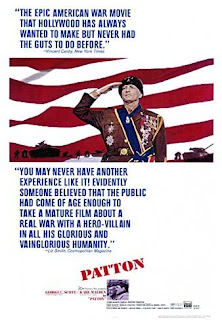
Patton (1970
Many people have complained about the Oscars becoming too political, but I don’t think that’s the reason for the current decline in interest in the ceremony. Other years have had far more political overtones.
Take the 1978 Academy Awards, for example.
When Vanessa Redgrave was announced as the winner for Best Supporting Actress for her work in Julia, she used her moment on the platform to denounce the “the hoodlums” attacking the Palestinians. The audience responded with both applause and loud boos. Later in the ceremony, before presenting the Oscar for Best Adapted Screenplay, Paddy Chayefsky chastised Redgrave for her remarks and was loudly cheered.
Whatever view you take on this issue, you’ve got to admit this was great theater and greatly entertaining.
The problem with Oscars now is that the politics are so very monolithic and boring. Someone will get up and say, “Down with Trump” or “Racism is bad,” and everyone will cheer. Perhaps not everyone in the Academy has the same political views, but it appears that only one set of views may be freely expressed.
In 1970, when Patton was released -- or when Patton won the Oscar in 1971 -- this wasn't the case. The Vietnam war was raging. Just as the nation was divided by the war, so was the Academy. Everyone knew that John Wayne and Jane Fonda had diametrically opposed views, but both had a place in the Academy and the Oscar ceremonies.
Francis Ford Coppola has said that when he was writing the screenplay for Patton, he knew that some in the audience would view the general as a hero and others as a jingoistic warmonger --so he included both Patton’s slapping a soldier for cowardice and his rescue of the soldiers of Bastogne. People who opposed the Vietnam war and those who supported it saw arguments for their case in the film. So they voted for it. And it won Best Picture because it's a film that is art rather than propaganda. It presents the complexity of this man, of war, and of life.
The film, fortunately for us here at Movie Churches, presents clergy but avoids simplicity in its presentation of the church.
One device used throughout the film is cutting to German military headquarters and listening in on German officers' comments about Patton. Field Marshall Erwin Rommel (Karl Michael Vogler) mentions that Patton (George C. Scott) “prays on his knees but curses like a stable boy.”
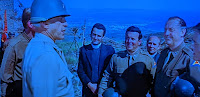
We are shown this contrast in Patton's personality when a group of clergymen meets with him. They are introduced as “men from the states here to look after the spiritual welfare of the men.” Patton greets them warmly. One of the chaplains says, “I was glad to see a Bible by your bed. Do you find time to read it?” Patton answers, “I sure do. Every G*d d**n day.”
Patton always seems to show great respect for the church and the clergy. When he entered the liberated city of Messina, Italy, he knelt before the Bishop of the city to receive his blessing. On the other hand, his theology wasn't strictly orthodox for a Christian. He also believed in reincarnation.
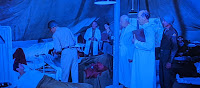
One of the most damaging moments in his career occurred shortly after Patton’s successful campaign in Sicily: the Slapping Incident. While visiting men in the infirmary, he encountered a man who claimed to be there because of shell shock. He had lost the nerve to fight. Patton reprimanded him for his cowardice and said his presence was an affront to the brave men in the tent who had been physically wounded in battle. He slapped the man and demanded he be removed from the tent.

This incident made headlines back in the States and caused great turmoil in political and military circles. Many demanded that Patton be booted out of service, or at least demoted. In the film, he rightly fears his career might be over. What bothers him most is that he won’t be able to fulfill what he feels is his divinely appointed destiny of glory in battle.
Patton goes to a church, kneels near the altar, and recites Psalm 63:
“O God, thou art my God; early will I seek thee:
my soul thirsteth for thee,
my flesh longeth for thee in a dry and thirsty land, where no water is;
to see thy power and thy glory,
so as I have seen thee in the sanctuary.
Because thy lovingkindness is better than life,
my lips shall praise thee.
Thus will I bless thee while I live:
I will lift up my hands in thy name.
My soul shall be satisfied as with marrow and fatness;
and my mouth shall praise thee with joyful lips:
when I remember thee upon my bed,
and meditate on thee in the night watches.
Because thou hast been my help,
therefore in the shadow of thy wings will I rejoice.
My soul followeth hard after thee:
thy right hand upholdeth me.
But those that seek my soul, to destroy it, shall go into the lower parts of the earth.
They shall fall by the sword:
they shall be a portion for foxes.
But the king shall rejoice in God;
every one that sweareth by him shall glory:
but the mouth of them that speak lies shall be stopped.”
When Vanessa Redgrave was announced as the winner for Best Supporting Actress for her work in Julia, she used her moment on the platform to denounce the “the hoodlums” attacking the Palestinians. The audience responded with both applause and loud boos. Later in the ceremony, before presenting the Oscar for Best Adapted Screenplay, Paddy Chayefsky chastised Redgrave for her remarks and was loudly cheered.
Whatever view you take on this issue, you’ve got to admit this was great theater and greatly entertaining.
The problem with Oscars now is that the politics are so very monolithic and boring. Someone will get up and say, “Down with Trump” or “Racism is bad,” and everyone will cheer. Perhaps not everyone in the Academy has the same political views, but it appears that only one set of views may be freely expressed.
In 1970, when Patton was released -- or when Patton won the Oscar in 1971 -- this wasn't the case. The Vietnam war was raging. Just as the nation was divided by the war, so was the Academy. Everyone knew that John Wayne and Jane Fonda had diametrically opposed views, but both had a place in the Academy and the Oscar ceremonies.
Francis Ford Coppola has said that when he was writing the screenplay for Patton, he knew that some in the audience would view the general as a hero and others as a jingoistic warmonger --so he included both Patton’s slapping a soldier for cowardice and his rescue of the soldiers of Bastogne. People who opposed the Vietnam war and those who supported it saw arguments for their case in the film. So they voted for it. And it won Best Picture because it's a film that is art rather than propaganda. It presents the complexity of this man, of war, and of life.
The film, fortunately for us here at Movie Churches, presents clergy but avoids simplicity in its presentation of the church.
One device used throughout the film is cutting to German military headquarters and listening in on German officers' comments about Patton. Field Marshall Erwin Rommel (Karl Michael Vogler) mentions that Patton (George C. Scott) “prays on his knees but curses like a stable boy.”
We are shown this contrast in Patton's personality when a group of clergymen meets with him. They are introduced as “men from the states here to look after the spiritual welfare of the men.” Patton greets them warmly. One of the chaplains says, “I was glad to see a Bible by your bed. Do you find time to read it?” Patton answers, “I sure do. Every G*d d**n day.”
Patton always seems to show great respect for the church and the clergy. When he entered the liberated city of Messina, Italy, he knelt before the Bishop of the city to receive his blessing. On the other hand, his theology wasn't strictly orthodox for a Christian. He also believed in reincarnation.
One of the most damaging moments in his career occurred shortly after Patton’s successful campaign in Sicily: the Slapping Incident. While visiting men in the infirmary, he encountered a man who claimed to be there because of shell shock. He had lost the nerve to fight. Patton reprimanded him for his cowardice and said his presence was an affront to the brave men in the tent who had been physically wounded in battle. He slapped the man and demanded he be removed from the tent.
This incident made headlines back in the States and caused great turmoil in political and military circles. Many demanded that Patton be booted out of service, or at least demoted. In the film, he rightly fears his career might be over. What bothers him most is that he won’t be able to fulfill what he feels is his divinely appointed destiny of glory in battle.
Patton goes to a church, kneels near the altar, and recites Psalm 63:
“O God, thou art my God; early will I seek thee:
my soul thirsteth for thee,
my flesh longeth for thee in a dry and thirsty land, where no water is;
to see thy power and thy glory,
so as I have seen thee in the sanctuary.
Because thy lovingkindness is better than life,
my lips shall praise thee.
Thus will I bless thee while I live:
I will lift up my hands in thy name.
My soul shall be satisfied as with marrow and fatness;
and my mouth shall praise thee with joyful lips:
when I remember thee upon my bed,
and meditate on thee in the night watches.
Because thou hast been my help,
therefore in the shadow of thy wings will I rejoice.
My soul followeth hard after thee:
thy right hand upholdeth me.
But those that seek my soul, to destroy it, shall go into the lower parts of the earth.
They shall fall by the sword:
they shall be a portion for foxes.
But the king shall rejoice in God;
every one that sweareth by him shall glory:
but the mouth of them that speak lies shall be stopped.”
He seems most fervent in the prayer for enemies to fall by the sword and be the portion of foxes, but he does ask for God’s will to be done.
Patton’s command is restored for what is arguably the most important battle of his career, the Seige of Bastogne. Part of the Battle of Bulge, this was the last great German offensive action of the war. In the Ardennes Woods of Belgium, a small contingent of American soldiers held out against the great Nazi war machine. On Christmas Day of 1944, the Nazi forces demanded that General Anthony McAuliffe surrender. His one-word reply was, “Nuts!”
Patton said a man of such eloquence must be rescued.
But there were obstacles to that rescue, chief of which was brutal winter weather hindering adequate aerial coverage for an attack. Patton recognized the problem and said, “If we have 24 hours of decent weather, we might make it.” He was told the weather forecast was for more snow, and his advisor said they would have to wait. Patton said, “We’re going to keep moving.”
Nonetheless, Patton realized he needed help, so he called in the Third Army Chaplain (Lionel Murton).
“You wanted to see me, General?”
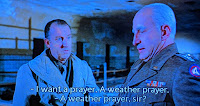
“Oh, yes, Chaplain. I’m sick and tired of the 3rd Army having to fight the Germans without the support of the Supreme Command, no gasoline, and now this ungodly weather. I want a prayer. A weather prayer.”
“A weather prayer, sir?”
“Yes, let’s see if you can’t get God working with us on this thing.”
“It’ll take a pretty thick rug for that kind of praying.”
“I don’t care if it takes a flying carpet.”
“Well, I don’t know how this is gonna be received, General. Praying for good weather so we can kill our fellow man.”
“Well, I can assure you, sir, because of my intimate relations with the Almighty… If you write a good prayer, we’ll have good weather. And I expect that prayer within an hour.”
“Yes, sir.”
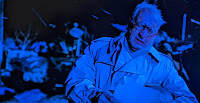
The chaplain writes a prayer, and Patton prays it.
“Almighty and most merciful Father, we humbly beseech thee of thy great goodness to restrain this immoderate weather with which we’ve had to contend. Grant us fair weather for battle. Graciously harken unto us as soldiers who call upon thee that armed with thy power we may advance from victory to victory and crush the oppression and wickedness of our enemies and establish thy justice among men and nations. Amen.”
Director Franklin Schaffner allows us to hear the prayer over brutal scenes of battle as Patton’s forces savage the German troops. (It’s rather amazing that this film is rated PG. The PG-13 rating didn’t exist in 1970, but I would think today the realistic violence of the film could earn it an R rating.)
Patton doesn’t forget to whom he owes the conditions that allowed for the attack. He says, “Weather’s perfect. Cod, get me that Chaplain. He stands in good with the Lord, and I want him decorated.”
 But after the victory in Europe, Patton is not sent to the ongoing war in the Pacific. Patton recognizes his day is done. He remembers that Roman conquerors would have a slave whisper in his ear, “All glory is fleeting.” I do wish we had seen the clergy in the film more strongly remind Patton that God’s glory was eternal. Still, we’re giving the clergy and the churches in the film a Three Steeple rating.
But there were obstacles to that rescue, chief of which was brutal winter weather hindering adequate aerial coverage for an attack. Patton recognized the problem and said, “If we have 24 hours of decent weather, we might make it.” He was told the weather forecast was for more snow, and his advisor said they would have to wait. Patton said, “We’re going to keep moving.”
Nonetheless, Patton realized he needed help, so he called in the Third Army Chaplain (Lionel Murton).
“You wanted to see me, General?”
“Oh, yes, Chaplain. I’m sick and tired of the 3rd Army having to fight the Germans without the support of the Supreme Command, no gasoline, and now this ungodly weather. I want a prayer. A weather prayer.”
“A weather prayer, sir?”
“Yes, let’s see if you can’t get God working with us on this thing.”
“It’ll take a pretty thick rug for that kind of praying.”
“I don’t care if it takes a flying carpet.”
“Well, I don’t know how this is gonna be received, General. Praying for good weather so we can kill our fellow man.”
“Well, I can assure you, sir, because of my intimate relations with the Almighty… If you write a good prayer, we’ll have good weather. And I expect that prayer within an hour.”
“Yes, sir.”
The chaplain writes a prayer, and Patton prays it.
“Almighty and most merciful Father, we humbly beseech thee of thy great goodness to restrain this immoderate weather with which we’ve had to contend. Grant us fair weather for battle. Graciously harken unto us as soldiers who call upon thee that armed with thy power we may advance from victory to victory and crush the oppression and wickedness of our enemies and establish thy justice among men and nations. Amen.”
Director Franklin Schaffner allows us to hear the prayer over brutal scenes of battle as Patton’s forces savage the German troops. (It’s rather amazing that this film is rated PG. The PG-13 rating didn’t exist in 1970, but I would think today the realistic violence of the film could earn it an R rating.)
Patton doesn’t forget to whom he owes the conditions that allowed for the attack. He says, “Weather’s perfect. Cod, get me that Chaplain. He stands in good with the Lord, and I want him decorated.”


