Showing posts with label priest. Show all posts

Thursday, November 24, 2022

The Final Films (bought for the blog)


The Ministers
(2009)
and Act of Contrition (The Redeemed) (2019)

I wonder how many other people in the world have seen both films I watched for this week’s Movie Churches. I don’t think there are a great many people in the world who have heard of both of this week’s films -- or either of this week’s films. They're not on most of the streaming services, but you can look them up on IMDb. As you can see by the photograph, they do exist in DVD form. In fact, I purchased them for this blog.

During Movie Churches' seven-year life, we've looked at a mix of obscure films and classics, very popular contemporary films and widely ignored modern movies. We’ve featured The Godfather and Sound of Music, as well as Oscar winners like Spotlight while they were still in the theaters. Sometimes we’ve featured wonderful (and awful) foreign films that were well known in their homelands, but not so well known here in the U.S. Some films we've talked about caused a stir back in their day, but are now widely forgotten.

The whole point of this blog has been to bring those in the church to consider how they are portrayed in the world and to bring some filmgoers to consider the accuracy of the portrayals of the church and clergy in what they viewed. But what about films that have, it seems, no cultural impact whatsoever?

On the other hand, a great number of people devoted time, energy, talent, and funds to bring these pictures about, and it does seem the filmmakers were trying to say something about issues of faith, so more power to ‘em, I guess.
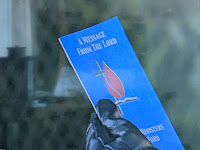

2009’s The Ministers is about twin brothers (played by John Leguizamo) who want to avenge their father’s death. He was murdered by corrupt cops (among them Harvey Keitel). The brothers commit a number of other jobs, often of the vigilante variety, leaving behind religious tracts that their late father had used. Their father, a minister who cared for his community, would almost certainly have been displeased by his sons' actions.

The Ministers pray for forgiveness before they go out to do their killings, but I don’t think that’s how it’s supposed to work -- the Lord’s Prayer doesn’t say, “Forgive our upcoming transgressions.” They also quote Scripture, even at the scene of the crime, which in my book makes what they do worse rather than better.

2019’s Act of Contrition (aka The Redeemed) stars Joe Estevez as a gangster who tries, on the last day of his life, to return to his estranged family. There are abundant voiceovers and flashbacks in the film but I’ll admit I had great difficulty following the plot. (Usually, when I have trouble discerning a plot point, I go to Wikipedia’s film summary, but The Ministers had a two-sentence plot summary and Act of Contrition was not to be found.)

Father Victor (Gregory Patrick Agnew), a priest, lies to the authorities to cover for his family. He also has a history of drinking problems and yet pulls out a bottle when visiting a member of the family in the hospital (“for old time’s sake”). Another priest, Father Boyle (Matt McCoy) says about him, “He is a spiritually charged, renegade priest.” But he seems like a poor representative of his faith to me.


So what do we have for Steeple Ratings for these two films? The pastor we see briefly in flashbacks in The Ministers seems decent enough, so we’ll give him three steeples. (His parenting skills -- raising murderers who expect preemptive forgiveness -- brings him down a bit.) Father Victor in Act of Contrition earns a meager two steeples.

This is the last weekly review for Movie Churches, but next week we’ll start a month of review starting with the worst films in our seven-year history.

Thursday, June 24, 2021

Mission Month Comes to an End with The Left Hand of God


The Left Hand of God
(1955)

Movie Churches is of the opinion that Humphrey Bogart is the greatest movie star of all time. (We usually confine ourselves to opinions about clergy in films, but this is such an obvious truth, it barely merits discussion.) Still, he has a serious flaw. Unlike, say, Robert Duvall (arguably one of the greatest film actors, which is different from a movie star) who appeared in many church-related films, Bogie never played a clergyman.

He came closest in 1955’s The Left Hand of God (directed by Edward Dmytryk), where his character pretends to be a priest. The film is set in a remote region of China, and it opens with Bogie -- in clerical garb -- arriving at a mission awaiting a priest. Bogie claims to be that priest, “Father O’Shea.” Dr. David Sigmund (E.G. Marshall) runs the mission hospital. He and his wife, Beryl (Agnes Moorehead) are assisted by nurse Anne "Scotty" Scott (Gene Tierney). 

The first sign that Father O'Shea is not who he claims is the gun among his belongings (if you don’t count the sign that he’s played by Humphrey Bogart.) The morning after he arrives, the “priest” is awakened by altar boy John Wong (played by Victor Sen Yung, one of the few major Chinese roles in the film played by someone of actual Chinese descent.) Bogie is obviously startled when John says, “Good morning, Father, you say Mass?” 

The new priest looks at the crucifix above his bed and seems to remember where he is and who he’s supposed to be.


John explains that he has been carrying on the work of the church as best he could, but a priest is needed for many duties. When Bogie asks what needs to be done, John says, “42 marriage. Many months since priest came. 36 baptisms. Should be more, but maybe more come now that you are here… Many people want confessing.”

Before doing any of these things, the “priest” says, “I would like to take a look around the village.” Scotty the nurse takes him on a tour, and he makes an un-priestly remark about going on a walk with an “attractive woman” (a comment that could easily get a man in trouble these days, not just priests). Scotty is taken aback by the remark, but he explains, “I wasn’t born a priest, In fact, I can remember when I was voted loudest dresser in college.”

The villagers seem so surprised by a priest walking around the town that we wondered if the previous priest ever left the Mission. One of the villagers asks "Father O'Shea" to bless his sick grandfather, and Bogie blesses the old man, making the sign of the Cross as he does so. He then asks the old man to give him a blessing -- to the pleasure and astonishment of all around.

As the ersatz priest continues to be pressured to give Mass, he goes to the mission library to find a “Selected Sermons” book from which to crib. He pretty much just reads from First Peter for his sermon (which is not a bad idea), then he amazes the congregation by addressing them in what seems to be the local Chinese dialect.  

Though most in the community are impressed by the new priest's work, Dr. Sigmund is not (though he does admit, “Father Coleman didn’t accomplish as much as you have in this short time.”). The doctor claims  “there is no earthly reason to keep it open.” 

Bogart responds, “Not earthly ones, but spiritual.” 

The doctor says with the threats of local warlords and the communists there is too much danger to continue the work. He asks “O’Shea” to talk to the Bishop about closing the Mission. 


Bogie responds testily, “The Bishop and I aren’t exactly buddies. You aren’t talking to your ... patients.” 

This angers the doctor and he says, “Don’t depend too much on that collar!” 

Bogie seems ready to rumble, asking, “Do you want me to take it off?”

Fortunately for the priest's reputation and the doctor's health, his wife Beryl intervenes and calms them.

Things become even more awkward at the mission when it becomes obvious that Scotty is falling for the man she thinks is a priest, and he doesn’t know how to deal with it. Beryl advises him to go to talk to the local Protestant missionary, Rev. Marvin (Robert Burton). He does and admits his true identity. 

His real name is Jim Carmody, and he had been an American pilot during World War II. When his plane crashed, a local warlord, Mieh Yang (played quite unconvincingly by Lee J. Cobb), rescued him and then put him to work in Yang's criminal activities. When one of Yang’s men killed a priest (the real Father O’Shea), Carmody decided to escape by taking O’Shea’s identity. Marvin marvels at the story but urges Carmody to come clean to the officials in the Catholic Church.


Things take a dark turn when one of Yang’s men discovers that Carmody is impersonating O’Shea. Carmody's betrayal angers the criminal, and he threatens not just the pilot, but also the mission and the village. When his gang surrounds the Mission, the doctor feels they have no choice but to fight back. But the “priest” has another idea. He will talk to Yang.

When Carmody had worked for Yang, they had often shot craps together. Carmody convinces Yang to let Carmody bet his freedom for the lives of those in the Mission and the village. And Carmody wins with a series of unlikely throws of the dice.

Then he goes back to the Mission and confesses his story to the doctor, the Catholic superiors, and eventually Scotty. But not to the villagers. Two new priests come to the Mission to take Father O’Shea’s place, and Carmody leaves after receiving a great outpouring of love and affection from the villagers for “Father O’Shea.”

So who should we give Movie Churches’ Steeple ratings? We probably shouldn’t give it to Jim Carmody since he wasn’t really a priest. (Though he does say, “Maybe there’s a little bit of a priest in every man.”) It doesn’t sound like the priests that preceded him were any great shakes since a gangster does a better job at priesting than they did, and we don’t learn enough about the new priests to give them a rating. But the Protestant missionary, Reverend Marvin, is a good listener for Carmody’s story and gives good advice, so we’re giving him Four Steeples, our highest rating.

Friday, May 14, 2021

Crime Month Reminds us: YOLO


You Only Live Once
(1937)


“Father Dolan is for everybody!” 

It’s hard to find a more ringing clergy endorsement than the words of Eddie Taylor (Henry Fonda) in praise of the prison priest in 1937’s You Only Live Once. The film is the second American film made by the great Austrian/German director Fritz Lang, who had already made great films in Germany like Metropolis and M

Though baptized a Catholic as a baby, Lang had Jewish heritage and he worried about the rise of the Nazis. This fear intensified when the regime began to censor his films, so he left Germany for the United States in 1933. It is interesting that Lang’s first two American films are quite critical of the American justice system, almost as if he was testing whether he would be able to practice the freedom of expression that was becoming impossible in his homeland. After making Fury, he made this film, the story of an ex-con who falls in love and marries his public defender’s secretary (echoed in the Coen brothers’ Raising Arizona where an ex-con marries a prison guard.)

But that ex-con, Eddie Taylor (Henry Fonda), can’t keep a job. The man that hires him out of prison uses the first possible excuse to fire the “jailbird;” Eddie is frustrated that he must rely on the income of his wife, Joan (Sylvia Sidney). He is tempted to return to a life of crime, and his former gang offers him a job. He resists the temptation, but when his former gang's heist goes wrong and six men are murdered, the gang frames Eddie for the killings.

Eddie is convicted of the murders and sentenced to death by electrocution, bringing him back to Father Dolan (William Gargan), the chaplain at the prison. At the start of the film, Father Dolan urged the parole board to give Eddie a chance and helped him gain his freedom.


Now that Eddie's back in prison, Father Dolan encourages him not to give up. He urges him to hope in his wife and hope in God, but Eddie becomes increasingly bitter. Father Dolan assures Eddie that he will be going to Heaven (with a Universalist theology which is quite different from my theology and is rejected by Eddie -- for very different reasons from mine).

The night before his execution, Eddie receives a gun that's been smuggled in, and Eddie takes hostages. As he tries to escape, investigators on the outside discover evidence that clears Eddie of the murders. Eddie is granted a pardon, and the warden tells Father Dolan. The priest tries to convince Eddie that he's been granted his freedom, but Eddie thinks it’s all a trick to make give up his gun.

With Father Dolan as his hostage, Eddie makes his way to the prison gate. When gunfire breaks out, Eddie inadvertently shoots the priest. If Father Dolan should cry out that he's been shot, the guards will come down on Eddie. Instead, the priest decides to remain quiet and give Eddie a chance to escape and live his life. Father Dolan acts out the words of Jesus in John 15:13, “Greater love has no one than this; to lay down one’s life for a friend.”

Early in the film, when Eddie’s criminal friends argue that Father Dolan was just another cog in the prison system, Eddie said that the priest was concerned about everyone, including the cons: “Father is for everybody!” And that is why the priest earns our highest Movie Churches rating of Four Steeples.

Friday, January 26, 2018

Mitchum Movie Month Continues: The Longest Day

The Longest Day (1962)
“Sir, my concern is not whether God is on our side; the greatest concern is to be on God’s side, for God is always right.” Abraham Lincoln was hesitant to claim divine righteousness for his cause, but that humility is tougher to find among the World War II allies in 1962’s The Longest Day.

Sure, when weather didn’t cooperate for the D-Day Invasion, Lt. Col. Benjamin Vandervoort (played by John Wayne) said, “Sometimes I wonder whose side God’s on,” but you can tell he doesn’t really doubt that God opposes the Nazis.

The Brits are sure they’re fighting for God, King, and Country, and the Americans the same (minus the king). When Brig. General James Gavin (Robert Ryan) sends out his troops he tells them, “When you get to Normandy, you will have only one friend -- God.”

The Longest Day is the true story of the Normandy invasion, with a screenplay by Cornelius Ryan based on his nonfiction book of the same name. His book reports on the story from a wide range of sources, including General Dwight Eisenhower and his command staff, paratroopers, members of the French Resistance, and even those on the German side.

Since it’s one of those “cast of thousands” movies, I’m on shaky ground including it as a Robert Mitchum film for Mitchum month. There’s Henry Fonda as Teddy Roosevelt Jr. and Peter Lawford as Lord Lovat and Richard Burton and Fabian and Paul Anka and Sal Mineo and Sean Connery and Red Buttons and Eddie Albert and Roddy McDowell and Rod Steiger and George Segal and Tommy Sands… lots of people.

But it’s Mitchum who plays Brig. General Norman Cota, the soldier who makes a climatic breakthrough off the beach up to the mainland. Mitchum is one of the three stars (with John Wayne and Henry Fonda) featured in many of the advertising posters. Even as a star, though, Mitchum has only about fifteen minutes of screen time in the three hour film.

Clergy have even less screen time, playing little cameos from one minute to, at the most, five minutes, but there’s enough of interest for us here at Movie Churches.

First of all, there is Father Louis Roulland (Jean-Louis Barrault), a French priest in the city of Sainte-Mere-Eglise, occupied by the Germans. He’s a fictional character who, I assume, Ryan intended to represent real clergy in occupied France.

In the film, he preaches to his congregation that “in our darkest hour we must trust in our unshakable belief that liberation will come.” He preaches this with a German officer in the congregation, which signals a special kind of bravery, chutzpah, or stupidity. This same priest, at the time of the invasion, alerts the mayor to the presence of Allied paratroopers, urging people to their aid.

In a true story (I remember it from the book), one of the paratroopers landed on the church, his parachute caught on the bell tower. He remained there for hours, the ringing of the bells rendering him deaf for days.

What I found truly impressive were two clergymen who landed with the paratroopers. Like the soldiers, the clergy are given “clickers” to signal fellow soldiers. One clergyman found himself alone in the field and began to click wildly. Another soldier approached him, “Come on, Padre, stop making all that noise.”

The clergyman responded, “I’m sorry, son, I’m lost.”

The soldier said, “Who isn’t? Come with me.” I was impressed by clergy who were willing to be lost and in grave danger to be with the troops.

Another paratrooping clergyman (John Gregson) landed in a stream, losing his communion set (a box with consecrated wine and bread) in the water. He searched for it frantically. The soldier who helped him find it shouted, “Glory be!”

The clergyman replied, “Son, let’s go about God’s work.”

The most impressive impressive clergy in the film, though, are a group of nuns who boldly walked through Sainte-Mere-Eglise as battle raged. When they got to a building where the Allied wounded were, an officer asked them what they were doing.

“I am Mother Teresa, Mother Superior of our convent. All of the sisters are qualified nurses.”

The officer replied, rather redundantly, “But this is a battle!” The nuns seemed to be quite aware of this fact and set to work.

Among the cast of thousands, God’s workers stand out in the film, earning the Church in the film Movie Church’s highest rating of Four Steeples.


Wednesday, February 17, 2016

Sacrifice (2011)

 I've reviewed a direct-to-video Movie Church with Christian Slater before, when we looked the horrible Movie Church in a horrible movie called The Confessor. Today's film not only has the dreaded Slater credit, but the even less promising threat of Cuba Gooding Jr., who went from Oscar winner to box office poison.

So I approached this film with great trepidation, and you probably won't be surprised to learn that the 2011 film Sacrifice (written and directed by Damian Lee, who has made a whole bunch of films I've never heard of) is really pretty awful. But we're here to look at the church in the film.

I'm pretty positive about the church in this film, because the priest in this film, Father Porter, (played by Christian Slater) wasn't always a priest. He was with the "special forces" in Afghanistan with a team of four other soldiers. They each got a one-word tattoo, a virtue, on his hand in solidarity.  The other four had "freedom", "family", "blood", "courage" on their hands and Porter had "sacrifice" (TITLE DROP!).

The other four soldiers died, and Porter has survivor's guilt. He decided become a priest because, as he says, "it was the hardest thing I could possibly do. Stupid, right?" He is, to say the least, conflicted about calling. He says, "Sometimes I wonder if I chose God or He chose me. 'Cause if he chose me, He made a mistake."

But we see him doing a decent job in his duties. An elderly woman comes to him and asks him to listen to her confession. He responds, "Didn't I hear your confession last night?" But he listens.

She tells the priest that sometimes she thinks she'll end up in a higher level in heaven than her husband. She asks him what she should do about this sin of pride. He gives her four Hail Mary's but doesn't ask her to call in the morning.

While he's hearing her confession, young thugs break into the collection box of the church and accidently knock over and break the statue of the Virgin Mary. A young man named Mike, visiting the church, offers a Virgin Mary statue to replace it. Mike is a drug dealer and the statue he gives was stolen from drug overlords -- and it's composed of pure heroin. But it's the thought that counts.

Father Porter also cares for John Hebron, an undercover police officer who takes on the drug world's worst of the worst. Because he caught some really bad guys, their associates came back and killed his wife and daughter. This has turned him into a cop on the edge who lives by his own rules. (Martin Riggs in Lethal Weapon you say? Of course, but not nearly that good.)

We do hear, in a flashback, Father Porter's memorial sermon for John's wife and daughter. "We celebrate the lives of Anna and Noelle, and cherish them in our hearts as we commend them to God's merciful love, the author of all life. God has created each person for eternal life. Jesus, the Son of God, with His death and resurrection has broken the chains of sin and death that bound humanity."

John, the cop, comes often to the church to light candles in his wife's memory. The priest asks why he lights the candles even though he doesn't believe in it. John says it's because his wife believed in it. The priest says, "God works in mysterious ways," which is a reliable go to cliché in hack films. John pulls out a flask and shares it with Father Porter. I'm assuming Kool-Aid was in the flask, but we're never told.

You may not be surprised to hear that eventually the bad guys come after that heroin statue in the church, and it's up to the cop on the edge and the special forces priest to stop them.

For a decent funeral sermon and that special forces training, I'm giving Father Porter and his church Three Steeples.


(This film earns its R rating. And on another pointless side note, the film opens at a game of the NHL finals. And it appears literally dozens of hockey fans are in the stands.)

Thursday, July 23, 2015

True Confessions (1981)

Eating in the best restaurants, drinking the finest wines, golfing with the rich and powerful: this is the life of a clergyman in "True Confessions," an adaptation of John Gregory Dunne's novel about the murder of a prostitute, roughly based on the infamous Black Dahlia murder in Los Angeles in the 1940's.

Robert De Niro plays a priest (Msgr. Desmond Spellacy) rising in the Catholic hierarchy of Southern California. Robert Duvall plays his brother (Detective Tom Spellacy), a policeman investigating the murder of "the Virgin Tramp" (a porn starlet who may have connections to the Catholic Church). Early in the film, Duvall's cop is called to a brothel where a priest has been found dead in a bed. Duvall was previously involved with the madam of the house, and they quickly agree to cover up the circumstances of the priest's death for the good of the brothel and the Church. The Monsignor and his superiors happily conspire with the cover-up.

It is only when it becomes apparent that murder may have been involved that Desmond seems uncomfortable with the church's connection with sleazy characters. Burgess Meredith (in his good guy Rocky's coach role rather than his Penguin persona) as Monsignor Seamus Fargo confronts Desmond about his love of power. De Niro responds that power allows him to minister more effectively, and, you know, help the poor. (We don't see him helping the poor, but rather schmoozing with the rich.)

There are many wonderful passages in Scripture about power and ministry (such as 1 Corinthians 1 where Paul wrote, "Brothers and sisters, think of what you were when you were called. Not many of you were wise by human standards; not many were influential; not many were of noble birth. But God chose the foolish things of the world to shame the wise; God chose the weak things of the world to shame the strong."), but neither priest thinks to refer to them.

Eventually, Tom's investigation into the prostitute's death leads to his brother's downfall. But there are plenty of corrupt, wealth- and power-loving clergy to take his place.

We see a couple of church services in the film, and since the story takes place in the 1940s, Latin is the language used. Perhaps one could argue that the mystery of the rituals of the church rise above the petty corruption of the clergy. But even if I wasn't a Protestant this is not a church I'd want to attend.

The film is bookended by a sequence of Tom going to visit his disgraced brother Desmond, now serving in a remote desert parish. Des remarks to Tom, "No one ever visits a priest to share good news." It is Des, though, who has bad news to share. He is dying of brain cancer. Desmond as a priest never seems to have much good news to share. He is just one more corrupt person in a world where everyone seems corrupt.


The question every week is "Would I want to attend this church?" My answer would be an emphatic "No." It gets 1 steeple.

Thursday, June 11, 2015

Confession Movie Churches: "Calvary" 2014

The best thing about the film "Calvary" is a quote from St. Augustine. Referring to the men next to Christ on the cross, he says, "Do not despair, one of the thieves was saved; do not presume, one of the thieves was damned." I'm not knocking the film at all, it is very, very good. But that quote is very, very great.

It's also a good introduction to some of the themes of the film, most obviously that the priest in the film is facing his own cross, his own Calvary. But the film is filled with many more thieves. The small town in which Father James (played by Brendan Gleeson) ministers seem to be the very incarnation of 2 Timothy, chapter 3 (For men will be lovers of self, lovers of money, boastful, arrogant, revilers, disobedient to parents, ungrateful, unholy, unloving, irreconcilable, malicious gossips, without self-control, brutal, haters of good, treacherous, reckless, conceited, lovers of pleasure rather than lovers of God"), a bunch of thieves mocking Christ on the cross.

I'm not reviewing movies here, only the movies in the churches along with the movie clergy. This church and this priest look very good because they stand in comparison to some very awful people. What makes the situation even more interesting is that the awful people in the film look down on the priest and the church.

The film opens with the priest hearing a confession which isn't really a confession. Instead we hear a man describing to the priest about how he was sexually abused by a priest when he was a young boy. He explains that the church did not punish the priest, who lived a long life and is now dead. And so that is why, the man explains, he will kill Father James the upcoming Sunday.

Everyone in the film is quite aware of the pedophile scandal in the Roman Catholic Church and seems to believe that this scandal takes away the moral standing of the church. Everyone in the town seems to believe the church no longer has a role in making moral judgments. In fact, strangely enough, the pedophile scandal affirms many aspects of Christian doctrine. It affirms the doctrine of original sin and the danger every believer faces of falling into sin. It also affirms the deadly nature of sin in a society that has been arguing that no aspects of sexuality are sinful since, as Woody Allen said, "The heart wants what the heart wants."

Father James is, for the most part, a good priest and a good man. But people look at his robes and refuse to take to heart his loving words and helping hand because he is a priest in the Catholic Church. Currently, plenty of people in the United States are anxious to dismiss the evangelical church because of its stand on homosexuality or gay marriage. At heart, I think the real issue is often just a desire to feel morally superior by declaring a political stance rather than needing to live out this verse (James 1:27, NIV): "Religion that God our Father accepts as pure and faultless is this: to look after orphans and widows in their distress and to keep oneself from being polluted by the world."

I do have my own problems with Father James. We see him giving one particularly bad piece of advice to a young man who is considering joining the army. The reason the young man gives gives is that he thinks shooting people will help him deal with his pent up lust, which he can't deal with in this small town with few women. The Father's council includes some rather unbiblical sentiments. First he condemns anyone who joins the services in peacetime as being apsychopath because the Bible says, "Thou shalt not kill". And he advises the guy to use pornography and to go to the big city and find slutty women. Why he doesn't advise the young to go to the big city and find a church where he can meet some nice Christian woman whom he can marry? Baffling.


There is another priest in the parish that proves to be a sniveling weasel, and the church building itself proves to be not up to fire code. But because you see Father James giving communion to the awful people of his town with loving compassion, I'm giving this Movie Church 3 steeples.


Thursday, June 4, 2015

Confession Movie Churches: "I Confess," 1953

Comparing this film with last year's "Calvary," another film coming up in Movie Churches' Confession Month, one sees a startling contrast between contemporary views of the church over the sixty year gap.

In "I Confess," everyone in the film seems shocked by the very notion that a priest might have committed a murder. Two young women spotted a man in a cassock at the scene of the murder (actually, the killer borrowed a priest's robe). The reaction of one of the police officers to this testimony? "It's absurd that a priest would be involved [in the murder.]" And the conversation in the district attorney's office?  "'The unpleasant part is a priest is suspected.' 'What nonsense!'" The very idea that a priest would be guilty of such a crime strikes the average character in the film (and, one assumes, the people in the audience) as outlandish.

Sixty years later, in the film "Calvary," after scandals with pedophile priests, the characters in the film and many people in the audience assume the very worst about priests and the Catholic Church. Killer priests have become a cliché in movies. Priests are even more likely to be the villain a film than CEOs and right wing politicians.

The priest of "I Confess" (actually, there are several priests in the film, but I'm talking about the featured priest, played by Montgomery Clift) is far from a villain.  Father Michael is widely respected in his community and quite trusted. He is so trusted, in fact, that when the monastery's caretaker, Keller (killer) commits a murder, he confesses the murder to Father Michael in full confidence that the priest will honor his vows and the sanctity of the confession and not reveal the truth.

His confidence proves to be well founded. Even when Father Michael is accused of the murder of a corrupt local lawyer; the priest will not reveal what he heard in confession.

The killer plants the bloody robe in the priest's car. When Father Michael testifies in court, he is asked, "Who might have put the robe in your car?" The Father takes a moment before answering. The film is set in Quebec, and a crucifix hangs above the Father's head. He answers the question truthfully but in keeping with his vows, "I can't say."

The prosecution in the trial must, of course, ascribe a motive for the priest to kill the lawyer. It is discovered that the lawyer was blackmailing the priest's former girlfriend, and the priest is alleged to continue to have a romantic relationship with the woman. This isn't true, but suspicion is planted in the mind of the public.

The priest is acquitted in the trial, but is still suspected of murder and adultery by many. Father Michael comes to know the experience of Christ: being despised and rejected by men. In time, (Hollywood being Hollywood) the true killer is revealed, but one suspects that Father Michael's experience will result in his being an even better priest.

Of course, we're here to review the Movie Church and not the movie. Which is just as well, because if you like movies, the fact that this film was directed by Alfred Hitchcock is reason enough to watch the film. Hitchcock was educated by Jesuits and many film study papers have been written about the themes and symbols of Catholicism and Christianity found in his films. In this film, those themes provide the text, rather than the subtext.

As for the Movie Church in this film...a Movie Church that has a priest with the integrity of Father Michael, willing to give his life to prison or the gallows rather than break his vows, gets this film four steeples.


-- Dean