Showing posts with label Robert De Niro. Show all posts

Thursday, July 14, 2022

Don't Nod Off Before the End of Crime Month: Sleepers


Sleepers
(1996)


Throughout my life -- and probably through the centuries -- an ethical argument has moved around Christian circles: is it ever morally excusable to lie? Jesus said, “Let your ‘yes’ be ‘yes’ and your ‘no’ be ‘no,’” but aren’t there times when the right thing to do is tell a fib? 

In these discussions, the name Rahab usually comes up. She was the prostitute who hid the Israelite spies in Jericho and lied when she was asked if she knew about their whereabouts. 

Someone else brings up the Holocaust and says undoubtedly it would be fine to lie to Nazis about hiding Jews. And then someone will tell a story from The Hiding Place about Corrie ten Boom's family, who believed God had called them to hide Jews from the Nazis. With people hidden beneath a trapdoor under the kitchen table, one member of the family, when asked, said that yes, people were hidden under the table. Feeling foolish because they'd lifted the tablecloth to look under the table, the Nazis left without noticing the trapdoor under the rug. Whoever tells that story will remind the listeners that God will protect His people as they tell the truth. 

Note: insert a smooth transition to this week’s Crime Movie, Sleepers here.


Written and directed by Barry Levinson, Sleepers is a very handy film for playing "Six Degrees of Kevin Bacon." The film stars not only Bacon as an abusive guard in a boys' reform school, but also features quite a number of other stars: Dustin Hoffman, Brad Pitt, Jason Patric, Billy Crudup, Minnie Driver, Bruno Kirby, Ron Eldard, and others. Most important (especially for our purposes here), Robert De Niro plays a priest, Robert “Bobby” Carrillo.

The film tells the story of four childhood friends living in Hell’s Kitchen in the 1960s: Shakes (Joe Perrino), Michael (Brad Renfro), John (Geoffrey Wigdor), and Tommy (Jonathan Tucker). All four are altar boys and also trouble makers. They have families that care for them -- with various levels of care. All four are cared for by their parish priest, Father Bobby. Shakes describes the priest in this way:

“Father Robert Carrillo was a longshoreman's son who was as comfortable sitting on a bar stool in a back alley saloon as he was standing at the altar during High Mass. He had toyed with a life of petty crime before finding his calling. He was a friend. A friend who just happened to be a priest.” Father Bobby plays basketball with the boys, but also calls them out when they start hanging out with neighborhood thugs.
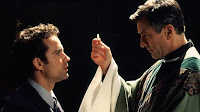

One of the boys is beaten up by his mother’s boyfriend. After visiting the boy in the hospital, Father Bobby goes to see the boyfriend. He says to him, “You’re a big guy; how much do you weigh? How much do you think John weighs? Next time you will be fighting me. You won’t need a doctor, you’ll need a priest. See you in church.” 

Not exactly a meek and mild approach, but rather like a shepherd protecting a lamb from a wolf.

But one day the boys play a practical joke that goes awry, accidentally injuring an innocent bystander. They are sent to reform school. Before they leave, Father Bobby promises Shakes he’ll stay in touch. Shakes asks the priest to only send good news, even if bad things happen. “You asking me to lie?” the priest asks. Shakes tells him, sure. And the priest tells him he can’t do that.

At the reform school, the boys are verbally, physically, and sexually abused by the guards, particularly a guard named Nokes (Bacon).

Father Bobby visits Shakes at the reform school. Shakes, in a voiceover, says, “I loved Father Bobby, but I hated looking at him.” At this point, we've already seen Nokes sexually assault Shakes and mock him for his Mother Mary medallion. When Nokes rapes Shakes, he forces the boy to cry out to God, getting a perverse amusement out of mocking the boy’s faith.

Shakes says to Father Bobby, “You shouldn’t come here, I appreciate it and all, but it’s not the right thing to do.”

Father Bobby explains it was on his way, “I stopped off in Attica to see an old friend of mine.”

“You have friends in Attica?” Shakes asks.

“Not as many as I’d like,” Father Bobby tells him, “He’s a murderer. Best friend. We hung out together, like you and the guys. We were both sent up here. This place killed him. Made him. Made him not care anymore. Don’t let this place do that to you, Shakes.” The priest hugs the boy before he leaves, and Shakes says he never felt closer to another human being.
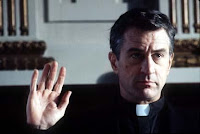

Shakes is released after a year, but the other boys serve another year after him. They grow apart over the years. Shakes (Patric) becomes a newspaper reporter and Michael (Pitt) becomes a lawyer working for the district attorney’s office. But Tommy (Crudup) and John (Eldard) become career criminals.

Years later, Tommy and John happen to meet their old guard, Nokes in a bar. They talk to him until Nokes realizes who they are. They then shoot him dead in the dark back room of the bar.

Tommy and John are arrested, and Michael insists on taking the case. Michael discloses to Shakes he took the case just to get his friends acquitted. He has a plan to make this happen, but a key part of his plan is bringing in Father Bobby to commit perjury and say he was with Tommy and John when the murder was committed.

This brings us back to the beginning of this post and the question, “Is it ever right to lie?” I won’t do any spoilers here about what Father Bobby does in the courtroom. I’ll just say that through most of the film, I thought I’d give the priest a Movie Churches rating of Four Steeples, but in the end, I’m just giving him Three Steeples.

Thursday, June 30, 2022

Crime Month: Sometimes, they're too pretty to be bad, right?


Crime Month: Live by Night (2016)


I always find it interesting how filmmakers attempt to make criminals the heroes of their films. In The Godfather films, the police are corrupt and the Corleones are surrounded with worse gangsters so they don’t look so bad. Often in films, we're supposed to sympathize with crooks who have a personal code, like Robert DeNiro’s thief in Heat. Or, sometimes, in films like Bonnie and Clyde, the killers are just so darn pretty the filmmakers want us to overlook their crimes.

In 2016’s Live By Night, we're offered several ways to believe Ben Affleck’s Joe Coughlin is a sympathetic character -- and it is Affleck’s character. He not only plays the role, he directed the film and wrote the screenplay based on Dennis Lehane’s novel. Though Joe is a thief and a killer, Ben wants to be sure we feel for the guy.

To start, Joe serves in World War I and is convinced of the idiocy of that war, especially in the way that world leaders kill people with impunity. Joe comes to believe there's no reason to respect government authority. He says, “The rules we lived by were lies and weren’t obeyed by those who made them.” (This isn’t a new argument for lawlessness in movies. by the way. It was made more subtly in the great 1939 gangster film The Roaring Twenties for James Cagney.) Joe doesn’t want to bow to any authority, even criminal authority, saying, “I don’t wanna be a gangster. Stopped kissing rings a long time ago.”


Joe falls in love with Emma Gould (Sienna Miller), the mistress of crime boss Albert White (Robert Glenister). When blackmailed to keep the affair secret, Joe refuse to pay and instead decides to flee to California from Boston, pulling one last heist to finance the trip. Instead, Joe is caught and sent to prison for three years. 

When he gets out, Joe swears vengeance on White and signs up to work for another crime boss, Maso Pescatore (Remo Girone), in order to have the resources to seek revenge.

Joe is sent to Florida, where the real machinations to make the audience root for him start: he opposes the Ku Klux Klan. The local sheriff’s brother-in-law, R. D. Pruitt (Matthew Maher), is a member of the KKK and he tells Joe he doesn’t like “Papists.” Joe tells him he hasn’t been inside a Roman Catholic Church for years, but this doesn’t matter to Pruitt, who becomes even more hateful when he learns Joe is dating a black Cuban woman. Pruitt starts a campaign of terror, bombing and shooting up Joe’s casinos.


Affleck was safe in assuming that audiences would cheer his character's vengeful campaign against the Klan after Joe is threatened for being a “N” lover. He drives the Klan out of the city of Tampa and gains great political leverage -- enough that he seems sure to be able to build his casinos without opposition.

But opposition comes from a very unexpected source.

Chief Figgis (Chris Cooper) considers going after Joe, so Joe takes extreme measures. Figgis’s daughter, Loretta (Dakota Fanning), had gone to Hollywood to be a star. Instead, she got hooked on heroin and was photographed in compromising positions. Joe showed the Sheriff those photographs and told the Sheriff his daughter would come home safely, but only if he (Joe) was treated well. The film makes it clear Joe didn’t harm Loretta in any way, and he feels really bad about using her for blackmail purposes, but a guy’s got to do what a guy’s got to do.

Loretta comes back to Tampa a changed woman. She becomes an evangelist, not hiding, but building her ministry upon her recent sordid experiences. She claims she is newly married, to Jesus Christ. She preaches against sin, particularly the sin of gambling. “Gambling destroys the spirit of man. The gambler fritters away the gifts of God.”

Joe attends one of her crusades and is not pleased about these rants against games of chance when he is looking to build a casino. He arranges a discussion with Loretta after one of her meetings. He asks her whether she could tone down the anti-gambling rhetoric and promises a generous donation if she does so.


Loretta tells Joe her father had told her there was good in him, but that his offer of a bribe makes her doubt. She tells him, “You profit through the evil addictions of others… But you can free yourself of that evil.” It's not something Joe wants to do.

He again asks her to stop speaking about gambling, but she responds, “I will, if God rewrites the Bible to say gambling is not a sin.” There really isn’t anything in the Bible that specifically condemns gambling. You could take Bible passages that talk about the wise use of money and conclude that gambling isn’t wise, but it is never directly condemned in Scripture.

Loretta’s preaching has an impact.  Local politicians refuse to give permission for Joe’s casino. Joe knows his boss would want him to come down hard on Loretta, but he doesn’t have it in him.

Loretta asks again to meet with Joe, and she tells him that she wonders whether the things she preached were true. Joe tells her it was her crusade that killed his casino, and she takes some comfort in that. She tells him, “I don’t know if there is a God. I hope there is. And I hope He’s good. Wouldn’t that be swell?”

She tells Joe, “We’re all going to hell.” Later, presumably because she can no longer live with her guilt over what she did in Hollywood, she cuts her own throat.

Joe is upset by this but goes on with his life in crime for a time. He retires when he can, and faces a tragedy of his own. But he never forgets Loretta.

And the audience doesn’t either, because she is by far the most sympathetic character in the film, earning a Three Steeple Rating.

Friday, October 1, 2021

Working for the Devil


The Devil's Advocate
(1997)
Angel Heart (1987)
Many of us have had employers who we doubted were wholly on the up and up. I worked at a movie theater where there were rumors the manager shaved off profits from the box office receipts (I know for a fact he sold expired hot dogs), but what if your employer wasn't just shady but was downright evil?

In John Grisham’s The Firm, a lawyer discovered his firm was a front for the mafia. The two films featured today have even more diabolic bosses (the mafia might work for these fellows). We'll first look at a film which, as in The Firm, features an attorney hired by a law firm that is much more than it seems. The very premise leads one to think of the many jokes about diabolic lawyers. 

In fact, a 19th-century evangelist, Lorenzo Dow, told a story of being on a preaching tour and coming to a the general store in a small town one cold winter night. The town's lawyers were gathered around the pot-bellied stove and listened while Dow told about a recent vision in which he had been given a tour of hell, much like the traveler in Dante's Inferno. One of the lawyers asked what he had seen. "Very much what I see here," Dow said. "All of the lawyers gathered in the hottest place."

1997’s The Devil’s Advocate (directed by Taylor Hackford), stars Keanu Reeves as Kevin Lomax, a small-town lawyer recruited by a high-powered law firm to practice criminal defense law in the Big Apple. The head of the firm goes by the name of John Milton (Al Pacino). No one in the film ever says, “Isn’t John Milton the name of that British poet who wrote Paradise Lost in which Satan plays a prominent role?” trusting the audience to note that obvious allusion.


As the film goes on, the firm asks Lomax to make increasingly questionable moral choices, and the identity of Milton as the devil becomes increasingly obvious. Lomax faces increasing moral and physical peril. 

If only he had listened to his mother. 

Judith Ivey plays Kevin’s mother, Alice, who senses moral peril when her son plans to move to the big city. Alice is active in her local (and well-attended) fundamentalist church where we hear the congregation singing a lively Gospel song (based on Romans 16:19.)


But Lomax is not a part of that church, as we learn when Milton questions Kevin about his mother and her church.

Lomax: My mother raised us, just the two of us. She wasn’t married. She’s a preacher’s kid, she’s pretty tough. She has a church she likes, she spends a lot of time there. When she goes out, it’s to do volunteer work.

Milton: Didn’t rub off the Book? The Church?

Lomax: I’m on parole.

Turns out he might have been much better off sticking to that church of his mother’s.


There is another church featured prominently in the film, used for the funeral of Eddie Barzoon (Jeffrey Jones), another member of Milton's law firm and a very bad man. The minister at the service eulogizes Barzoon as a wonderfully moral man, a pillar of the community. This is a church where Milton seems very much at home (though his presence does make the Holy Water boil). That fact alone adversely affects the church’s Steeple Rating negatively, though the church is the place Lomax’s wife Mary Ann (Charlize Theron) seeks comfort after Lomax's boss rapes her,

(Several very beautiful Manhattan churches were used for the production, including the Church of the Heavenly Rest, Central Presbyterian Church, and the Church of the Most Holy Redeemer.)


In 1987’s Angel Heart, private detective Harry Angel (Mickey Rourke), is working for a different sinister boss (or client) who goes by the name of Louis Cyphre (Robert De Niro). Really, I can't understand why the devil in these films can’t be a little more subtle in naming himself. (Lou-Cipher… Get it?) Cyphre hires Angel to track down a man by the name of Johnny Favor.

Angel, like Lomax in our other film, is led down a dark path leading to more and more evil and debauchery. But fortunately for this blog, he encounters a variety of churches along the way, including a church led by a mercenary preacher who tells his congregation, “If you want to show your love for God...Open up your purses, open up your wallets. Some of you are saying, ‘You should end up in a Cadillac’ but if you love me, I should end up in a Rolls Royce.”


At one point, Angel passes a river baptism conducted by a fundamentalist congregation. Cyphre arranges to meet Angel in the pews of what seems to be a very formal church. Angel isn’t pleased at all with this meeting place and lets his client know, swearing up a storm. Cyphre instructs Angel to watch his language, but Angel replies, “I don’t give a F*%$ if this is a church. Churches give me the creeps.”

These two films have churches that seem like relatively healthy congregations and some that give me the creeps. Still, I’m going to give the various churches in these two films a Movie Churches average of Two Steeples.


I don’t usually note this, but readers should be aware that both of these films have scenes with strong language, violence, and sexual content. The Devil’s Advocate received an R rating and Angel Heart received a rare X rating. Just so you know.

Friday, June 9, 2017

Missionary Movie Churches: The Mission

The Mission (1986)
One of the great iconic images of English literature is from John Bunyan’s Pilgrim’s Progress: the protagonist, Christian, finally drops his great burden at the Cross. That image is reimagined in the 1986 film, The Mission. The film is set the 1740’s in the jungles of South America, and in the role of Christian is Rodrigo Mendoza (Robert De Niro), a mercenary working for slavers.

When Rodrigo kills his brother but isn’t criminally prosecuted, he is wracked with guilt. (His brother is played by Adrian Quinn, so apparently killing the star of Reckless is not considered a crime.) Rodrigo’s suicidal guilt leads him to Jesuit missionary priest Father Gabriel (Jeremy Irons). Gabriel loads Rodrigo’s own armor and weapons onto the man’s back and, with him, hikes into the jungles. They eventually climb up the Iguazu Falls (on the border between Argentina and Brazil). Other Jesuit priests argue it is too much, but Rodrigo doesn’t think so -- so neither does Gabriel (“How long must he carry the burden?” a priest asks. “God knows,” Gabriel replies). No one is allowed to cut off the burden, until Rodrigo reaches the top of the falls. And then, the indigenous people whom Rodrigo had enslaved are the ones who cut the burden from his back.

It’s a powerful scene, encapsulating together repentance and grace.

The film is full of beautiful images and thoughtful dialogue that deal with complex issues of religion, politics, and culture. The film took the highest prize (the Palme d'Or) at the Cannes Film Festival and the Oscar for Best Cinematography. Some of the credit goes to the director, Roland Joffé, but even more credit goes to the great screenwriter Robert Bolt (A Man for All Seasons and Lawrence of Arabia) for the original story as well.

Bolt takes complex issues and allows them to be complex, allows different positions to be argued well. For instance, he takes on the issue of pacifism and allows for two different Christian perspectives on the issue, as Jesus did when he said both to both to turn the other cheek and to bring a sword.

Many spoilers ahead

In the third act of the film, the abolitionist government cedes land to the Portuguese, who still profit from making the native South Americans into slaves. The Catholic missionaries are caught in the middle of the political intrigue, and (spoiler) the Catholic hierarchy orders the Jesuits to withdraw from their missions. Neither Rodrigo (now a member of the order) or Father Gabriel are willing to do so.

Gabriel decides to stay with the Guarani, the people he’s been working and living among, in their mission, on their land, and with them, to face the Portuguese armies and mercenaries without resistance. Rodrigo decides to resist violently. Rodrigo asks for Father Gabriel’s blessing before he goes to battle. Gabriel refuses, saying, “If you’re right you’ll have God’s blessing. If you’re wrong, my blessing won’t mean anything.” So Rodrigo leads an army and Gabriel leads a choir. From an earthly perspective, both men lose. But perhaps from a heavenly perspective, both men are victorious.

After the mission is destroyed and the people are again enslaved, two church bureaucrats discuss the tragedy. One says, “We must work in the world as it is, and the world is thus.”  The other responds, “No, thus we have made the world.”

The Mission is a four steeple film at moviechurches.com
If, for this movie, I were rating men like these representatives of the Vatican, I’d have a much lower Steeple rating, but I’m giving Father Gabriel, Rodrigo, the men of the Jesuit order at the mission, and the people of their congregation Four Steeples.


Thursday, April 21, 2016

Movie Churches during the Great Depression: We're no Angels (1989)

Jesus said in Matthew 7:15, "Watch out for false prophets. They come in sheep's clothing, but inwardly they are ferocious wolves." Now admittedly, Robert De Niro and Sean Penn as the escaped cons disguised as priests might not be wolves (they're more like lhasa apsos), but you'd hope the monks that welcomed them into their monastery would have been a little more discerning.

We're No Angels, directed by Neil Jordan (of The Crying Game and one of my favorite werewolf films, The Company of Wolves) and written by David Mamet (Glengarry Glen Ross and The Untouchables), is a darkish comedy set during the Great Depression.

As usual, we're reviewing the religious institution in the film, in this case The Weeping Madonna Monastery, rather than the film itself. But the film opens in a different institution, a U.S. penitentiary near the Canadian border. A man, Bobby, is about to be executed, and two convicts --Ned and Jim (De Niro and Penn) -- are brought in to be witnesses. A priest is also brought in to hear Bobby's confession, but Bobby scoffs. Turns out, Bobby's got a gun. He escapes, taking Ned and Jim along. Bobby kicks the priest on the way out, which is better than the bullets a couple of the guards get.

Ned and Jim find themselves wandering a country road where they notice a sign for the Weeping Madonna that features Hebrews 13: 2  ("Do not forget to show hospitality to strangers, for by so doing some have shown hospitality to angels without knowing it" -- thus the title). They meet a woman who, for some inexplicable reason, mistakes them for priests from the monastery. Jim quotes the verse from Hebrews, which confirms her ungrounded suspicion.

When they meet the Father who runs the monastery, he assumes Jim and Ned are the priests from Arizona the monastery has been expecting: Fathers Brown and Riley, who together wrote the book A New Look at Revelations and are considered "two of the finest thinkers in the world." It's swell that this monk and others apparently value learning, but when they fail to realize these two dim bulbs aren't who they thought, one assumes they would have celebrated the Emperor's New Clothes as well.

When the convicts join the monks for dinner, Jim (now called Father Brown) is asked to say grace. He basically says, "Be nice to people" for grace; a swell sentiment, but the prayer should have been a clue to the other monks and priests that he wasn't really a priest. Maybe if he'd prayed, "Rub-a-dub-dub, thanks for the grub" they might have caught on.

A young monk approaches Jim and asks him to explain something in his book to him. The monk (an early role for John C. Reilly) refers to a verse, 10:19, without saying what book of the Bible it's from (it's Deuteronomy). He asks if, in the book, they were going for a Gnostic meaning in the verse and Jim says, sure that's it. I have real problems here, since half of the New Testament epistles take time to condemn Gnostic teaching (sorry Dan Brown, Gnosticism stinks).

The convicts want to cross the border into Canada. Every year, the monks of the Weeping Madonna Monastery have a procession, taking the statue to a sister church in Canada. Ned and Jim see this as their opportunity to escape. However, the monks must take a sick person with them as part of the procession. They take a young deaf girl, the daughter of a local prostitute (Demi Moore). Spoiler -- eventually a miracle ensues.

Before the procession, a monk or priest is chosen by lottery to give a sermon. Jim wins the lottery. He doesn't know what to say, so he uses a flyer selling a Colt revolver as his starting point. He eventually says that God may be all in your head, and he doesn't know whether God is good or not, but if it comforts you to believe in God, do it. For some reason, this gets a big ovation from the crowd, and the priests and monks love it. I don't think the Apostle Paul would have been so thrilled. He cared about truth. He wrote that if Jesus was not raised from the dead, our faith is pointless.

The monastery is named after a statue on Mary on the grounds that occasionally seems to cry. The priest who runs the place knows that there's a hole in the roof that drips on the statue, making it look all sad at times. The clergy at the monastery seem to think that it's better for the little people to have something to believe in, even if it's not true. I think God values truth much more than the clergy in this film do.

God is pretty big on truth. Jesus called himself "the Truth." But the clergy at the Weeping Madonna Monastery are not particularly concerned about truth, which is why they earn just two steeples.


Thursday, July 23, 2015

True Confessions (1981)

Eating in the best restaurants, drinking the finest wines, golfing with the rich and powerful: this is the life of a clergyman in "True Confessions," an adaptation of John Gregory Dunne's novel about the murder of a prostitute, roughly based on the infamous Black Dahlia murder in Los Angeles in the 1940's.

Robert De Niro plays a priest (Msgr. Desmond Spellacy) rising in the Catholic hierarchy of Southern California. Robert Duvall plays his brother (Detective Tom Spellacy), a policeman investigating the murder of "the Virgin Tramp" (a porn starlet who may have connections to the Catholic Church). Early in the film, Duvall's cop is called to a brothel where a priest has been found dead in a bed. Duvall was previously involved with the madam of the house, and they quickly agree to cover up the circumstances of the priest's death for the good of the brothel and the Church. The Monsignor and his superiors happily conspire with the cover-up.

It is only when it becomes apparent that murder may have been involved that Desmond seems uncomfortable with the church's connection with sleazy characters. Burgess Meredith (in his good guy Rocky's coach role rather than his Penguin persona) as Monsignor Seamus Fargo confronts Desmond about his love of power. De Niro responds that power allows him to minister more effectively, and, you know, help the poor. (We don't see him helping the poor, but rather schmoozing with the rich.)

There are many wonderful passages in Scripture about power and ministry (such as 1 Corinthians 1 where Paul wrote, "Brothers and sisters, think of what you were when you were called. Not many of you were wise by human standards; not many were influential; not many were of noble birth. But God chose the foolish things of the world to shame the wise; God chose the weak things of the world to shame the strong."), but neither priest thinks to refer to them.

Eventually, Tom's investigation into the prostitute's death leads to his brother's downfall. But there are plenty of corrupt, wealth- and power-loving clergy to take his place.

We see a couple of church services in the film, and since the story takes place in the 1940s, Latin is the language used. Perhaps one could argue that the mystery of the rituals of the church rise above the petty corruption of the clergy. But even if I wasn't a Protestant this is not a church I'd want to attend.

The film is bookended by a sequence of Tom going to visit his disgraced brother Desmond, now serving in a remote desert parish. Des remarks to Tom, "No one ever visits a priest to share good news." It is Des, though, who has bad news to share. He is dying of brain cancer. Desmond as a priest never seems to have much good news to share. He is just one more corrupt person in a world where everyone seems corrupt.


The question every week is "Would I want to attend this church?" My answer would be an emphatic "No." It gets 1 steeple.