
Crime Month: Live by Night (2016)
I always find it interesting how filmmakers attempt to make criminals the heroes of their films. In The Godfather films, the police are corrupt and the Corleones are surrounded with worse gangsters so they don’t look so bad. Often in films, we're supposed to sympathize with crooks who have a personal code, like Robert DeNiro’s thief in Heat. Or, sometimes, in films like Bonnie and Clyde, the killers are just so darn pretty the filmmakers want us to overlook their crimes.
In 2016’s Live By Night, we're offered several ways to believe Ben Affleck’s Joe Coughlin is a sympathetic character -- and it is Affleck’s character. He not only plays the role, he directed the film and wrote the screenplay based on Dennis Lehane’s novel. Though Joe is a thief and a killer, Ben wants to be sure we feel for the guy.
To start, Joe serves in World War I and is convinced of the idiocy of that war, especially in the way that world leaders kill people with impunity. Joe comes to believe there's no reason to respect government authority. He says, “The rules we lived by were lies and weren’t obeyed by those who made them.” (This isn’t a new argument for lawlessness in movies. by the way. It was made more subtly in the great 1939 gangster film The Roaring Twenties for James Cagney.) Joe doesn’t want to bow to any authority, even criminal authority, saying, “I don’t wanna be a gangster. Stopped kissing rings a long time ago.”
Joe falls in love with Emma Gould (Sienna Miller), the mistress of crime boss Albert White (Robert Glenister). When blackmailed to keep the affair secret, Joe refuse to pay and instead decides to flee to California from Boston, pulling one last heist to finance the trip. Instead, Joe is caught and sent to prison for three years.
When he gets out, Joe swears vengeance on White and signs up to work for another crime boss, Maso Pescatore (Remo Girone), in order to have the resources to seek revenge.
Joe is sent to Florida, where the real machinations to make the audience root for him start: he opposes the Ku Klux Klan. The local sheriff’s brother-in-law, R. D. Pruitt (Matthew Maher), is a member of the KKK and he tells Joe he doesn’t like “Papists.” Joe tells him he hasn’t been inside a Roman Catholic Church for years, but this doesn’t matter to Pruitt, who becomes even more hateful when he learns Joe is dating a black Cuban woman. Pruitt starts a campaign of terror, bombing and shooting up Joe’s casinos.

Affleck was safe in assuming that audiences would cheer his character's vengeful campaign against the Klan after Joe is threatened for being a “N” lover. He drives the Klan out of the city of Tampa and gains great political leverage -- enough that he seems sure to be able to build his casinos without opposition.
But opposition comes from a very unexpected source.
Chief Figgis (Chris Cooper) considers going after Joe, so Joe takes extreme measures. Figgis’s daughter, Loretta (Dakota Fanning), had gone to Hollywood to be a star. Instead, she got hooked on heroin and was photographed in compromising positions. Joe showed the Sheriff those photographs and told the Sheriff his daughter would come home safely, but only if he (Joe) was treated well. The film makes it clear Joe didn’t harm Loretta in any way, and he feels really bad about using her for blackmail purposes, but a guy’s got to do what a guy’s got to do.
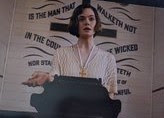
Loretta comes back to Tampa a changed woman. She becomes an evangelist, not hiding, but building her ministry upon her recent sordid experiences. She claims she is newly married, to Jesus Christ. She preaches against sin, particularly the sin of gambling. “Gambling destroys the spirit of man. The gambler fritters away the gifts of God.”
Joe attends one of her crusades and is not pleased about these rants against games of chance when he is looking to build a casino. He arranges a discussion with Loretta after one of her meetings. He asks her whether she could tone down the anti-gambling rhetoric and promises a generous donation if she does so.

Loretta tells Joe her father had told her there was good in him, but that his offer of a bribe makes her doubt. She tells him, “You profit through the evil addictions of others… But you can free yourself of that evil.” It's not something Joe wants to do.
He again asks her to stop speaking about gambling, but she responds, “I will, if God rewrites the Bible to say gambling is not a sin.” There really isn’t anything in the Bible that specifically condemns gambling. You could take Bible passages that talk about the wise use of money and conclude that gambling isn’t wise, but it is never directly condemned in Scripture.
Loretta’s preaching has an impact. Local politicians refuse to give permission for Joe’s casino. Joe knows his boss would want him to come down hard on Loretta, but he doesn’t have it in him.
Loretta asks again to meet with Joe, and she tells him that she wonders whether the things she preached were true. Joe tells her it was her crusade that killed his casino, and she takes some comfort in that. She tells him, “I don’t know if there is a God. I hope there is. And I hope He’s good. Wouldn’t that be swell?”
She tells Joe, “We’re all going to hell.” Later, presumably because she can no longer live with her guilt over what she did in Hollywood, she cuts her own throat.
Joe is upset by this but goes on with his life in crime for a time. He retires when he can, and faces a tragedy of his own. But he never forgets Loretta.
 And the audience doesn’t either, because she is by far the most sympathetic character in the film, earning a Three Steeple Rating.

Affleck was safe in assuming that audiences would cheer his character's vengeful campaign against the Klan after Joe is threatened for being a “N” lover. He drives the Klan out of the city of Tampa and gains great political leverage -- enough that he seems sure to be able to build his casinos without opposition.
But opposition comes from a very unexpected source.
Chief Figgis (Chris Cooper) considers going after Joe, so Joe takes extreme measures. Figgis’s daughter, Loretta (Dakota Fanning), had gone to Hollywood to be a star. Instead, she got hooked on heroin and was photographed in compromising positions. Joe showed the Sheriff those photographs and told the Sheriff his daughter would come home safely, but only if he (Joe) was treated well. The film makes it clear Joe didn’t harm Loretta in any way, and he feels really bad about using her for blackmail purposes, but a guy’s got to do what a guy’s got to do.
Loretta comes back to Tampa a changed woman. She becomes an evangelist, not hiding, but building her ministry upon her recent sordid experiences. She claims she is newly married, to Jesus Christ. She preaches against sin, particularly the sin of gambling. “Gambling destroys the spirit of man. The gambler fritters away the gifts of God.”
Joe attends one of her crusades and is not pleased about these rants against games of chance when he is looking to build a casino. He arranges a discussion with Loretta after one of her meetings. He asks her whether she could tone down the anti-gambling rhetoric and promises a generous donation if she does so.

Loretta tells Joe her father had told her there was good in him, but that his offer of a bribe makes her doubt. She tells him, “You profit through the evil addictions of others… But you can free yourself of that evil.” It's not something Joe wants to do.
He again asks her to stop speaking about gambling, but she responds, “I will, if God rewrites the Bible to say gambling is not a sin.” There really isn’t anything in the Bible that specifically condemns gambling. You could take Bible passages that talk about the wise use of money and conclude that gambling isn’t wise, but it is never directly condemned in Scripture.
Loretta’s preaching has an impact. Local politicians refuse to give permission for Joe’s casino. Joe knows his boss would want him to come down hard on Loretta, but he doesn’t have it in him.
Loretta asks again to meet with Joe, and she tells him that she wonders whether the things she preached were true. Joe tells her it was her crusade that killed his casino, and she takes some comfort in that. She tells him, “I don’t know if there is a God. I hope there is. And I hope He’s good. Wouldn’t that be swell?”
She tells Joe, “We’re all going to hell.” Later, presumably because she can no longer live with her guilt over what she did in Hollywood, she cuts her own throat.
Joe is upset by this but goes on with his life in crime for a time. He retires when he can, and faces a tragedy of his own. But he never forgets Loretta.


