Showing posts with label Ben Affleck. Show all posts

Thursday, June 30, 2022

Crime Month: Sometimes, they're too pretty to be bad, right?


Crime Month: Live by Night (2016)


I always find it interesting how filmmakers attempt to make criminals the heroes of their films. In The Godfather films, the police are corrupt and the Corleones are surrounded with worse gangsters so they don’t look so bad. Often in films, we're supposed to sympathize with crooks who have a personal code, like Robert DeNiro’s thief in Heat. Or, sometimes, in films like Bonnie and Clyde, the killers are just so darn pretty the filmmakers want us to overlook their crimes.

In 2016’s Live By Night, we're offered several ways to believe Ben Affleck’s Joe Coughlin is a sympathetic character -- and it is Affleck’s character. He not only plays the role, he directed the film and wrote the screenplay based on Dennis Lehane’s novel. Though Joe is a thief and a killer, Ben wants to be sure we feel for the guy.

To start, Joe serves in World War I and is convinced of the idiocy of that war, especially in the way that world leaders kill people with impunity. Joe comes to believe there's no reason to respect government authority. He says, “The rules we lived by were lies and weren’t obeyed by those who made them.” (This isn’t a new argument for lawlessness in movies. by the way. It was made more subtly in the great 1939 gangster film The Roaring Twenties for James Cagney.) Joe doesn’t want to bow to any authority, even criminal authority, saying, “I don’t wanna be a gangster. Stopped kissing rings a long time ago.”

Joe falls in love with Emma Gould (Sienna Miller), the mistress of crime boss Albert White (Robert Glenister). When blackmailed to keep the affair secret, Joe refuse to pay and instead decides to flee to California from Boston, pulling one last heist to finance the trip. Instead, Joe is caught and sent to prison for three years. 

When he gets out, Joe swears vengeance on White and signs up to work for another crime boss, Maso Pescatore (Remo Girone), in order to have the resources to seek revenge.

Joe is sent to Florida, where the real machinations to make the audience root for him start: he opposes the Ku Klux Klan. The local sheriff’s brother-in-law, R. D. Pruitt (Matthew Maher), is a member of the KKK and he tells Joe he doesn’t like “Papists.” Joe tells him he hasn’t been inside a Roman Catholic Church for years, but this doesn’t matter to Pruitt, who becomes even more hateful when he learns Joe is dating a black Cuban woman. Pruitt starts a campaign of terror, bombing and shooting up Joe’s casinos.


Affleck was safe in assuming that audiences would cheer his character's vengeful campaign against the Klan after Joe is threatened for being a “N” lover. He drives the Klan out of the city of Tampa and gains great political leverage -- enough that he seems sure to be able to build his casinos without opposition.

But opposition comes from a very unexpected source.

Chief Figgis (Chris Cooper) considers going after Joe, so Joe takes extreme measures. Figgis’s daughter, Loretta (Dakota Fanning), had gone to Hollywood to be a star. Instead, she got hooked on heroin and was photographed in compromising positions. Joe showed the Sheriff those photographs and told the Sheriff his daughter would come home safely, but only if he (Joe) was treated well. The film makes it clear Joe didn’t harm Loretta in any way, and he feels really bad about using her for blackmail purposes, but a guy’s got to do what a guy’s got to do.

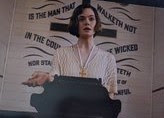
Loretta comes back to Tampa a changed woman. She becomes an evangelist, not hiding, but building her ministry upon her recent sordid experiences. She claims she is newly married, to Jesus Christ. She preaches against sin, particularly the sin of gambling. “Gambling destroys the spirit of man. The gambler fritters away the gifts of God.”

Joe attends one of her crusades and is not pleased about these rants against games of chance when he is looking to build a casino. He arranges a discussion with Loretta after one of her meetings. He asks her whether she could tone down the anti-gambling rhetoric and promises a generous donation if she does so.


Loretta tells Joe her father had told her there was good in him, but that his offer of a bribe makes her doubt. She tells him, “You profit through the evil addictions of others… But you can free yourself of that evil.” It's not something Joe wants to do.

He again asks her to stop speaking about gambling, but she responds, “I will, if God rewrites the Bible to say gambling is not a sin.” There really isn’t anything in the Bible that specifically condemns gambling. You could take Bible passages that talk about the wise use of money and conclude that gambling isn’t wise, but it is never directly condemned in Scripture.

Loretta’s preaching has an impact.  Local politicians refuse to give permission for Joe’s casino. Joe knows his boss would want him to come down hard on Loretta, but he doesn’t have it in him.

Loretta asks again to meet with Joe, and she tells him that she wonders whether the things she preached were true. Joe tells her it was her crusade that killed his casino, and she takes some comfort in that. She tells him, “I don’t know if there is a God. I hope there is. And I hope He’s good. Wouldn’t that be swell?”

She tells Joe, “We’re all going to hell.” Later, presumably because she can no longer live with her guilt over what she did in Hollywood, she cuts her own throat.

Joe is upset by this but goes on with his life in crime for a time. He retires when he can, and faces a tragedy of his own. But he never forgets Loretta.

And the audience doesn’t either, because she is by far the most sympathetic character in the film, earning a Three Steeple Rating.

Friday, May 13, 2022

A Stop in France: The Last Duel


The Last Duel
(2021)


In 1950, Akira Kurosawa made a groundbreaking film, Rashomonabout a horrible crime. The story was presented from a variety of perspectives. 

Since, unfortunately, Movie Churches is spending this month in Europe, there isn’t time for a side trip to Japan. More importantly, since we focus on Christian churches and clergy, the priest in that film is Buddhist. 

In 2021, director Ridley Scott made Kurosawa's gimmick his own by telling the story of a sexual assault from three different perspectives. His tale takes place in medieval France, so it works for this month's theme, and the priest in the film is Roman Catholic -- so that works too. Of course, Kurosawa’s priest was a kind, thoughtful man and Ridley’s priest is a cynical, corrupt politician. But we work with what we have.


The Last Duel
is based on a true story. Jean de Carrouges (Matt Damon) and Jacques le Gris (Adam Driver) are squires serving under Count Pierre de Alencon (Ben Affleck) after the Caroline War. Jacques becomes the Count’s tax collector and takes the prize property of Jean’s wife’s dowry. But worse is to come. 

Jacques rapes Jean’s wife, Marguerite de Carrouges (Jodie Comer) so Jean challenges Jacques to a duel, trusting the outcome will be directed by God and prove to all what is right.

But as I mentioned, this story is told from different perspectives. Jacques doesn’t believe he raped Marguerite. He believes he loves her and she loves him. The only real problem from his perspective is the awkward marriage vows between Jean and Margueritte (after the act he tells her, “We could not help ourselves.”)


Jacques goes to his priest, Le Coq (Zeljko Ivanek), but not regarding the sin of rape.

Jacques: “Forgive me Father, for I have sinned.”

Priest: “ Speak my son.”

J: “I carry a sin that weighs heavy upon my heart.”

P: “What is it, my son?”

J: “I have committed the sin of adultery against a man I once considered a friend.”

P: “You know your commandments?”

J: “Yes, Father. I ask forgiveness.”

P: “My son, Matthew tells us, everyone who looks at a woman with lust has already committed adultery with her in his heart.”

J: “But is love a sin, Father? How can I seek absolution for love?”

P: “This is the work of the devil. This temptress leads you astray. Just as Eve lured Adam from the divine path. That is not love.”

J: “Then what?”

P: “God is faithful. He will not let you be tempted beyond what you can bear.”


Note that the priest puts the blame on the woman. He doesn’t really listen to Jacques about what he has done. He doesn’t consider that perhaps Jacques does have a really significant sin problem here. Not just “lusting in his heart”, but literal adultery -- if he would take take Jacques at his word. Also coveting -- literally -- his neighbor's wife. And, well, rape. But the priest doesn’t really seem to want to have to deal with real sin.

Even worst is to come from this priest.

When Jean accuses Jacques of raping Marguerite, the priest looks for legal loopholes to help Jacques escape responsibility.

Jacques is still under the delusion that his violent act was a consential transaction. He tells the priest, “It’s taken all my strength not to return to her. We knew it was wrong. I confessed my adultery and performed my penance. This charge of rape is false.”

The priest counters, “The common mind is not capable of such nuance.” He argues that instead of going to civil court, he should use his ordination to be tried in the Ecclesiatic Court. “Use the benefit of clergy. There really is no decision to make. You’re a cleric in minor orders. So, you can escape the jurisdiction of the secular courts and be tried by the Church where conditions are more favorable. Men holding church office number disproportionately among those accused of rape. They escape serious punishment by claiming the benefit of clergy, so… We’ll have the church try your case and be done with the matter.”

That a priest is making this argument is quite worrisome, but Jacques wants to make a public display of his “innocence.”

The priest, however, is worried about how Jacques will look when people consider the accusation made by Jean’s wife. He wonders why she was bold enough to make the accusation. "Yet under extraordinary pressure and at great risk to her name and reputation, Lady Marquritte has said that [the rape] did happen. Formally this is not about her. Rape is not a crime against a woman. It is a property crime against a male guardian, in this case Jean… This is not a matter over which a duel should be fought to the death. It should be settled quietly. Take the benefit of clergy.”

Though considering rape as a property crime was the law of the time, a priest's blithe agreement with this position is quite unsettling. 

We see no need for generousity in judging this priest for our Movie Churches rating -- after all the man has been dead for centuries. We give him our lowest rating of One Steeple.

Thursday, September 9, 2021

This Isn't How We Play the Game: School Sports Month Continues!


The Way Back
(2020)

The Way Back came out at a very interesting time. Note the date on the poster pictured here. “March 6 Only in theaters.” And yes, that was in 2020. This film opened just shortly before most movie theaters in the United States closed, so it's probably the movie a lot of people saw on their most recent trip to a movie theater.


The night before the full lockdown in Washington State, we went to Rodeo Drive-in in Bremerton. The Way Back was one of our options, but instead, we watched Pixar’s Onward

I did see this film in 2020, on DVD, and last week I checked it out of the library to watch it again.

The Way Back must have been a very personal film for Ben Affleck, though his only hat was that of star. Brad Ingelsby wrote the screenplay and Gavin O’Connor directed, but the story of an alcoholic forced to deal with his problem reflects the actor/writer/director’s public battle with the bottle.

The film is the story of Jack Cunningham, an ironworker who was a high school basketball star. When the basketball coach at Bishop Hayes Roman Catholic High School has a heart attack, the school’s principal, Father Edward Divine (John Aylward), calls Jack and asks him to coach the team. He leaves a message on Jack’s machine (leaving a phone number that doesn’t include "555" and closing his message with, “God bless.”) Jack hesitates but eventually agrees.

Jack's not alone when he works with the team. A math teacher (Al Madrigal as Dan) serves as assistant coach and Father Mark Whelan (Jeremy Radin) is the Team Chaplain. When the chaplain asks Jack how he feels about taking on the job, Jack tells the chaplain, “F***, I’m as nervous as s***.” 

Whelan is quite obviously taken aback.


Jack goes into Gene-Hackman-in-Hoosiers mode and turns a last-place team into a real competitor. He does the old “cutting the cocky star player from the team when he doesn’t follow the rules” routine and works the kids hard, but he also swears like a, well, ironworker. During a game when the team gets sloppy, Cunningham yells at them to “Reach into their shorts to see if they have a pair. Because you’re playing like a bunch of pu****s!” accompanied by a number of F-Bombs.

Chaplain Whelan watches this display aghast. On the bus ride after the game, the chaplain tries to have a heart-to-heart with the coach. Chaplain says, “Jack, I just wanted to have a little chat with you about something that is on my mind. I don’t know if you recall from your days as a student that we have a Code of Conduct at Hayes, and part of that code of conduct includes the use of appropriate language. I know you’re trying to motivate the team but I wonder if there isn’t a different way.”

“So you’d like me to be more Christlike from the bench?” Jack responds.

“Our job isn’t just to win basketball games but also to develop men of integrity and faith. I’d like you to give it some thought,” the priest answers.

Jack tells the priest that there are so many problems in the world he has a hard time believing God cares about the language they use. The priest tells him that as Christians we integrate faith into our lives, so yes, He cares.

Now I understand that in the real world coaches often do use colorful language. My brother had quite the stories about his basketball coach at dear old Piner High. But using F-bombs to insult the officials isn’t going to go over well in any league or level of play. And a religious school should hold its staff to a higher level. If anything, I thought the priest was a bit wimpy in holding Jack accountable. Jack is a lot tougher in holding his players accountable.

But, of course, Jack does have a bigger problem than swearing. He’s still drinking.

It seems quite odd that the rival coaches are aware of Jack’s drinking problem but the priests who hired him weren't. A rival coach mocks Jack for hanging out at the bars. It does seem the school should have done a bit of research and reference checks.

When his assistant coach tells Jack that he found empty beer cans in the coach’s office, Jack first snaps at him for snooping in his office and then comes up with a lame excuse for the cans. But Jack drinks more as the season schedule becomes tougher and family pressures rise. After winning the big game that secures a spot in the playoffs, Jack comes into practice drunk.


Father Divine goes to Jack with the assistant coach and fires Jack. The priest says, “Our decision is final, we have a zero-tolerance policy for alcohol.” 

Jack snarls back at the priest and the assistant coach. Jack goes on another bender and winds up with a DUI in jail. But the team plays on.

The chaplain prays with the team before they play their first playoff game (the first time Bishop Hayes goes to the playoffs since Jack was a player). He prays not for victory, but for the boys to play their best. Before they go out, the team captain drops an F-bomb.

In my job, I work with men in recovery from alcohol and drug addiction, so I appreciate employers giving such men a chance. The priests of the school were irresponsible in hiring Jack, but when they recognize their mistake, they deal with it. That’s why  I give Fathers Divine and Whelan a three of four steeple rating.

And on another note, something outside of the film: I read recently that though he previously described himself as an agnostic, Affleck has been attending a Methodist Church with his family. He said, “Faith has served me well in my recovery as an alcoholic.” We at Movie Churches wish Mr. Affleck ongoing success in his recovery.

Friday, June 10, 2016

Clergy in Crisis month: To the Wonder (2012)

Hosea doesn't usually get a lot of screen time. I've heard the Lord's Prayer in dozen of films; the Sermon on the Mount and the 23rd Psalm aren't too uncommon in scripts, either. But the Minor Prophets don't spend much time at the multiplex (with the possible exception of Jonah in Moby Dick and Master and Commander). Thinking about it, in real world pulpits you don't often hear sermons from Hosea either.

The Book of Hosea tells the unusual story of a prophet marrying a prostitute; their relationship represents God's relationship with his people. Father Quintana's (Javier Bardem) homily on the book of Hosea is at the heart of Terrence Malick's film, To The Wonder.

Malick has never been a populist, popcorn-selling machine as a filmmaker. His films usually avoid crisp narrative and instead favor lingering nature shots and philosophical pondering. And even with that, some critics referred to To The Wonder as perhaps his least accessible film. The plot of the film, such as it is, follows an American, Neil (Ben Affleck), in Paris, where he falls in love with a single mother, Marina (Olga Kurylenko). He asks her to return with him to Oklahoma.

In the States, Marina meets Father Quintana, the pastor the Catholic Church in Neil's hometown. Her first husband, the father of her child, abandoned her and she has married again, she says. The Church has told her that because of this, she's ineligible to participate in Communion. (This teaching seems to me contrary to what Paul wrote in I Corinthians 7:15, "But if the unbeliever leaves, let it be so; the brother or sister is not bound in such circumstances".)

The film then follows a couple of different tracks that seem unrelated: the disintegrating relationship of Neil and Marina and Father Quintana's interior, spiritual struggles. Many audiences and critics are troubled by the seeming lack of continuity between the stories, but they are connected by the priest's sermon about Hosea. The literal struggles in a marriage (beware of bedroom scenes) are mirrored in the priest's spiritual struggles.

In a voiceover prayer, the Father says to his Father, "Everywhere you're present, but I can't see You. You're in me, around me, and I have no experience of You; not as I once did. My heart is cold, hard." Some in the congregation notice. One woman in the congregation tells the priest, "Father, I'm going to pray for you, so you will receive the gift of joy." A janitor in the church tells the priest he can tell he's lonely.

Yet the priest doesn't stop ministering. We see him preaching and giving sacraments. We see him at a wedding and talking with parishioners. He visits prisoners, crack addicts, and the poor. Toward the end of the film, we see him take Marina's confession and give her communion. Another parishioner expresses thanks to the priest for bringing the Gospel to Bartlesville.

Father Quintana encourages those in his congregation to continue to love. He reminds them that love is not a feeling, but a duty Christ has commanded us to practice. He continues to love God, though he feels dry. The Father continues to pray in faith, "Christ be with me, come before me, behind me, in me, above me and below me."

In the film Night Moves, Gene Hackman's character says of films of Eric Romher, "Watching the films is like watching paint dry." There are many who feel the same way about Malick's films. Fortunately, I'm not here to review films, but the churches and the clergy in those films. I'm giving Father Quintana's ministry 3 Steeples.