Showing posts with label Christmas. Show all posts

Thursday, December 23, 2021

Is it Christmas, though?


Come to the Stable (
1949)

To be honest, even with the title “Come to the Stable” and the setting in Bethlehem and a nativity scene, I’m not sure this is really a Christmas film. The Bethlehem in the film is Bethlehem, Connecticut. The nativity scene has been arranged by a woman who paints religious art using locals as her models. And the title isn’t about coming to the place of Jesus’ birth but rather a barn some folks use while they're working to build a children's hospital.

Perhaps I’m not being altogether clear. Let me start with the theme of the month and then get to the film.

This is Christmas month here at Movie Churches. We're always on the lookout for Christmas films featuring churches and clergy because most don’t. Elf and White Christmas and The Grinch and A Christmas Story and Die Hard are completely clergy-free. We’ve already featured most of the Christmas films that include a church (or clergy) -- such as The Bishop’s Wife (and The Preacher's Wife), The Bells of Saint Mary's, The Holly and the Ivy, Home Alone, and Prancer.

So, when I learned about this film titled Come to the Stable and saw that it featured nuns -- well, I assumed it would work well in a December slot.  It tells the story of two nuns from a French order who come to New England to build the above-mentioned children’s hospital. (The screenplay by Oscar Millard and Sally Benson was based on a story by Clare Boothe Luce for which Luce earned an Academy Award nomination.) The director, Henry Koster, was the director in 1949 (Koster secured his place in film history by being the man who brought Abbott and Costello to the screen.)


During World War II, Sister Margaret (Loretta Young) ran a children’s hospital in Normandy. The Americans were going to invade the region and the nun pleaded with an American general to spare the place. He did spare the hospital, at the cost of his soldiers' lives. Which led Sister Magaret to vow to construct a children’s hospital in America.

Sister Margaret, American-born, is joined on her quest by French-born Sister Scholastica (Celeste Holm), another member of the Order of the Holy Endeavor. They choose the location for their hospital in Bethlehem because a painter of religious works, Amelia Potts (Elsa Lancaster) lives there. One of her paintings was called “Come to the Stable,” so come they do -- to the stable where the artist works. They burst in upon the artist, unannounced, as she is working on a representation of the nativity. Local children and a couple of adults and sheep and a cow recreate the scene. (Though there is snow outside, there is no indication the nuns have arrived at Christmas time. Could be February for all we know.)


The barn where Amelia works is owned by Bob Masen (Hugh Marlowe), a well-to-do composer. The nuns convince Masen to let them stay in the barn. They also ask him for money to support their hospital project, which he gives. They borrow his jeep and drive it recklessly and get parking tickets that Masen must pay. They know he sleeps late in the morning, but they wake him up again and again as he tries to sleep. Sister Margaret particularly is so focused on her hospital dream, she treats Masen in a demanding and thoughtless fashion. Really, Sister, manners are important in ministry.

The sisters go to the local Bishop (Bael Ruysdael) to share their plans with great enthusiasm. After meeting with the nuns, he talks with a Monsignor (Regis Toomey.) The Bishop says, “Sometimes the simple blind faith of such sisters is…” 

“Disturbing,” says the Monsignor, trying to fill in the blank.” 

“No,” the Bishop says, “Sublime.”


Sister Margaret wants to build her hospital on a hill she saw in another painting by Potts, but she learns the property is owned by Luigi Rossi (Thomas Gomez). When she asks where to find the man, she is told to ask any police officer and they’ll know. Sister Magaret doesn’t seem to catch the hint that Rossi is a crook. When she meets him, she also doesn’t follow the bookie’s references to race tracks. (She assumes Santa Anita is a saint she doesn’t know.)

The nun pesters the crook until he does agree to donate the land for the hospital on the condition that she installs a stained glass window in honor of his son that died in the European theater of WWII.

That hillside, though, is across the way from Masen’s property. He won’t admit it to the nuns, but he doesn’t want a hospital for a neighbor. So behind the scenes, he works against the hospital being built.

Sister Margaret sends a message to the rest of her order (eleven nuns and a priest) to come from France to America to stay in the barn. She does this without consulting the owner of the property. Or Amelia Potts, who finds herself without a studio and sharing her very small home with all the nuns.

The nuns eventually get the children’s hospital built and for that, they earn Three Steeples. If they'd had more consideration for those who help them, they would have earned four. 

Friday, December 3, 2021

Christmas in the Mountains


The Lodge
(2020)

The Lodge. Sure it’s a Christmas film. Father takes his kids and his bride-to-be up to a snowy cabin to spend Christmas in the mountains. Heartwarming, right? 

Well, there are some elements some might consider a little less Yuletidish… Such as a dog that freezes to death (but that kind of thing happens in those Christmas Vacation films). Or the loaded revolver (it is an heirloom, so, family?) And then there's the backstory of a religious suicide cult. 

I guess The Lodge isn’t at all like a Hallmark Christmas film, but then neither is Die Hard (which scientific studies have conclusively demonstrated is a Christmas film. You disagree? Science denier).

The Lodge was written and directed by Severin Fiala and Veronika Franz; it premiered at Sundance Film Festival in 2019 and went into theatrical release in February of 2020 -- just before theaters shut down for the pandemic. The most famous person in the cast, Alicia Silverstone (of Clueless fame), plays the wife of Richard Hall (Richard Armitage) and mother of their children, Aiden (Jaeden Martell) and Mia (Lia McHugh). Alicia doesn’t stick around for long, but this is not a Silverstone film because that character, Laura, puts a gun in her mouth and pulls the trigger very early in the film. She was devastated that Richard was divorcing her to marry a much younger woman, Grace (Riley Keough).


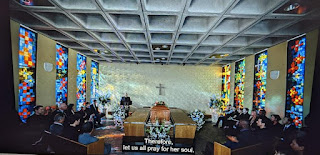
It's a horrible thing for those kids, especially at Christmas time. But fortunately for this blog, they have a church funeral for Laura. It seems a bit like a Catholic Church, but it can’t be, because the service isn't a mass, and (usually) Catholic Churches won't hold services for suicides. So is it some kind of Protestant service? The minister (priest?) conducting the ceremony says some odd things.

“Death is a new beginning...Let us pray for her soul as she crosses that she will get to where she needs to go.” That sounds like he might be talking about purgatory, which is a Catholic thing, but then again, she committed suicide.

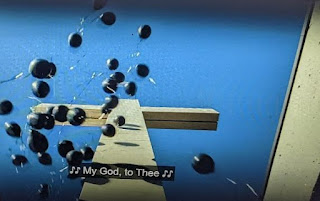
Then after the indoor portion of the ceremony, Laura's family and friends gather outside and release a plethora of black balloons. 


Which was odd. (I'm planning to write out plans for my memorial service in the next month or so. If I die before then, remember that I don't want black balloons. Really, I don't want balloons of any kind at the service.)

That's really the only church we see in the film, except for an excerpt from a service in the church Grace attended as a child. Aiden and Mia search the web to find information about this church and find it was the suicide cult I referred to earlier. A couple dozen of members of the church committed suicide, and the only survivor was twelve-year-old Grace. In that service, we hear the hymn, “Nearer My God to Thee.”


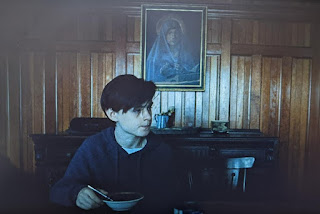
Grace seems to have become understandably adverse to religion and its symbols. When Richard takes Grace to the cabin in the woods, she seems uncomfortable with the cross in their bedroom. And the picture of Mother Mary in the dining room. (Laura seems to have done the decorating.)

Unfortunately, Richard leaves Grace alone with the children at the cabin and goes back to work, planning to return on Christmas Eve. The children are not happy to be with the woman they blame for their mother’s death. Grace tries to make things homey for the kids by decorating for Christmas.

But during the night, all the decorations, along with all of Grace’s belongings, vanish. And the power goes out. And their phones run out of power. And the heating system shuts off. And did I mention that Richard had left them in this cabin deep in the woods without any form of transportation? You know how in “The Christmas Song” when Andy Williams sang about “scary ghost stories?” This film's kind of like that -- if you're looking for that kind of Christmas story.

So what's the steeple rating for the churches in the film? That church where the funeral was held wouldn't have done well the ratings, but suicide cults lead to our lowest possible rating of One Steeple.

Wednesday, December 23, 2020

Christmas Cameo Month: Noëlle


Noëlle (
or Mrs. Worthington’s Party) 2007

I realize that most of this month's films haven't been what people think of as Christmas movies, but this week’s film...Well, just look at that title! (The first, not the second title.) This is certainly a Christmas film with the Christian meaning of Christmas coming right through in its presentation of priests and the Church. 

Unfortunately, it's not very well made -- but that isn’t really our concern here at Movie Churches. It did win not one, but two awards at the Fort Lauderdale International Film Festival (Best Director and Best American Indie Runner Up) but this film doesn’t make me want to seek out other Fort Lauderdale winners.

This film was written, directed, and produced by David Wall -- who also stars as Father Jonathan Keene, a priest who specializes in euthanizing churches that are struggling financially. He is sent to a small fishing village, Swan River, in Cape Cod.

Father Keene goes to the Sacred Heart Chapel. We can see from the church sign that the church used to have many services, but all have been scratched off the sign except for one service at 10:00 am on Sunday mornings. Keene goes in to see the pastor of the church, Father Simeon Joyce (Sean Patrick Brennan), but can’t find him on the property. He searches through the small town to find him and eventually discovers him at the Old Inn.

Father Joyce is with a group of other men at a table in the bar, quite drunk. Father Keene sees him, confronts him, and Father Joyce responds with a twisting of Scripture, saying he is practicing “being filled with the spirits.”

We find out that the priests went to seminary together. Joyce knows Keene’s current job and isn’t happy to see him. He rightly discerns Keene is there to decide whether Sacred Heart should be closed. He refers to Judas as he asks Keene, “Shouldn’t you greet me with a kiss?” Joyce calls Keene the “hitman” of the Archdiocese.


Keene attends a Sunday morning worship service with meager attendance and anemic worship. He confronts Joyce with attendance figures. Previously 150 people attended but attendance had fallen to twenty people. Joyce tells Keene that he may be right, “Maybe we are dead.” They have this discussion with the congregation listening (one woman sticks her tongue out at Keene).

Keene tells Father Joyce he might have a solution to the church’s problems. Christmas is coming and the church could do a live Nativity scene, with a real Mary, Joseph, shepherds, and wise men. Why he thinks this one-time gimmick will make a difference in the health of the church baffles me, but all agree.

The biggest challenge in doing this outdoor nativity scene is that almost everyone who attends the church is AARP eligible. All the men are really too old to play Joseph, but the real problem Father Keene recognizes is that any of the women available to play Mary have grey hair  -- which doesn’t work with the audition call sheet. So naturally, Father Keene thinks of recruiting the woman he met at the train station when he came to town, Marjorie Worthington. Majorie is played by Kerry Wall (yes, the wife of the producer, director, and star of the film. Kerry’s audition for the film must have been a real nail-biter.) 

The Walls had been married for twenty years when they made this film (and had three children), so Kerry wasn’t exactly ideal casting to play the teenage mother of the Son of God either, but…

Majorie doesn’t attend Sacred Heart Chapel, but her mother does. Her mother also throws a big Christmas Eve party every year, big enough to be one of the alternate titles of this film. Father Keene, however, wants to do his outdoor nativity scene in very cold weather with very old people at exactly the same time as the party. I don’t believe Father Keene went to any church growth seminars.

Keene makes a great effort to convince Majorie to play Mary. He finally convinces her, but soon everyone learns that Majorie, an unmarried woman, is pregnant. 

Father Keene tells her she can’t possibly play Mary in the church's nativity scene. After all, how can an unmarried pregnant woman possibly play Mary?

Even worse, the father of Majorie’s child is already married and isn’t interested in leaving his wife for Majorie. Having compassion for Majorie and her situation, Father Joyce offers to leave the priesthood and marry her. I guess he figures his church hasn’t been going that great anyway. But here is the big spoiler -instead Father Keene ends up leaving the priesthood and marries Majorie. You see, the only reason Keene entered the priesthood in the first place is that he got his girlfriend pregnant in college and forced her to have an abortion. He became a priest out of guilt, which is not exactly a calling.

But Father Keene’s last act as a priest is allowing Father Joyce’s church to stay open. And for unexplained reasons, we learn in an epilogue that the church grows in the next three years. Maybe a priest threatening to marry a parishioner spurs church growth? God does work in mysterious ways.


Anyway, two priests so anxious to abandon their vows leads us to give to the priests and church in this Christmas film two out of four steeples.

Thursday, December 12, 2019

Christmas Movie Churches: Prancer

Prancer (1989)
I love Tom Stoppard’s play, Rosencrantz and Guildenstern are Dead, in which two very minor characters from Shakespeare’s Hamlet are put in center stage. There have been Santa books, films, and plays without number which make minor mention of his reindeer. And there is, of course, Rudolph the Red-Nosed Reindeer. But the other eight that pull the sleigh are usually lumped together as a group. This film takes one of the eight, usually interchangeable, reindeer and makes him the hero in 1989’s Prancer.

Okay, Prancer isn’t really the hero of the film. The protagonist is a little girl named Jessica Riggs (Rebecca Harrell Tickell) who lives in the small town of Three Oaks, Michigan. She lives with her widowed father and older brother, and the family is struggling to keep financially afloat. Her father, John (Sam Elliot with his famed mustache), is considering sending Jessica off to live with her Aunt Sarah (Rutanya Alda).

Jessica attends a small school -- one assumes it's a public school. Her class is practicing “Oh Little Town of Bethlehem” for the upcoming Christmas pageant. Jessica sings louder and with much more enthusiasm than the other children, and sadly, she's not always in key. Her teacher encourages her to sing more softly. (Jessica’s father mentions that Jessica, "plays Christmas records all year.”)

For reasons that are not really clear, Jessica’s father doesn’t attend the pageant, which focuses on the birth of Jesus, with a traditional nativity scene. It seems that this school is still flying under the radar of the American Civil Liberties Union. We don’t see any attempt to balance the Christmas celebration with a Hannukah celebration (we don’t hear them singing the Dreidel song). But one of the teachers does talk about the magic of the full moon and claims that a full moon on Christmas brings a magical time of peace. So I guess there is an attempt to balance Christianity with New Age nonsense.

Immediately after the pageant, Jessica and her friend are walking home through the snowy town as it's being decorated for Christmas with Santa and reindeer hanging above Main Street. When one of the reindeer (Jessica somehow recognizes it as Prancer) falls onto the street and is smashed. Before long, as the full moon waxes, an injured reindeer appears in Jessica’s barn. Clearly, a kind of sympathetic magic is at work.

Three Oaks United Methodist Church
Jessica takes care of the reindeer but decides against telling her father. She gets the town vet (Abe Vigoda) to care for the reindeer. She begins working for a grouchy hermit, Mrs. MacFarland (Cloris Leachman), to pay for reindeer food. And she asks the local department store Santa (Michael Constantine, yet another TV Land favorite) to send a message to the real Santa Claus that she has Prancer (not since Miracle on 34th Street has anyone really been able to tell the difference between reindeer that aren’t Rudolph.)

But this department store Santa, Mr. Stewart, doesn’t send the letter to Santa. Instead, he takes it to the local newspaper, which -- in an incredible act of journalistic malpractice -- publishes a story about Jessica, using her full name, without interviewing Jessica or talking to her father. It is published as an opinion piece, a spin on the famous “Yes Virginia, There is a Santa Claus” editorial, saying there is hope because there are girls like Jessica that still believe in Santa Claus. That newspaper is opening itself up for a huge lawsuit.

I’ll give the pastor of Jessica’s church the benefit of the doubt that he assumed Jessica and her father were fully aware of the newspaper article and had given consent for the story to be written. Otherwise, his decision to read the newspaper story during a worship service, without Jessica’s consent, is almost as irresponsible.

I’m guessing from the briefly seen sign in front of the church building that it’s Methodist (the flame and cross). It seems to be a decent church. We hear the pastor deliver a quite orthodox prayer. As befits the season, the congregation sings “Hark the Herald Angels Sing” but also “How Great Thou Art.” I found it amazing that the congregation was able to sing both songs while holding lit candles with the little cardboard drip protectors. Usually, because it takes time to get all the candles lit, one song is the maximum that can be sung with those little candles. Usually that song is “Silent Night.” And I'm baffled that they use candles for a morning service. Jessica is sent to church with her aunt. (Her dad stays home to read the Sunday newspaper, but not thoroughly enough to get to the editorial about Jessica.)

The pastor concludes this pre-Christmas service by reading the newspaper story about Jessica and her belief in Santa Claus. “Town of Three Oaks is in good hands as long as we have children like Jessica Riggs with their hope and wonder,” he concludes. I’d think you’d want to conclude such a service focussed on Jesus rather than Santa, but that’s me.

But there is something that is very good about this church. Mrs. MacFarland comes to church, apparently inspired by her interaction with Jessica, and many people of the church welcome her with great warmth. This weighs heavily in the Movie Church Steeple Ratings.

So I’m going to leave some of your plot questions unanswered here. “Is that reindeer in Jessica’s barn the real Prancer?” “Does the reindeer rejoin Santa and his sleigh team?” “Is Jessica able to remain with her father?” These questions, I’m sure, will perplex anyone who has ever seen a Christmas film (that is not Bad Santa.)

But to finish up our Movie Churches business, we're giving the church and pastor in Prancer a three out of four steeple rating.


Friday, December 21, 2018

Christmas Movie Churches About Money... Maybe

Millions (2004)
All due respect to A Charlie Brown Christmas, but I'm over lectures in Christmas entertainment about materialism. Especially when the message is interrupted by commercials with new car keys given as “stocking stuffers” and the Little Drummer Boy bringing Coke to the manger. An exception to this rule is Danny Boyle’s thoughtful and charming 2004 feature, Millions.

It tells the story of an English boy, Damian, who recovers a satchel of cash that falls (as far as he can tell) from the sky. He shares his find with his brother, Anthony, who warns him they can’t let anyone know about the find, or the government will “take away 40%. That’s nearly all of it.” Anthony is torn between buying cool things and investing wisely, whereas Damian would like to give the money to the poor.

An added complication is that the money is in pounds, and the nation is about to convert to the Euro. (When the film was made, it seemed likely that Britain would change from their current monetary system of pounds, crowns, pennies, guineas, nobles, shillings, parsnips, topsy poos, wattle nellies, and daring shanks to the European Union's system of Euros. Brexit has, of course, changed all that.) Anthony and Damian need to do something with the money before the conversion or it will be worthless. Another complication that the boys don't realize at first is that the money is stolen -- and the thief is looking for it.

The film is set at Christmas time. Though there are no churches in the film, the boys' school may have some church connection. It's called All Saints, they encourage charitable giving, and they perform a Nativity Play complete with a donkey on wheels to take Mary to Bethlehem. There is clergy in the film -- top clergy -- saints, in fact. Saints appear to Damian (though no one else can see them).

St. Clare of Assisi is the first saint Damian sees, and she tells Damian she's the patron saint of visions, and therefore, television. She smokes cigarettes, and when Damien asks if that is allowed in heaven, she assures him you can do whatever you want in heaven. Damian asks if Clare has seen a Saint Maureen, and she tells him no. Maureen is Damian and Anthony’s mother who recently passed away.

St. Francis of Assisi encourages Damian in his desire to give money to the poor, much to Anthony’s annoyance. Damian takes a group of street beggars to Pizza Hut where they order extravagantly, and he puts a thousand pounds into a robotic bin at their school that's raising money to dig wells for clean water in Africa. When his donation is identified, both boys are sent to the principal’s office. Anthony says they stole the money so they can keep the real secret (and the rest of the money) from being discovered.

Damian is also visited by a group of saints, the martyrs of Uganda. 23 Anglican and 22 Catholic converts to Christianity were executed for their faith in the Kingdom of Buganda (now Uganda). Damian notices they are praying desperately for something and learns they are praying for water. The martyr encourages him to use his money to build wells.

The Apostle Peter also visits Damian, noting he's the patron saint of security. He encourages Damian to keep the key to his old house safe, and he encourages Damian to lead by example, citing the story of the boy who gave his bread and fish prior to the feeding of the 5,000. Peter claims the only miracle that happened that day is that people were encouraged by the boy’s example to share themselves. All four of the Gospel writers shared this story, and if that’s what happened, I think one of them would have said so instead of telling the story as they did. It's a case of bad theology from a screenwriter being put in the mouth of a saint.

Which is really too bad, because there is so much good theology in the film. The whole story works like one of the parables Jesus told. Jesus told the parable of the shrewd manager  (Luke 16) who used his master’s wealth for the short time it was in his possession to ensure himself a prosperous future. The expiring money in the film reminds us that worldly wealth is fleeting and is most wisely for the benefit of the Kingdom of God.

At Christmas time (and all year through), it is good to think of gifts we can give that will be of eternal worth -- like giving water to the thirsty and food to the hungry. Jesus said gifts like that have eternal value.

I love the film as a whole, but because Saint Peter’s theology in the movie doesn’t match his theology in Scripture, we can’t give the saints of this film our highest rating, but they still earn a solid 3 Steeples.