
Driving Miss Daisy (1990) and 12 Years a Slave (2013)
One can’t look at the history of the Academy of Motion Picture Arts and Sciences without being puzzled by how often it gets things wrong -- particularly when it comes to the Oscar for Best Picture. Just look at 1990, when the award for Best Picture was given to Driving Miss Daisy.
Driving Miss Daisy isn’t really a bad film. It’s quite competently made with two great actors (Jessica Tandy and Morgan Freeman) in good form. With a script adapted from a well-written play, it doesn’t stray too far from its stage origins. It’s fine. But Best Picture?
The members of the directors’ caucus of the Academy didn’t think enough of the film to nominate director Bruce Beresford for his work on the film (though he'd been nominated, justly, for his work on Breaker Morant and Tender Mercies.)
There were certainly more entertaining films released in 1990, such as Indiana Jones and the Last Crusade, Bill and Ted’s Excellent Adventure, Batman, and the immortal Road House.
There were more emotionally satisfying films like Say Anything, When Harry Met Sally, and the film most likely to make a man cry, Field of Dreams.
There were more artistically audacious films such as Henry V, My Left Foot, Drugstore Cowboy, and UHF. There were even films that were more bold and insightful on the subject of race, like Glory and Do the Right Thing, either of which would have been a far better choice for Best Picture.
And even more unfortunately for this blog, Driving Miss Daisy doesn’t have much in the way of church or clergy. But there is some.
The film tells the story of an old woman, Miss Daisy (Tandy) who needs a driver. Her son (Dan Aykroyd) hires an African American chauffeur (Freeman) and an unlikely friendship develops between driver and driven. Miss Daisy is Jewish and attends synagogue, but this blog is about Christian churches. The synagogue in the film seems nice enough, though people seem to attend more to meet social than spiritual needs. In fact, Miss Daisy accuses her daughter-in-law of a horrible social crime: “socializin’ with Episcopalians."
A Christian church makes a brief appearance for a funeral service where the choir gives a spirited rendition of “What a Friend We Have in Jesus.” (About the best thing about the church and the synagogue in the film is their good music programs.)
There is one prominent Christian clergyman in the film, the Reverend Doctor Martin Luther King.
When the great civil rights leader speaks at a local dinner, Miss Daisy is excited and happy to attend. She doesn’t invite her friend Hoke to join her (though he drives her to the event, of course -- and she has an extra ticket). Though she claims to be a supporter of civil rights, she doesn’t think of Hoke as a person worthy of such an august social affair. So Hoke listens to the dinner speech on the radio in the car outside of the dinner.
Beresford made a really odd filmmaking choice in this scene. We hear King’s speech, but we don’t see the speaker. Using film footage of King speaking or using an actor to play the role, but instead, we hear a tinny recording of the great man, experiencing the speech rather like Hoke listening in the car. This choice might have been forced on the filmmakers by the King estate, notorious for their tight grip on the handling of MLK’s image.

A much more worthy recipient of the Best Picture Oscar was 2013’s 12 Years a Slave. Director Steve McQueen (not to be confused with the iconic, but deceased, actor) brought the true story of Solomon Northup (Chiwetel Ejiofor), a free man, who was abducted and sold as a slave. As the title indicates, he was enslaved for twelve years.
It’s a powerful story and a helpful balance to the romanticized images of slavery presented in older films like Gone With the Wind.
And though we don’t see depictions of formal churches or clergy in the film, there are three informal gatherings of slaves that could be called “church” for good and ill.
Northup’s first owner, William Ford (Benedict Cumberbatch), gathers his slaves for the reading of Scripture, and he seems to believe it is for their benefit. He reads passages from the Gospels, including Jesus’ command to care for the “least of these,” without seeming to grasp the irony of the moment. Ford’s good intentions contrast sharply with Northup’s second owner, Edwin Epps (Michael Fassbender), who only reads the slaves passages of Scripture admonishing them to obey their masters and justifying his use of the whip. Far better than either of these is when the slaves gather by their own choosing to memorialize a murdered companion, comforting each other as they sing “Roll, Jordan, Roll”. This feels like the only true church in the film.
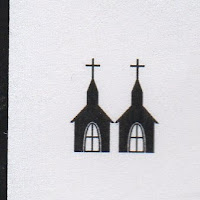 The combined churches and clergy in the two receive a Movie Churches rating of Two Steeples. That nasty Epps really brings the averages down.
And even more unfortunately for this blog, Driving Miss Daisy doesn’t have much in the way of church or clergy. But there is some.
The film tells the story of an old woman, Miss Daisy (Tandy) who needs a driver. Her son (Dan Aykroyd) hires an African American chauffeur (Freeman) and an unlikely friendship develops between driver and driven. Miss Daisy is Jewish and attends synagogue, but this blog is about Christian churches. The synagogue in the film seems nice enough, though people seem to attend more to meet social than spiritual needs. In fact, Miss Daisy accuses her daughter-in-law of a horrible social crime: “socializin’ with Episcopalians."
A Christian church makes a brief appearance for a funeral service where the choir gives a spirited rendition of “What a Friend We Have in Jesus.” (About the best thing about the church and the synagogue in the film is their good music programs.)
There is one prominent Christian clergyman in the film, the Reverend Doctor Martin Luther King.
When the great civil rights leader speaks at a local dinner, Miss Daisy is excited and happy to attend. She doesn’t invite her friend Hoke to join her (though he drives her to the event, of course -- and she has an extra ticket). Though she claims to be a supporter of civil rights, she doesn’t think of Hoke as a person worthy of such an august social affair. So Hoke listens to the dinner speech on the radio in the car outside of the dinner.
Beresford made a really odd filmmaking choice in this scene. We hear King’s speech, but we don’t see the speaker. Using film footage of King speaking or using an actor to play the role, but instead, we hear a tinny recording of the great man, experiencing the speech rather like Hoke listening in the car. This choice might have been forced on the filmmakers by the King estate, notorious for their tight grip on the handling of MLK’s image.
A much more worthy recipient of the Best Picture Oscar was 2013’s 12 Years a Slave. Director Steve McQueen (not to be confused with the iconic, but deceased, actor) brought the true story of Solomon Northup (Chiwetel Ejiofor), a free man, who was abducted and sold as a slave. As the title indicates, he was enslaved for twelve years.
It’s a powerful story and a helpful balance to the romanticized images of slavery presented in older films like Gone With the Wind.
And though we don’t see depictions of formal churches or clergy in the film, there are three informal gatherings of slaves that could be called “church” for good and ill.
Northup’s first owner, William Ford (Benedict Cumberbatch), gathers his slaves for the reading of Scripture, and he seems to believe it is for their benefit. He reads passages from the Gospels, including Jesus’ command to care for the “least of these,” without seeming to grasp the irony of the moment. Ford’s good intentions contrast sharply with Northup’s second owner, Edwin Epps (Michael Fassbender), who only reads the slaves passages of Scripture admonishing them to obey their masters and justifying his use of the whip. Far better than either of these is when the slaves gather by their own choosing to memorialize a murdered companion, comforting each other as they sing “Roll, Jordan, Roll”. This feels like the only true church in the film.


