Showing posts with label Andrew Garfield. Show all posts

Thursday, July 21, 2022

Crime Month Continues: The Eyes of Tammy Faye


The Eyes of Tammy Faye
 (2021)


The single funniest thing I ever read was in a decades-old issue of The Wittenburg Door, a Christian satire magazine. Every year they honored theological luminaries such as Woody Allen and Steve Martin. In this issue, Tammy Faye Bakker was named “Theologian of the Year.” What made me laugh very, very hard was an excerpt from TFB’s bestselling book, Running to the Roar. You’ll have to trust me that her writing about the death of her dog was hysterical. Surprisingly, this passage made me laugh much more than anything from the writers of The Wittenburg Door.

When the article came out (1980), I couldn't have imagined an Oscar-winning movie made about this woman. I never thought Jim and Tammy Faye Bakker would be at the forefront of a series of sex scandals involving prominent TV evangelists. (Envisioning this sort of thing would have been even less possible because I pictured the couple more like cartoon characters than real people with real sexual desires and impulses.)

I also didn’t imagine Jim Bakker being convicted of 24 counts of wire fraud and being sent to prison, but that would have certainly have seemed more feasible. Also, that is what makes it possible for us to feature this film in Movie Churches' Crime Month.

The Eyes of Tammy Faye is based on an independent documentary by Randy Barbato and narrated by RuPaul Charles. Writer Abe Sylvia and director Michael Showalter made this feature film that seeks to portray the founders of the PTL (Praise the Lord) network as real people rather than caricatures (not always successfully). Jessica Chastain won an Oscar for her portrayal of Tammy Faye and Andrew Garfield played Jim.

The film begins with Tammy as a child. She doesn't enter the local Pentecostal Church but instead watches services through a window from the outside. Tammy's mother won't allow Tammy to go to the church services because the girl will remind the congregation that Tammy's mother was divorced from her father and that the mother wasn't allowed back to the church until the congregation realized that she was the only person who could play the piano. Eventually, Tammy disobeys her mother, enters the church, prays to receive salvation through Christ, and demonstrates the presence of the Holy Spirit with ecstatic utterances.  
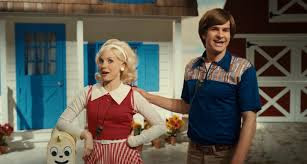

Tammy and Jim meet at North Central Bible College. Jim tells Tammy about his previous dream of being a DJ and his love for rock and roll. Soon they go for a roll in the hay, get married, and are forced to drop out of school. The two go on the road as itinerant ministers, with Jim preaching and Tammy singing and working puppets. They eventually catch the attention of Pat Robertson, who puts them on CBN (the Christian Broadcasting Network) where Jim became the first host of The 700 Club. When Jim sees that Pat is financially much better off than he and Tammy, he decides to start his own network, the PTL Sattellite Network -- featuring himself and Tammy.

Over the years, things did not go well. Though they requested donations for specific needs, the funds were siphoned off for their homes (mansions) and the creation of a Christian amusement park that was never actually built. Tammy Faye developed an addiction to prescription drugs. Rumors continued about Jim having homosexual affairs and to quiet that rumor, he had an affair with (or possibly raped) Jessica Hahn, an employee. Tammy Faye had at least one, and possibly a series of affairs.

One of the few ways that the film seems to try to portray Tammy Faye in a positive light is in her outreach to AIDS patients and her expressions of love for those in the gay community. This is in stark contrast to its portrayal of Jerry Falwell who is portrayed as a harsh, vindictive opponent to the “Gay Agenda” and those with the “Gay Cancer.” What is sadly lacking in the portrayal of either side of this debate is any effort to wrestle with the Scriptural elements in this debate.

In the end, Jim goes to prison, and Tammy Faye struggles to carry on after becoming a joke and pariah in much of the Christian and secular worlds. She and Jim divorce; both remarry (although this isn’t clearly shown in the film). Tammy Faye continues to trust Jesus and finds a way back into ministry along with becoming a bit of a gay icon. The film concludes with Tammy Faye singing “The Battle Hymn of the Republic” and crying out, “God bless the United States of America!”

For good and ill, the Bakkers lived a uniquely American story. Tammy Faye died in 2007 and Jim continues to minister in spite of great health challenges. He has expressed sorrow for many of his actions, including preaching the “health and wealth gospel.”

The best we can give the Bakkers, as portrayed in the film, is a Movie Churches rating of Two Steeples. But the real Tammy Faye and Jim Bakker we leave to the judgment of a kind, just, and loving God.


The real Tammy Faye and Jim Bakker with the actors


Monday, February 20, 2017

Presenting the First Ever Golden Steeple Awards

Movie Churches Award Night 2017
Award shows make you wait until the end of the night to find out the winner of the Big Awards, but we don’t do that here at Movie Churches. We’re going to tell you in the second paragraph the winner of The Golden Steeple of 2016 for the Best Depiction of Churches/Clergy/Faith in a Nominee for the Oscar for Best Motion Picture. This is the first year of the award, which honors the most attractive depiction of a Movie Church.


And the winner is… Hacksaw Ridge!


Now that you know who won, perhaps you’d like to hear about all the nominees (which just so happen to be the same films nominated this year for the Best Picture Oscar).


Hacksaw Ridge tells the true story of Desmond Doss, a conscientious objector during World War II who fought to go into battle as a medic. His church, Seventh Day Adventist, is seen only briefly. We see him doing chores at the church as the choir practices, but throughout the film Doss’ choices are made on the basis of his faith. And they are often difficult choices with hard consequences. Doss questions God and His Word, but continues to be faithful, resulting in a truly amazing work of grace. (It should be noted though, that the film gets one church detail very wrong. There’s no way a good Seventh Day Adventist of his time would go on a first date to the movies. That’s like a Southern Baptist of the time taking his sweetheart to a bar. Wouldn’t happen.)


Hidden Figures would probably be first runner up for the Golden Steeple. It’s another historical story; in this case, it’s about the African American women who played a crucial but previously unheralded role in the space race of the early 1960s. There are a couple of scenes in what seems to be a Methodist church which the women mathematicians attend. The pastor of the church is quite supportive of the civil rights movements from the pulpit, lauding the accomplishments of his congregants. Big bonus: the church is depicted as a great matchmaking location.


No mention of the Golden Steeple nomination?
Fences, based on the classic August Wilson play about troubled domestic life, also has a strong church presence. Hollywood is much more comfortable with churches in historical dramas. Churches are also much more likely to be shown in a positive light when the film deals with African American characters. Rose (Viola Davis), the wife and mother in the film, finds strength and comfort in her local church. Her husband, Troy (Denzel Washington), speaks reverently of Scripture but implies that pastors are money grubbing. The film also has a pious, almost saccharin, religious ending.


Moonlight also has an African American character that speaks well of the church and Scripture. Unfortunately that character, Juan (portrayed by Mahershala Ali), is also a drug dealer. In this coming of age story about Chiron, a bullied boy growing up gay, his friendship with Juan and Juan’s girlfriend provide him with rare glimpses of kindness and compassion.


No, Bridges does not play God
Hell and High Water, a story of brothers who rob banks to pay the mortgage, doesn’t have any scenes in churches, but we see the exteriors of churches often in the small towns where the story takes place. The two Texas Rangers pursuing the brothers discuss their faith, and the Native American Ranger surprises the Ranger played by Jeff Bridges with his orthodox Christian faith.


Lion is the true story of a Indian boy (not Native American), Saroo, who is separated from his family and then adopted by an Australian couple. As an adult, he searches for the family he lost as a child. We don’t see any Christian churches in the film, but as starving child, Saroo, finds nourishment from the food offered to Hindu idols. (I don’t think the Apostle Paul would have any problem with that.)


Arrival, the story of the reaction of nations to alien visitors from space, has a single reference to a church. The scientists attempting to communicate with the aliens hear a news story about the demise of hundreds in a “church” that is actually a suicidal cult.


Again, the Golden Steeples are snubbed
Manchester by the Sea has an interesting and mixed take on churches. Lee (Casey Affleck), the emotionally tortured protagonist in the film, explains to his nephew Patrick that as Catholics, they’re Christians just as much as Patrick’s newly “born again” mother. The Catholic Church is where ceremonies take place -- weddings and funerals. However, the Church seems to provide no spiritual comfort for Lee. And -- as often happens in current films -- it goes without saying that the Born Again Evangelical Christians (Matthew Broderick and Gretchen Mol) are judgmental jerks. Though Matt’s home is decorated with Christian bookstore knickknacks, he has no problem with “living in sin” with Gretchen.


And finally, La La Land, the probable winner of the Oscar for Best Picture, has no Movie Churches at all. The story of an actress and a jazz musician seeking stardom doesn’t seem to have any interest in spiritual things. As some have commented, the movie does seem to capture contemporary Hollywood’s values of placing personal fulfillment and fame over even romantic love (let alone God’s love).

So even if Mel Gibson, Andrew Garfield, and the rest of the cast and crew of Hacksaw Ridge are overlooked on Oscar night, they can take comfort in being the winners of the first ever Golden Steeple. (And whenever they want to come to Fresno to collect their award, I’ll construct one and roll out the red carpet.)